Category: Featured

  • How TETFUND paints Benue with projects

    The TETFund official train currently moving around the country to inspect and or commission projects recently made a three-day stopover in Benue State of Central Nigeria.

    It was such an impactful engagement that the people have not stopped eulogizing President Muhammadu Buhari for uplifting the educational horizon and broadening opportunities in the State, especially the Benue South Senatorial District, through the Tertiary Education Trust Fund (TETFund).

    The TETFund executive train, driven by its Executive Secretary, Arc. Sunny Togo Echono, first pulled to a stop at the Joseph Sarwuan Tarka University, JOSTUM, (formerly Federal University of Agriculture) Makurdi, where Chairman House of Representatives Committee on TETFund, Hon Aminu Suleiman, led the team to inspect four projects worth N1.20 billion which had been executed during the tenure of Prof Richard Kimbir as Vice-Chancellor.

    They were: a Laboratory/Workshop Block for Entrepreneurship Development Centre; Female and Male Hostel Blocks; as well as an Academic Office Building for College of Agronomy.

    The new Vice Chancellor, Prof Isaac Itodo, was beside himself with joy as he expressed gratitude to TETFund for the projects.

    Still in the State capital, Arc Sunny Echono moved over to the state owned Benue State University (BSU) where Minister of Special Duties and Inter-Governmental Affairs, Senator George Akume, a former Governor of the State, represented President Muhammadu Buhari to commission six gigantic Projects to the tune of 02.60 billion naira. These included one Academic Office Building; a Block of Offices at College of Health Sciences; Faculty of Education Complex; as well as the Health and Counceling Development Centre and the Centre for Research and Innovation. The TETFund Executive Secretary informed the audience at BSU that the Federal Government has made huge investments in Education, between 2011 and 2021 especially, adding that in Benue State BSU, JOSTUM, Benue Polytechnic, Colleges of Education in Katsina Ala and Oju, plus the newly established Federal Polytechnic at Wannune, have all been granted various developmental approvals awaiting releases.

    In his own remarks, Senator Akume thanked TETFund for having sponsored thousands of Lecturers in Benue tertiary Institutions for postgraduate courses both within and outside Nigeria, as well as to attend internal and foreign Academic conferences.

    Prof Joe Iorapuu, BSU Vice Chancellor, made a case for more TETFund intervention to enable the University achieve her expansion Program.

    From Makurdi, the TETFund train moved to Otukpo on Friday 12th May, with the Executive Secretary expertly deploying his great wealth of experience as a construction expert, to navigate the unmotorable Makurdi-Otukpo interstate highway. Even at that, the entourage still spent two and half hours on the hundred kilometers stretch.

    In Otukpo, the ancient capital of the Idoma people, the TETFund team inspected the ongoing remodeling of an Office Complex belonging to the Federal University of Health Sciences Otukpo. It is also a TETFund sponsored Project under the 2022 Special Impact Intervention Projects.

    Arc Sunny Echono, while in Otukpo, also visited HRM Och’Idoma V, Agabaidu John Elaigwu Odogbo Obagaji to deliver a special message from President Muhammadu Buhari.

    At the newly reconstructed Och’Idoma Palace, glowing in its new splendor, Arc Sunny Echono presented the paramount ruler of the Idoma people a letter from Mr President appointing him Chancellor of the Federal University of Otuoke, Bayelsa State. President Buhari, in the letter, said the appointment was based on the enviable track records of the royal father, in addition to his leadership qualities, integrity, commitment to the development of education and the sustenance of peace and stability of Nigeria.

    Accepting the offer, Agabaidu John Elaigwu Odogbo Obagaji expressed his utmost gratitude to Mr President for finding him worthy of the prestigious position. He also thanked Arc Echono for doing so much towards the development of Nigeria, especially Benue State.

    The TETFund Executive Secretary had earlier sent a heartfelt congratulatory message to the Och’Idoma in which he recognized that the highly revered position of Chancellor in the University system “personifies the highest ideals of the University, encompassing its vision, purpose, and relevance to society”. In his letter of congratulations, Arc Echono also stressed that as a royal father, the Chancellor would provide the moral compass to productively engage all segments of the University, and also act as the stabilizing antidote in times of inevitable crises. “As the custodian of our culture and traditions, you represent a veritable tool for national integration and cohesion, giving shape and direction to the University”, the Executive Secretary added.

    Saturday, May 13th 2023, marked the last phase of the three-day TETFund visit to Benue State. Obagaji town, headquarters of Agatu  Local Government Area, hosted the team to the commissioning of the TETFund built National Open University of Nigeria (NOUN) Obagaji Study Center, as well as the Foundation Laying Ceremony of an Information Communication Technology (ICT) Center and Perimeter Fence.

    At Obagaji, Arc Sunny Echono pointed out, in his speech, that education represented the greatest love anyone could bequeath to children. He said the NOUN OBAGAJI STUDY CENTER would provide access to Education for those who otherwise could not attend regular Universities, thanking the Hon Minister of Education, Malam Adamu Adamu, for graciously increasing the number of Study Centers in the country.

    HRM Och’Idoma expressed joy that in addition to education, employment opportunities would also be extended to the people in the area through the establishment of the Obagaji Study Center of the NOUN, advising the people Agatu to take full advantage of the facilities.

    Others who appreciated TETFund included Deputy Governorship candidate of PDP in the 2023 elections, Hon Sir John Ngbede, and Rt Hon Solomon Agidani.

    Vice Chancellor of the Federal University of Health Sciences Otukpo (FUHSO), Prof Innocent Ujah, mni, OON, very ably represented by the Vice Chancellor Academics, Prof Steve Abah, extolled the developmental disposition of the TETFund Executive Secretary, saying that his engagements so far clearly point to the direction of his leadership traits.

    In similar vein the JOSTUM Vice Chancellor, Prof Isaac Itodo, described Arc Sunny Echono as a pragmatic Patriot who is out to advance easy and fast learning across Nigeria.

    Prof Joel Eriba, Provost of the Federal College of Education, Odugbo, called for support for Arc Echono who, he told the audience, has taken up the education of Nigerian youths as his personal challenge.

    The Auditorium and Academic Blocks were commissioned by HRM Agabaidu Och’Idoma and Prof Isaac Itodo respectively, while former Ambassador to Algeria, Amb Mohammed Mabdul, laid the foundation for the ICT Building.

    Highlight of the roundup at Obagaji was the decoration of TETFund Executive Secretary, Arc Sunny Togo Echono, in the red and black Idoma cultural attire, by HRM Agabaidu for “his great contributions to Idomaland”.

    To the glory of God the TETFund train touched down safely in Abuja the evening of 13th May, 2023.

    Benue people are hoping for many of such awesome visits.

  • Is Nigeria a Failed State?

    The apparent answer is, ‘No, Nigeria is not a failed state.’ But that response doesn’t capture the full nuances and complexities that the question requires. So, what is a failed state? Development scholars have no unanimity on a single definition of the term or when a nation should be considered failed. 

    However, a broad definition of a failed state should show a country without a functioning government, where its institutions, due to social, political, or economic pressure, are broken, dysfunctional, and exist largely in name only.

    Common features of a failed state include the inability to effectively enforce law and order, tax citizens, loss of control over a large territory, widespread violence and insecurity, economic decline and widespread poverty, displacement and humanitarian crises, lack of basic services, weak or ineffective governance, and limited international recognition. 

    Because this definition and its intrinsic features are so broad, many developing countries would apparently fit into the category of a failed state since they face one or a combination of these challenges. But being poor and underdeveloped should not automatically mean a country has ‘failed.’

    Many developing countries, especially in Africa, struggle with the provision of basic services such as power and water; experience economic decline and widespread poverty, in addition to extensive violence and insecurity. Yet, these countries have functioning (but weak) national governments and somewhat strong institutions such as the police and the army. The government’s sovereignty also extends across the whole country and is recognized globally as the legitimate authority in the land. 

    There are, however, classic examples of failed states where there is little debate about the accuracy of the term. A good example is Haiti, the poorest country in the northern hemisphere, where, according to the World Bank, around 60 percent of its 12 million population live in poverty.

    But poverty is not the reason why Haiti is easily categorized as a failed state. It is because of the failure of its government and the shrinking space it controls, in comparison to non-state actors such as gangs which increasingly control large portions of the land and are the de-facto authority there.  

    The UN estimates that 60 percent of Port-au-Prince, Haiti’s capital, is controlled by armed gangs, and over 150,000 people have been displaced by violence.  Homicide, rape, armed robbery, kidnapping, and lynching are prevalent in the country. With the national police powerless to stem the tide, the people increasingly resort to self-help and vigilante justice which further fuel the cycle of violence. 

    Although, Haiti has always been a weak state, its slide into anarchy began in 2021 with the assassination of its former president Jovenel Moïse by foreign mercenaries, mostly Colombians and a few Haitian Americans. Since that time, it has not conducted any elections to replace the assassinated president or the lawmakers whose tenure has now expired. The current de facto ruler Ariel Henry was an appointee of the late president and so technically Haiti doesn’t have a legitimate government put in place by the people.

    Yemen, Libya, and Somalia are the other countries easily regarded as failed states. These countries are at war, with the central government lacking real authority outside the capital or a few sub-regional areas. State institutions such as the police and the army are nonexistent or weak where they exist, sharing authority with non-state actors such as gangs or rebel groups. Consequently, public services have collapsed, and there is weak or ineffective governance and an inability to enforce law and order.

    Based on these extreme cases, Nigeria is not a failed state.  We have a central government that is universally recognized as the sovereign authority, as well as sub-regional governments with well-defined roles and responsibilities. Our state institutions such as the judiciary, the police, and the army are strong and have authority across the country. 

    Though weak, there is an effort to provide essential public services such as education, electricity, water, and roads, across the country by the federal and state governments. We also have functional and large civil services and a strong sense of a national boundary. 

    But these positives do not tell the whole story.  Nigeria is also a bitterly divided country, facing serious sectarian crises and agitations for the dissolution of the federation. In the North East, especially in Borno State, a large portion of the area is under the control of Islamist groups Boko Haram and its offshoots, ISWAP. These groups seek an Islamist theocracy in Borno and other adjacent states. They do not recognize the authority of the federal and state governments and impose a harsh interpretation of the Sharia in the areas under their control. 

    In the southeast, the ESN, the armed wing of the separatist group IPOB, wages a low insurgency battle against the Nigerian state, through kidnapping, armed robbery, and terrorism. The ESN/IPOB is so effective that it successfully imposes a dawn-to-dusk curfew on the five states of the region on Mondays. Unlike Boko Haram and ISWAP, it does not hold any territory but is fearsome and seeks the dissolution of Nigeria, with the southeast becoming an independent Biafra Republic.

    In the northwest, banditry is rife, especially in Zamfara, Katsina, and Sokoto states. Many areas in those places are in the firm grips of notorious bandits who are the de-facto law and order.  There are even reports of crime kingpins collecting taxes and imposing laws regarding movement, trade, and other activities.

    In the North-Central, there is an appalling level of insecurity with the herder/farmer conflicts claiming thousands of lives. Southern Kaduna, Benue, and Plateau appear to have become killing fields with people being slaughtered daily. This week alone, over 130 people were killed in Mangu and Riyom local governments in Plateau State, and many houses were destroyed. Such killings have become all too common and rarely make the front pages of the newspaper. 

    So while Nigeria may not be officially regarded as a failed state, it is evidently not an example of a stable and mature democracy either. It, in fact, exhibits many features of a fragile state, including economic decline and widespread poverty, extensive violence and insecurity, and notably, the loss of some territory to non-state actors. But these symptoms have not coalesced nor developed into a full-blown disease yet and have therefore not overwhelmed the government. 

    While that may be a cause to cheer, we should be wary because failed states don’t suddenly happen. It often begins with the gradual erosion of national sovereignty and the weakening of state institutions through corruption, nepotism, and politics, a situation Nigerians are currently very familiar with.

    In conclusion, while Nigeria may not be a failed state, it is definitely a frail one.

  • Applauding the Godwin Obla Foundation Kidney Centre in Benue 

    The date was January 20, 1961, and the occasion was the inauguration of the 35th President of the United States.

    After taking his oath of office, the young incoming President John F. Kennedy called out to his people- “And so, my fellow Americans: ask not what your country can do for you – ask what you can do for your country.” 

    This call continues to resonate with every patriotic citizen with a commendable sense of “civic action and public service”.

    Last April 17, 2023 was a memorable day in the ancient city of Otukpo, the traditional headquarters of the Idoma nation, Benue South Senatorial District. Long neglected by succession administrations at both federal and state levels, Otukpo town is currently enjoying some reawakening in infrastructure, following the siting of a Federal University of Health Sciences (FUHS) by President Muhammadu Buhari. 

    Further to the flurry of amenities that are being put in place to support the effective takeoff of the university, a private individual made a humongous intervention of a magnitude never witnessed in the annals of individual philanthropic gestures in Idomaland, if not the entire Benue State.

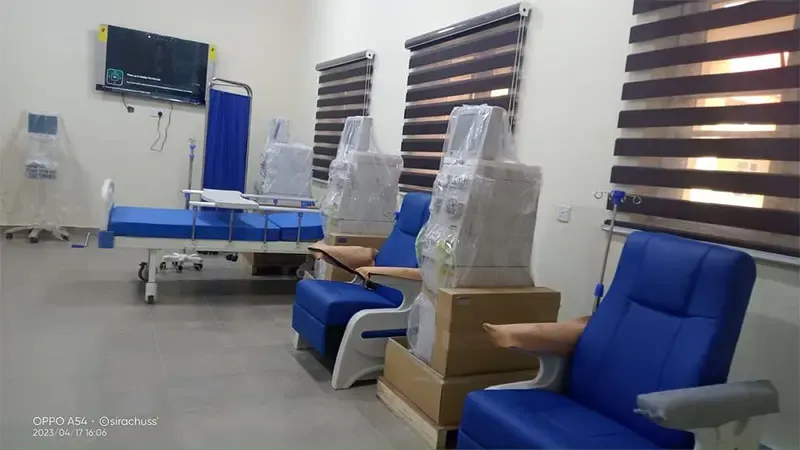
    This was the commissioning of an ultramodern Kidney/Dialysis Centre, built and equipped by the GODWIN OBLA FOUNDATION, initiated and funded by Chief Godwin Odumu Obla, SAN, in furtherance of his ceaseless philanthropic giving-back-to-the-society Program, and donated to the Teaching Hospital of the Federal University of Health Sciences, Otukpo. 

    Some of the dialysis machines at the centre

    It was a day of sober reflections, a day of long but inactive political knives, a day of nostalgic regrets, and a day of hope, as well as a day of appreciation. Indeed, it was a day of mixed emotions. Most of all, 17th April 2023 would go down as a day of realization and challenges. 

    The premises of the former General Hospital, where the Centre is located, is a colourful beehive of activities as people from far and near thronged the venue to appreciate Chief Godwin Odumu Obla, the first Senior Advocate of Nigeria from Benue South Senatorial District for his show of love towards his late wife, expressed in his determination to provide such needed health care facilities, the absence of which led to her untimely demise.

    The JUDITH OGWA OBLA KIDNEY CENTRE is named after Chief Godwin Obla’s wife who passed on in the United States of America on 21st March, 2022, due to complications arising from a protracted battle with diabetes which resulted in kidney failure.

    Her passing on to eternal glory was a glaring manifestation of the unacceptable gap between health facilities in Nigeria and other more advanced societies, prompting her husband to promise a well-equipped health Centre for his people back home. 

    For a man who has always regarded a promise to be a debt, Chief Obla pulled all available resources together and within four months the Centre became ready for handover, Project fully completed and appropriately equipped and furnished. Apart from handing over the state-of-the-art KIDNEY CENTRE to FUHSO’s Council, the Vice Chancellor of the first Federal Government-established Medical University, Prof Innocent Ujah, had a memorable 17th April 2023, as an avalanche of academic endowments totaling N40 million naira was thrust at FUHSO, still by the GODWIN OBLA FOUNDATION. 

    Some of these included the Judith Ogwa Obla Prize for Best Graduating Student in Nephrology; Joseph Elagbaje Obla Snr Prize (to honor his late father) for Best Graduating Student in Internal Medicine; GODWIN ODUMU OBLA Prize for Best Graduating Student in Urology; and Dr Idoko Edwin Obe Prize for Best Overall Graduating Student (in memory of the first Idoma Medical Doctor).

    Each of the four endowments is to attract an annual cash gift of not less than a million naira. 

    The GODWIN OBLA FOUNDATION and FUHSO signed agreement papers to legitimize the handover, which also included the public presentation of the real bank cheques to Prof Innocent Ujah. 

    The Director General of GODWIN OBLA FOUNDATION, Elder Michael Uba Obande, JP, had, in his speech while welcoming dignitaries to the historic occasion, given a brief exposition on the FOUNDATION which is committed to upholding the biblical Good Samaritan principle of extending assistance to the needy. He told the audience that GODWIN OBLA FOUNDATION has already impacted lives positively through its Projects in such areas as the Benue Judiciary, St Francis College, Wesley High School, and New Vision Institute of Technology (all in Otukpo).

    The mammoth crowd which witnessed the great event included Benue State Deputy Governor Benson Abounu, Deputy Governor-elect Sam Ode, Distinguished Senator Abba Moro, House of Reps Member Ottah Agbo, Och’Idoma V, Catholic Bishop Michael Apochi and other members of the clergy as well as members of both Obla and Ugbo families.

    The Obla, the centre benefactor had advised the Vice Chancellor of the university, Innocent Ujah, a professor of Obstetrics and Gynecology, to set up a team of eminent medical professionals based in the US to fashion out “a proper clinical governance structure.”

    To ensure staff discipline, Mr. Obla said Close Circuit Television (CCTV) cameras would be installed at the centre to capture medical personnel activities as they relate to patients’ care.

    He explained that the facility would serve as a research and training centre to assist government in planning, policy and decision-making.

  • Gearing up for children’s education ahead of rainy season

    ‘Rain, rain, go away’, a short nursery rhyme, suggests how unwelcomed the rainy season is to everybody, especially children.

    Also known as the wet season, the rainy season is the time of year where the majority of a country’s or region’s annual precipitation occurs. In Nigeria, rainfall is experienced throughout the year, with most significant rainfall occurring from April to October, and with minimal rainfall occurring from November to March. It is, however, briefly interrupted in August in the southern part of the country.

    Rainy season in Nigeria is a blessing and curse. This is because like other works of nature, there are many advantages and disadvantages of rain. On one hand, the people get a break from the scorching sun, temperatures drop, and the crops get enough water. Then, on the other hand, plans get ruined, traffic intensifies, and one gets wet and cold.

    The weather in Nigeria is very easy to understand. Just like everyone learned in the elementary school, Nigeria, like the rest of West Africa and other tropical lands, has only two seasons – the dry and rainy seasons.

    Primary-schoolchildren-in-Benin-City-going-to-school.-Photo-by-Universal-Images-Group

    Rainy season in Nigeria is experienced in two different ways. In Southern Nigeria, the rainy season features heavy and abundant rain. The annual rainfall received in this region of the world is usually high. The rainy season in Nigeria differs by region. Rainy season is different in northern and southern Nigeria.

    In southern Nigeria, light rainfall begins in March, with the peak of the rainy season being June and July. In June and July, it rains cats and dogs. A brief break is experienced in August, to begin again in September, and the season does not end until late October.

    In northern Nigeria, rainy season does not come until June. Rainy season in Nigeria is the planting season, and with the dry season comes the harvest. After the rainy season comes the dry season, which is accompanied by a dust-laden air mass from the Sahara Desert, locally known as the harmattan season in Nigeria.

    Residents of the country would describe the weather conditions in Nigeria as violent and apologetic. This is because the weather is never on ones’s side.

    Last year, the United Nations Children’s Fund (UNICEF) disclosed that more than 2.5 million people in Nigeria were in need of humanitarian assistance following severe flooding that ravaged the country. The agency also stated that 60 per cent of those affected were children.

    It further revealed that about 1.5 million children were at increased risk of waterborne diseases, drowning and malnutrition due to the flood.

    UNICEF further explained that the floods which had affected 34 out of the 36 states in the country, had also displaced 1.3 million people, while over 600 people have lost their lives and over 200,000 houses have either been partially or fully damaged.

    “Cases of diarrhea and water-borne diseases, respiratory infection, and skin diseases have already been on the rise. In the North-eastern states of Borno, Adamawa and Yobe alone, a total of 7,485 cases of cholera and 319 associated deaths were reported as of 12 October. As rains are expected to continue for several weeks, humanitarian needs are also expected to rise,” a statement by UNICEF said.

    The flooding in Nigeria has also affected the education sector as it left behind trails of destruction in schools. It led to schools being closed down, children dropping out of school and school absenteeism as some school buildings were used as evacuation centres.

    For example, in Anambra State, the government had announced the closure of all the primary and secondary schools in the flooded communities and other flood prone areas in the state.

    Some towns in Ogbaru Local Government Area were flooded due to the overflow of the River Niger. Also, some communities in Anambra West and other LGAs were affected.

    Commissioner for Education in the State, Prof Ngozi Chuma-Udeh, during the period, in a public service announcement released by her aide, Chioma Unachukwu, said that the closure of the schools became necessary to ensure the safety of the schoolchildren.

    “I am directed to convey the Honourable Commissioner’s approval for the closure of all schools in riverine and flood prone areas in the state with immediate effect in compliance with the already published 2021/2022 Special Academic Calendar for riverine and flood-prone areas in the state,” it partly read.

    Also, the Bayelsa State Government had to direct all public primary, secondary and private schools in the state to suspend all academic activities and embark on a flood break until Friday, November 11, 2022.

    The directive became necessary to safeguard the lives of teachers and students as the flood had continued to submerge parts of the state.

    Reports have it that flood took over parts of Adagbabiri, Swali, Azikoro, Amassoma, Agudama Epie, Igbogene, Sagbama Communities and Nembe Kingdom in the State.

    In Delta State, the Delta State University of Science and Technology, Ozoro, had to be shut down for two weeks by the government as a result of the ravaging flood that has negatively affected most parts of the institution.

    The state Commissioner for Higher Education, Dr. Kingsley Ashibuogwu, announced the closure of the university during an emergency visit for on the spot assessment of the impact of the flood on the institution.

    The Commissioner noted that with the level of the flooding, it was no longer safe for students to remain on campus.

    Faculties mostly affected by the flood included that of Administration and Management, Computer Science, and Environmental Sciences.

    Others included the Faculty of Agriculture, Mass Communications, the University Health Centre, the library, generator plant house, Staff Club, as well as the administrative building of the university.

    The Commissioner expressed hope that within the two weeks duration, the flood would have receded.

    He added that the measure was taken in the best interest and safety of students and workers in the university community and assured students and the school management that lectures and academic activities would resume as soon as the flood receded.

    With the reports of this magnitude last year, education experts had worried that the destruction by the flood will increase the number of out-of-school children in Nigeria which the United Nations Educational, Scientific and Cultural Organisation (UNESCO) disclosed to be about 20 million.

    “I feel the flood will take us back a lot especially when it pertains to the out-of-school children in the country,” Edwina Obom, an education specialist, said.

    She, therefore, urged the Federal Government to ensure that steps are being taken to either prevent the natural disasters or minimise the issues.

    This advice is important as the National Emergency Management Agency (NEMA) has warned Nigerians to expect severe flooding this year.

    The Director General of NEMA, Mustapha Ahmed, during an event in Abuja in March, said that there had been seasonal climate predictions and annual flood outlooks by the Nigerian Meteorological Agency (NiMet) and the Nigeria Hydrological Services Agency (NIHSA).

    He said last year’s flood disaster in the country was an eye-opener for NEMA, and warned that the agency would spread early warning messages and signals to states, local government areas and Federal Capital Territory (FCT).

    “We will not keep quiet. We want them to know that there will be flooding this year,” he said.

    At the beginning of the year, the Nigerian Meteorological Agency (NiMet), has, in its 2023 Seasonal Climate Prediction (SCP), disclosed that the rainfall Onset date is predicted to be earlier than the long-term average in most parts of the country.

    The NiMet Director-General, Prof. Mansur Bako Matazu, during an unveiling of the 2023 SCP stated this on the issue of this year’s flooding.

    “Definitely, we have peak rainfall between July to September and in such times, because of high soil moisture, we expect flash floods around cities and we are also expecting riverine floods in those areas that are flood-prone,” he added.