Category: Editorial

  • Stop the in-fighting at FUHSO

    Stop the in-fighting at FUHSO

    The tussle for the leadership of the Federal University of Health Sciences, Otukpo (FUHSO), if left unchecked may torpedo the growth and development of the young institution that was established barely five years ago.

    It is on record that many opposed to the leadership style of the pioneer Vice Chancellor and others that are determined to minimize his role in influencing the choice of a successor, had locked horns in a fight culminating in the suspension of the Vice Chancellor on October 17, 2024, barley three weeks to the end of his tenure, today, November 6th, 2024.

    As at late Tuesday night, various narrations state that there are two Acting Vice Chancellors calling the shot in the school. First, there is Professor Agbo Ediga who was appointed on October 17, 2024 by the Governing Council after it suspended the out-going Vice Chancellor, Professor Innocent Ujah on the allegation of acts of insubordination and other offences.

    Even though a letter by the Permanent Secretary, Federal Ministry of Education, Dr. Nasir Sani Gwarzo and addressed to the Pro Chancellor and Chairman of the Governing Council ordered the reversal of the suspension of Professor Ujah, the Pro Chancellor insists that as the representative of the President of the Federal Republic, who is the Visitor and Chancellor of the University, the Permanent Secretary can not reverse or counter his decision.

    Armed with the reinstatement letter by the Permanent Secretary, the suspended Vice Chancellor Ujah, was reported to have stormed the university yesterday, November 5, and summoned a meeting of the senate which notice, Nigerian Anchor gathered was served on select members of the senate. Following this move, the Pro Chancellor was reported to have mobilised men of the Nigerian Police to seal off the venue. This was however, countered by a troupe of the Nigerian Army that was allegedly invited by the embattled Vice Chancellor.

    It is reported that another Acting Vice Chancellor, Professor Stephen O. Abah has been announced by the outgoing Vice Chancellor.

    Nigerian Anchor sources reveal that a tense atmosphere now prevail on the university campus.

    We condemn this unbridled quest for power by all actors and call for cessation of hostilities without further ado.

    The university is a citadel of learning and a centre of excellence from where the larger society expects the best conduct at all times. Conducts such as the one unravelling at FUHSO is most shameful and a great embarrassment to the university community, especially the students who, all along had perceived these personalities as role models.

    Most affected by this despicable conduct of the characters engaged in this power tussle are the good people of the Idoma nation and the illustrious sons and daughters who laboured and fought to attract this unique Ivory Tower to be located at the heart of the Idoma nation. It is a no brainer emphasizing that this unfortunate incident presents grave reputational cost to the Idoma nation, seeing as most of the dramatis personae are Idoma who should have learnt not to launder their dirty linens in public.

    Finally, we call on authorities at the supervising Ministry of Education not to take sides with any of the warring factions but act as a principled arbiter and firmly order that parties sheath the sword and allow peace to reign by acting based on the rule of law and respect for constituted authority.

  • ₦40,000 Rice: FG Extends Sale To Three States

    The federal government is set to commence the sale of its subsidized rice at ₦40,000 per 50kg in some other states of the federation.
    The states set to be the next beneficiaries of the federal government food subsidy initiative are Lagos, Kano and Borno States.
    This was made known by a director at the Federal Ministry of Agriculture and Food Security, who spoke to Punch on Monday on the condition of anonymity.
    It would be recalled that the government, in September, announced the commencement of the sale of rice to Nigerians at the subsidized rate of ₦40,000 per 50kg.
    The Minister of Agriculture and Food Security, Abubakar Kyari, officially launched the sale and distribution of the subsidized rice in Abuja.
    However, a Director in the Ministry said the government is now set to extend the programme beyond Abuja as part of a broader strategy to ensure that no Nigerian goes to bed hungry.
    “As I speak with you now, we are going to activate Lagos and Kano states for the sales any moment from now. Borno State is also going to be addressed,” the agriculture ministry official said.
    The official also debunked claims that the sale of the subsidized rice has been suspended in Abuja.
    “We have not even gone anywhere; how can we stop? The sales are ongoing, and we are actively engaging with other states,” he said.
    Another official at the ministry said civil servants in Abuja, particularly around the federal ministries have been benefiting from the sales of the subsidised rice.
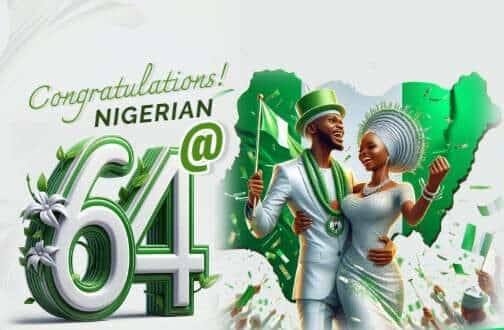
  • Nigeria @ 64: Walk your talk!

    Nigeria @ 64: Walk your talk!

    Nigeria, the giant of Africa. One in every four black persons, they say is a Nigerian. Nigeria is the most populous black nation on earth. In the diplomatic circle, it is believed that the route to Africa passes through Nigeria. In deed, many believe that when Nigeria coughs, the rest of Africa catches cold. And so on and so forth.


    The wonderful appellations that are deployed to describe my beautiful country are so enchanting, they blow my head!


    As one who has had the privilege of stepping foot on the shores of not a few countries, I bear testimony to the wonderful encounters I’ve had with the nationals of a couple of countries who literally want to open you up to know what makes you tick when they discover you are a Nigerian.


    Nigeria used to be a beautiful country of happy, indeed, very happy people.


    On paper, I can boast that Nigeria is one of the richest countries in the world. Like a musician once sang: Me I like my country. I like the land and people. Everything e dey for Nigeria. Make we join hands to make Nigeria better.


    Many argue that there is not a single inch of the country’s 923,768 square kilometers of landmass  that cannot grow a crop or where, if you dig deep, you would not find one earth mineral or two of value. Gold, coal, petroleum, gas, tin, iron, lithium, bauxite, bitumen, kaolin, lead, zinc, tin, limestone, etc, etc, abound.


    Nigeria is a country of humongous potentials in both man and materials. Nigeria has a vibrant youth population with over 42.54% aged between 0–14 years. In fact, as of 2022 when Nigeria’s total population was estimated to be 217, 079, 601 according to “Worldometer,” the youths account for 70 percent, amounting to a huge 151 million youths, while 42 percent of the 70 percent are under the age of 15 years. By about 4am this morning while I write this piece, Nigeria’s population is estimated at 233,893,209


    Nigerians are some of the most intellectually endowed individuals on earth. They are brilliant, smart and courageous. They are often intrinsically motivated and launch out to the highest heights to excel. Both domestically and across the globe, Nigerians shatter age old academic records. It is on record that there are about 400,000 Nigerians in the USA and they are amongst the most successful immigrant population in that country.


    As a country, it is regrettable however, that Nigeria’s greatness has largely remained in the realm of potentials rather than transformative. Over the years, successive leaders of Nigeria failed to leverage on the innate potentials nature endowed the country with.


    Sixty four years after independence from British colonial rule, Nigeria is today almost a shadow of its old self, where the gains of the mid 70s, up to the early 90s, achieved mainly through proceeds from the export of crude oil, have been lost. Unfortunately, the past 25 years of civilian rule have been one single spell of unanticipated disaster where Nigeria’s performance in social, economic and political spheres decelerated so rapidly that the country now features prominently in several underdevelopment indices.


    Poverty, insecurity, stealing of public funds, hunger, bad governance, indiscipline and other forms of irresponsible behavour by public officials are rife. Large swaths of Nigeria’s landmass are now under the control of so-called unknown gunmen such as bandits, terrorist herdsmen, kidnappers, ritualists and cattle rustlers. Violent criminal acts are rampant in both rural and urban areas.


    Most of these acts of criminality continue unabated because of leadership failure. Since the dawn of civil rule in 1999, many observe that almost every succeeding regime perform worse in governance than the previous one. There is also a consensus of opinion that partisan politics has been militarised and criminalised, whereby all that matters is how to when the next election.


    There is really no use boring readers with the gory tale of leadership failure under this Fourth Republic, save to note that Nigerians are in for a very long night because the politicians are showing no signs of retreating from their path of bad governance and stealing of public funds. Anyone in doubt may take another look at the current situation of statecraft and last week’s Edo state election as a case in point.


    Nigerians have to take their destiny in their own hands. Though it is argued that the people get the leadership they deserve, change must also come from within, since all the people can not be the same. The challenge I see is that the American presidential democracy that we practice saddles the electorate with a huge responsibility that the Nigerian populace cannot execute. That responsibility is the onerous task of recruiting the national leadership. This remains a task that the largely illiterate, uninformed, hungry and poor Nigerian electorate continues to fail at executing.


    President Bola Ahmed Tinubu therefore has his work duly cut out for him. Unlike the leaders before him, he must walk the talk. He must look inwards to rediscover the strength of Nigeria and Nigerians, and provide the leadership to grow the economy from within. The president must discard the bogey passion of chasing so-called foreign investors because there is no record in human history to support that approach to economic growth and development.


    The President must realize that money goes to where it is welcome. So, even if we are to expect foreign investors to grow the Nigerian economy, the investment climate must be conducive enough to attract such investment. At the moment, local farmers cannot go to their farms, not to talk of foreigners.

  • Mmesoma, JAMB and Nigerian sentiments

    The controversy surrounding the Joint Admissions and Matriculations Board (JAMB) and candidate Ms. Mmesoma Ejikeme has sparked widespread discourse across Nigeria, with many expressing their views and sentiments on the matter.

    The public outcry against JAMB intensified when they accused Ms. Mmesoma of manipulating her UTME result, leading to a heated debate about the examination body’s actions.

    In Nigeria, sentiments often influence the way people perceive and react to various issues in the country, be it religious or ethnic.

    As expected, sentiments came into play in the case of Ms. Mmesoma, with some individuals defending her based on their personal biases or affiliations.

    However, it is crucial to approach such issues with objectivity, considering the available facts rather than being swayed solely by sentiments.

    Initially, many people supported Ms. Mmesoma, sympathizing with her as a young girl who appeared incapable of manipulating her exam results or being part of an exam malpractice syndicate.

    They believed her claims that she had achieved a remarkable score of 362, dismissing JAMB’s accusation that she had fraudulently altered her result. Yet, JAMB took a firm stance, imposing a three-year ban on her for attempting to tarnish their reputation.

    The situation took an unexpected turn when Ms. Mmesoma appeared on a television program and confessed that her original score was, in fact, 249, contradicting her previous claims.

    This revelation left many of her supporters shocked and embarrassed. Even INNOSON Motors, which had initially awarded her a N3 million scholarship, withdrew the offer and publicly apologized to JAMB.

    This incident ignited a significant controversy and further intensified sentiments among Nigerians.

    Corruption has long plagued Nigeria, permeating various sectors, including education. Consequently, people have developed a lack of trust in the system, resulting in heightened sensitivities and reactions to fraud cases.

    It is essential to acknowledge that such instances of fraud undermine the integrity of examinations, which are crucial for a fair and merit-based selection process.

    Even though those in high authority appear not to be setting good examples, Nigerians value fairness and equal opportunities, making cases like Ms. Mmesoma’s particularly sensitive and triggering strong sentiments.

    Ms. Mmesoma’s confession of UTME fraud, no doubt sent shockwaves throughout Nigeria’s educational landscape.

    This fraud case sheds light on the prevalence of malpractice in examinations and the potential consequences for individuals involved and the wider educational system.

    However, the controversy surrounding Ms. Mmesoma’s confession also evoked another range of sentiments among Nigerians.

    While many expressed disappointment and anger at her actions, viewing her fraud as a betrayal of trust, some individuals sympathized with her. They attributed her actions to the pervasive culture of corruption in Nigeria, highlighting the numerous cases of falsified documents and certificates among the country’s leaders.

    This sentiment stems from a deep-rooted concern about the state of the educational system, with critics arguing that cases like Ms. Mmesoma’s expose the loopholes in the examination process and necessitate stricter measures to curb malpractice and uphold academic integrity.

    Despite the disappointment expressed by some Nigerians, sympathy towards Ms. Mmesoma persisted, as many acknowledged the societal pressures and intense competition students face.

    The pursuit of admission into higher institutions can drive individuals to desperate measures, jeopardizing their ethical principles. This sentiment calls for a more empathetic approach to understanding the underlying factors that contribute to such actions.

    Consequently, the psychiatric evaluation and psychological assistance recommended by the committee set up by Governor Charles Soludo, as well as his directive to follow the recommendations diligently, are widely welcomed.

    To address these issues effectively, it is crucial not to throw the baby away with the bath water and address the underlying factors that drive fraud in the educational system, while fostering a supportive and ethical environment for academic pursuits.

    We call for stricter measures, such as increased surveillance during examinations and stringent penalties for malpractice and fortification of the system to avoid glitches of any kind.

    What Nigerians yearn for is promoting transparency, accountability, and meritocracy within the education sector because this is vital to restoring faith in the system.

    Attending a university should not be for the rich only who can afford private schools, even with their very poor UTME scores whilst support via the new Student Loan scheme should be focused on indigent students. Proper scrutiny should always be made in the selection process and it should be as transparent as crystal.

    By doing so, Nigeria’s educational institutions will maintain their integrity and provide fair opportunities for all students.

    Government should also recognize the concerns expressed by Nigerians and work collectively towards eradicating fraud, upholding academic integrity, and fostering a system that truly reflects the nation’s aspirations for quality education.

  • The NIGERIAN ANCHOR: A Media Flagship Berths

    A new ship berths at Nigeria’s ever-busy media seaboard and it’s the NIGERIAN ANCHOR, a development-focused newspaper that aspires to chronicle happenings in the restless waters of the Nigerian political and economic system.
    We Anchor the News about the interplay of forces that jostle for supreme roles in the quest to decide who gets what, when and how.
    As nations position themselves to play pivotal roles in the lives of other players in the global system, many Nigerians struggle to catch a glimpse of their own country and its leaders in action, trying either to extend its sphere of influence or at the very least, strengthen its institutions and mores. Unfortunately, many think these have not been the best of times for the ‘Giant of Africa’, that had been the defender of citizens’ rights against imperious leaders in Africa.
    There is no doubting the fact about Nigeria being the largest economy in Africa. But the numbers portray it currently as a rich country of very poor people. The joke is that Nigeria is a country of very brilliant people but governed by some of its dumbest minds. A country that exports what it does not produce but imports what it produces abundantly.
    Nigeria is a paradox of stupefying magnitude. Interestingly, the enigma covers the fact that what does not kill the country strengthens it. Almost when you write it off, Nigeria rises up to universal applause.


    Regardless of what anyone might want to think or believe, Nigeria is one of the most endowed countries in the world. Its potentials in human and material resource are humongous. Nigerians are rich in character and easy to lead.
    They follow examples, good or bad, easily, but willing to make the change. The very funny but perplexing fact is that almost every Nigerian has a fair idea about the challenges halting the proper development of the country; yet many fail to take advantage when opportunities to effect desired changes present itself.
    Nigeria can therefore by likened to a powerful man of great strength but undone by missteps.
    The over-arching objective of this paper, therefore, is to communicate development for progressive change. We shall aim to set the agenda and draw the attention of society to unique positive conduct and work ethic that drive development through sustained reportage of these values.
    The choice of timing for birthing the NIGERIAN ANCHOR is not only deliberate but fortunate. It is happening at a critical juncture where our persevering democracy births a new regime.
    We commit to ample reportage that enriches the growth trajectory and enhances the development narrative. We shall strive to draw attention of the discerning public to view the other side of the coin through constructive criticism.