
Category: Labour

  • FEC Approves 100% Gratuity Exit Benefit for Federal Civil Servants

    FEC Approves 100% Gratuity Exit Benefit for Federal Civil Servants

    The Federal Executive Council (FEC) has approved the implementation of a landmark Exit Benefit Scheme that will grant retiring federal civil servants a gratuity equivalent to 100 per cent of their total annual emolument.

    The scheme, which takes effect from January 1, 2026, marks a significant step in the Federal Government’s efforts to strengthen the welfare structure of the civil service and ensure that officers who have served the nation for a minimum of ten years retire with financial security and dignity.

    The approval followed extensive deliberations and technical work by an Inter-Ministerial Technical Committee established by the Office of the Head of the Civil Service of the Federation.

    The committee collaborated with the National Pension Commission, the Budget Office of the Federation, and the Office of the Accountant-General of the Federation to design a sustainable implementation framework.

    According to the government, the Exit Benefit Scheme serves as a strategic enhancement to the existing Contributory Pension Scheme.

    It is intended to provide retiring officers in treasury-funded ministries, extra-ministerial departments, and agencies with a substantial financial cushion at the point of retirement.

    Head of the Civil Service of the Federation, Mrs. Didi Esther Walson-Jack, described the approval as a watershed moment for Nigeria’s public service.

    She commended the Federal Executive Council for endorsing what she called a transformative policy that recognises the dedication and sacrifices of federal civil servants.

    In a Press Statement, by Eno Olotu, Director, Press and Public Relations Office of the Head of the Civil Service of the Federation, Walson-Jack was reported to have said, “This approval is a profound acknowledgement of the invaluable contributions of our civil servants who have devoted their productive years to public service and national development.”

    She noted that the new Exit Benefit Scheme significantly strengthens the retirement package available to federal officers and reinforces confidence in the government’s commitment to the welfare of civil servants.

    The Head of Service also stated that the initiative aligns with ongoing reforms aimed at building a more motivated, performance-driven and people-centred civil service.

    She added that detailed implementation guidelines for the scheme will be released in due course.

    The reintroduction of gratuity payments comes 22 years after Nigeria adopted the Contributory Pension Scheme. The Federal Government said the latest approval demonstrates its continued commitment to policies that improve the welfare of civil servants while deepening reforms designed to secure the future of the federal public service.

  • Women’s Coalition Pushes Bold Labour Reforms, Gender Parity in Governance

    Women’s Coalition Pushes Bold Labour Reforms, Gender Parity in Governance


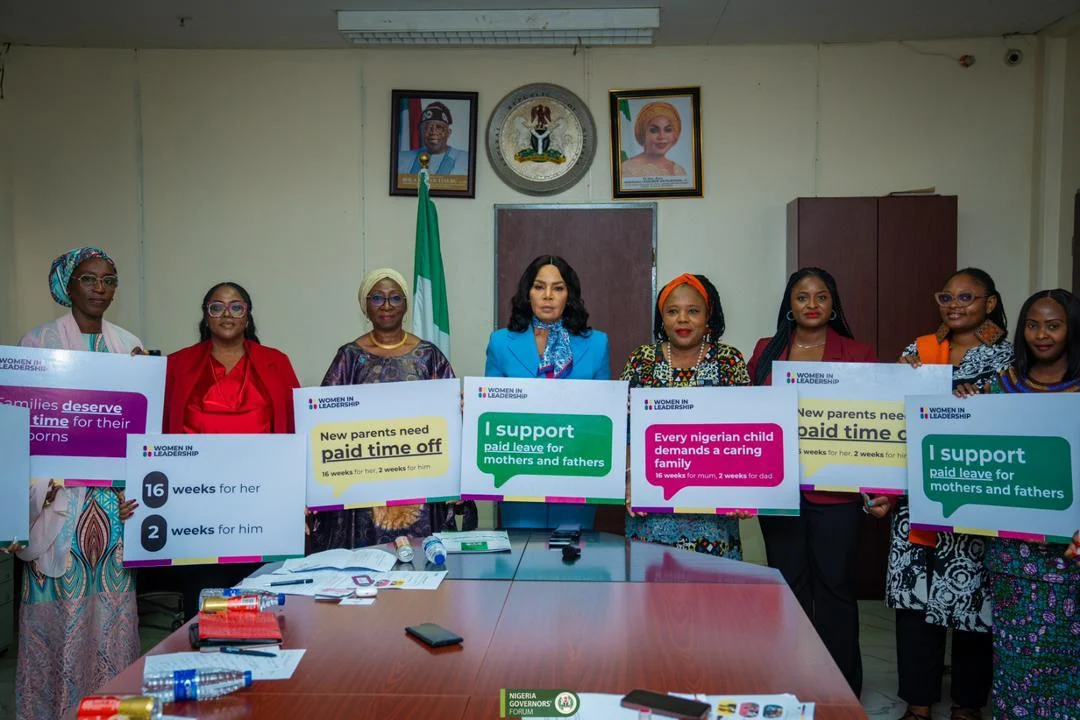
    Nigeria’s top women leadership networks have renewed calls for sweeping labour reforms and stronger gender inclusion in governance.

    The call was made after a high-level meeting with the Minister of State for Labour and Employment, Hon. Nkeiruka Onyejeocha.

    Onyejeocha: Inclusive Leadership Drives National Growth

    Welcoming the delegation, Onyejeocha described their push as vital to building a more resilient workforce.

    “Gender-inclusive leadership is not just about fairness; it’s a strategic imperative,” she said. “No nation can achieve sustainable growth or global competitiveness if half its population is excluded from the rooms where key decisions are made.”

    Coalition Seeks 16-Week Paid Maternity Leave, 14-Day Paternity Leave

    The coalition urged both government and major employers to adopt a national minimum of 16 weeks fully paid maternity leave and 14 days paid paternity leave.

    In a signed statement, NGF Director of Media and Strategic Communications, Yunusa Tanko Abdullahi said the group warned that the existing 12-week, half-pay policy pushes many women out of the labour market.

    “Nigeria loses the return on its investment in girls’ education when women are forced out due to weak family-leave policies and inadequate care systems,” the group said.

    Responding, Onyejeocha reaffirmed the government’s commitment to reform.

    “Our ongoing review of labour laws will close gaps that hinder women’s participation,” she stated, adding that the Ministry is upgrading its labour inspectorate system to enforce equal pay, maternity protection, and safe workplaces.

    $114 Billion in Unpaid Care Work: Coalition Demands Recognition

    Highlighting Nigeria’s undervalued care economy, the coalition estimated that women contribute over $114 billion in unpaid care work annually, limiting their economic participation.

    They urged the government to introduce childcare subsidies, professionalize care services, and strengthen protection against pregnancy discrimination to unlock productivity and inclusion.

    NGF Targets 20 States for Six-Month Parental Leave by 2027

    Hauwa Haliru, Director of Gender Affairs at the NGF, backed the coalition’s call for longer leave.

    “At the NGF, we are advocating six months paid maternity leave and using the Spouses’ Forum to promote six months paternity leave as well,” she said.
    “Nine states have already adopted the six-month policy, and our target is twenty by 2027.”

    Federal Push for 35 Percent Women in Leadership

    On governance, Onyejeocha restated the Federal Government’s goal of at least 35 percent female representation across all levels.

    “A leadership structure that includes 35 percent women is not only fair — it’s essential for balanced and empathetic governance,” she said.

    Coalition Urges Stronger Media Partnership

    The women leaders also appealed for robust media collaboration to amplify women’s voices through interviews, features, and policy coverage.

    They noted that visibility drives understanding, helping to entrench Nigeria’s commitment to gender-balanced leadership.

    Minister Pledges Continued Collaboration

    Onyejeocha closed the session with a promise of partnership.

    “Together, we can build workplaces, boardrooms, and institutions that reflect the true strength and potential of our nation,” she said.

  • Association berates Dangote anti-workers practices

    Association berates Dangote anti-workers practices

    The Association of Senior Civil Servants of Nigeria (ASCSN) has expressed displeasure over the anti-workers practices displayed by Dangote Refinery.

    The National President of ASCSN, Mr Shehu Mohammed, in a statement on Monday, said that the arbitrary dismissal of workers for exercising their constitutional right to freely associate and belong to a trade union was a gross violation.

    Mohammed said that the arbitrary dismissal of workers was a gross violation of Section 40 of the Nigerian Constitution and a direct breach of Nigeria’s obligations under International Labour Organisation (ILO) conventions.

    He expressed total solidarity with the Trade Union Congress of Nigeria (TUC) and the Petroleum and Natural Gas Senior Staff Association of Nigeria (PENGASSAN), in condemning the unjust and anti-labour practices carried out by the management of Dangote Refinery.

    “Such acts are unacceptable and cannot be tolerated in a democracy. We, therefore, stand shoulder-to-shoulder with TUC and PENGASSAN in demanding the immediate reinstatement of all affected workers.

    “We support the call for an independent investigation into the refinery’s anti-worker practices,” the national president said.

    He commended the decision of TUC to place affiliates on stand-by for a possible national action should the demands not be met.

    Mohammed warned that if the matter was not resolved within a reasonable time frame, the ASCSN might be compelled to join the national action in full force, in defence of workers’ rights and to ensure justice was done.

    “An injury to one worker is an injury to all. No employer, regardless of size or influence, will be allowed to trample upon the rights and dignity of Nigerian workers,” 

  • Just in: Victory at last!

    Just in: Victory at last!

    NUPENG suspends strike as Dangote workers can join labour unions

    Following an agreement with Dangote Refinery and Petrochemicals management on the controversial topic of workers’ unionization, the Nigeria Union of Petroleum and Natural Gas Workers (NUPENG) has called off its statewide strike.

    Both sides signed a Memorandum of Understanding (MoU) at a conciliation meeting called by Labor Minister Muhammad Maigari Dingyadi in Abuja.

    It was stated in the resolutions that Dangote Refinery and Petrochemicals will permit willing workers to become members of legally recognized unions.

    This decision came after NUPENG members accused the Dangote Group of depriving workers the opportunity to join recognized labor unions during two days of industrial action.

    When the dispute came to a head, the federal government stepped in through the Ministry of Labour and Employment.

    The process of unionization will start right away and be finished in two weeks, from September 9 to September 22, 2025.

    Additionally, the agreement states that no employee would face consequences for taking part in the strike.

    A part of the MoU read: “That since workers’ unionisation is a right in line with the provisions of the extant laws, the management of Dangote Refinery and Petrochemicals agreed to the unionisation of employees of Dangote Refinery and unionisation of employees of Petrochemicals, who are willing to unionise.

    “That the process of unionisation shall commence immediately and be completed within two weeks (9th–22nd September, 2025), and it was agreed that the employer will not set up any other union.

    “Arising from the strike notice, no worker or employee of Dangote Refinery and Petrochemicals will be victimised.”

    The Nigerian Labour Congress (NLC), the Trade Union Congress (TUC), the Dangote Group, NUPENG, the Nigerian Midstream and Downstream Petroleum Regulatory Authority (NMDPRA), and the Ministry of Labour and Employment all signed the agreement.