Tag: AFROBEATS

  • Davido Thrills Fans as Flytime Fest 2025 Lights Up Lagos

    Davido Thrills Fans as Flytime Fest 2025 Lights Up Lagos

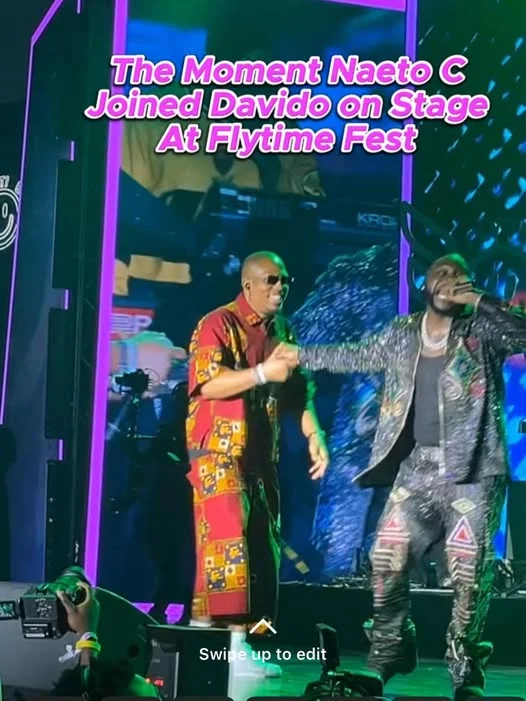
    Flytime Fest 2025 drew thousands of music lovers to Lagos on Thursday night as Nigerian music superstar, Davido, delivered a breathtaking performance at the Eko Convention Centre.

    The News Agency of Nigeria (NAN) reports that the concert stretched into the early hours of Friday, with fans filling the venue to witness electrifying live performances from some of Nigeria’s biggest music acts.

    The annual festival, which celebrates sound, culture and live entertainment, offered fans an immersive concert experience, with top artistes delivering high-energy performances that kept the audience fully engaged throughout the night.

    The highlight of the event came when Davido stormed the stage to thunderous applause, thrilling fans with a string of hit songs that had the crowd singing and dancing from midnight until dawn.

    The award-winning artiste showcased powerful vocals and dynamic stage presence, delivering electrifying renditions from his extensive music catalogue and further heightening the excitement at the venue.

    The performance was amplified by surprise appearances from guest artistes, including Dremo and Peruzzi, who joined Davido on stage to the delight of the cheering crowd. While Dremo thrilled fans with energetic rap verses, Peruzzi delivered smooth melodies that drew loud sing-alongs.

    Davido, Chike, Odumodu Black, others at Flytime Fest, Lagos

    Several attendees who spoke with NAN expressed excitement at witnessing Davido’s live performance. Adewale Ogunleye described the concert as exceptional, saying Davido’s energy remained unmatched from start to finish.

    Funke Akinwale, who attended the festival with friends, described the experience as unforgettable, while Musa Abdullahi praised the joyful atmosphere and positive vibes at the event.

    Another attendee, Chiamaka Nwoye, commended the organisers for a well-executed festival, noting that Flytime Fest continues to improve yearly and unite people through music.

  • Nigeria launches 12-member Council for Creative Technology Features

    A critical milestone will be attained today, as the National Council for Arts and Culture (NCAC), announces the launch of the Council for Creative Technology Futures (CCTF).

    A statement made available to Nigerian Anchor in Abuja describes the launch as a groundbreaking national initiative designed to place Nigeria at the forefront of global innovation where culture meets code.

    In the statement pushed out by Dr. Dennis Olofu Head, Media National Council for Arts and Culture the launch enjoys full approval from the Federal Ministry of Art, Culture, Tourism and Creative Economy (FMACTCE).

    He states that the launch represents a bold step towards the realisation of a Nigeria creative economy projected to surpass $25 billion by 2025.

    Membership

    Dr. Olofu stated that membership of the council shall be pro bono and composed to reflect national service ethos and a shared commitment to a digitally empowered creative sector.

    It was further stated that in its first phase, the Council will establish foundational frameworks and deliverables, paving the way forward for the cci and the creator economy, Strategic partnerships will be developed with the British Council, University for the creative arts United kingdom, UNESCO, Google, Meta, AfDB, Giz,

    European Union, Netflix, and other key development and technology partners—mobilizing investment, technical expertise, and global exposure for Nigeria’s creative-tech future.

    The members of the council are: Charles Emembolu – TechQuest, Talent Development (Chairman), Misan Harriman – Director & Photographer, Dayo Elegbe – Sponge Group, Digital Marketing, Bizzle Oshikoya – The Plug, Music & Talent Management and Kemi Awodein – MD, Chapel Hill Denham.

    Others are, Osas Peter – Founder, BlackAt, Malik Afegbua – AI Storytelling & Creative Visual Futurism, Sandra Oyewole – IP Lawyer, Olajide Oyewole & Co., Judith Okonkwo – Imisi 3D, AR & New Technology Leader, Dr. Dahiru Sani – Founder, Kaduna Business School and Dr. Chinedu Odoala – Head, NCAC Secretariat

    Dr. Olofu asserts that Nigeria continues to shape global narratives across music, film, fashion, gaming, and digital content as the CCTF plays the role of “ a highlevel policy, strategy, and implementation platform for harnessing emerging technologies such as Artificial Intelligence (AI), Augmented and Virtual Reality (AR/VR), Web3, and blockchain across over 49 creative industry sectors.’

    Quoting Obi Asika, the Director General of NCAC Dr.Olofu wrote “This Council is about merging culture and code, storytelling and smart contracts, heritage and innovation.”

    The Director General was also quoted as saying, “We are not just reacting to global change we are leading it from Africa.”

    “The launch of the Council for Creative Technology Futures is a milestone,” Asika added. “We are building the foundation for Nigeria’s creative future where our stories, music, art, and innovation are protected, monetized, and celebrated globally.”

    Mandates of the CCTF

    The core mandate of the Council for Creative Economy Features comprises guiding  Nigeria’s creative industries into a digitally empowered future that drives job creation and economic growth, as well as equipping creators with global tools, platforms, and market access.

    Its mandate also entails enhancing Nigeria’s position as a cultural and technological powerhouse.

    It was also stated that the CCTF will deliver the National Creative-Tech Framework & Roadmap (2025–2030), aligning with the National AI Strategy, Executive Order 005, the Digital Economy Policy (2020–2030), and NCAC-led programs such as ICE Hubs and Discover Naija.

    The council will also take memorandum from stakeholders and collaborate closely with NCAC sister agencies in culture and tourism and memorandum from interested stakeholders’ angle.

    It will also advance global advocacy to elevate Nigeria’s creative sector on international platforms and look for the best-in-class solutions to drive economic growth.

  • Ayra Starr leads Spotify’s 2025 impact list

    Ayra Starr leads Spotify’s 2025 impact list

    Spotify has announced Nigerian singer Oyinkansola Aderibigbe, known as Ayra Starr, as the leading artiste in its Global Impact List for 2025.

    Phiona Okumu, Spotify’s Head of Music for Sub-Saharan Africa, shared the news in a statement on Tuesday.

    Okumu revealed Ayra Starr’s dominance on Spotify’s Global Impact List, leading 30 Nigerian songs and connecting with audiences worldwide.

    The top 10 list includes Ayra Starr, Rauw Alejandro, and Rvssian’s “Santa”; Tems’s “Love MeJeJe”; Burna Boy, Coldplay, Elyanna, Little Simz, and TINI’s “WE PRAY”; and more.

    Other songs featured are Ayra Starr and Giveon’s “Last Heartbreak Song”; 21Savage, Burna Boy, and Metro Boomin’s “Justlike Me”; Tems and Tyla’s “No.1”; and others.

    Okumu highlighted Nigerian artistes breaking boundaries, saying Spotify is proud to amplify their global reach.

    She explained that Nigerian music’s influence has gone global, with Ayra Starr leading the charge in Spotify’s 2025 Global Impact List.

    The list showcases 30 Nigerian songs with the strongest international connections this year, reflecting Nigeria’s growing global influence.

    Okumu called Ayra Starr a chart-topping force, reshaping the global music scene with her international success.

    Ayra’s hits top Nigerian charts, with her music becoming global anthems that resonate worldwide.

    “As a Spotify RADAR and EQUAL alumna, Ayra Starr was Nigeria’s most-streamed female artiste in 2024,” Okumu said.

    While only two of her tracks, “Last Heartbreak Song” and “Bad Vibes”, are on the Global Impact List, Ayra’s collaborations like “Santa” highlight her wide-reaching influence.

    The success of “Santa”, featuring Rvssian and Rauw Alejandro, showcases Ayra’s ability to connect across diverse markets.

    Ayra Starr’s six entries on the list, including “Commas”, “GOOD FEELiNGS”, and “Hypé”, show her versatility and global appeal.

    Her album The Year I Turned 21 was one of the top 10 most-streamed albums of the year, cementing her global presence.

    Okumu emphasised the power of collaboration in amplifying Nigerian music’s global impact, noting 22 of the 30 songs are collaborations.

    She explained that collaborations are essential for Nigerian artistes aiming for international success, with 19 involving artistes from other countries.

    Songs like “Santa”, “WE PRAY (TINI Version)”, and “Another Vibe” demonstrate the power of such cross-continental partnerships.

  • Ayra Starr Reflects on the toll of fame at 22

    Ayra Starr Reflects on the toll of fame at 22

    Afrobeats female sensation, Ayra Starr has revealed the challenges she faces in her fast-paced career, expressing that despite being only 22, she often feels worn out and “old” compared to her peers.

    During a recent discussion in Nairobi, Kenya, she shared her desire for rest and a simpler lifestyle amid her busy schedule.

    The artist finds her drive within the creative process, stating that each song helps her to better understand her artistic journey and purpose.

    As she looks to the future, she remains focused on her craft, acknowledging that making music clarifies her goals.

    Recently, Ayra made headlines with her historic YouTube Live concert, which was broadcast globally from Nairobi.

    This milestone event celebrated the launch of her eagerly awaited second album, The Year I Turned 21, marking a significant achievement in her career.

  • Nigeria’s Ailing Economy Killing Showbiz

    Nigeria’s Ailing Economy Killing Showbiz

    Nigeria’s entertainment industry, often celebrated for its creativity and economic potential, faces severe challenges due to the country’s ailing economy.
    In 2021, the film industry was reported to have contributed 2.3% ($660 million (239 billion naira)) to GDP.
    Indeed, the arts, entertainment, recreation, film, sound recording, and music production sectors contributed N288.31 billion to the GDP in the first quarter of 2014; by the same period in 2024, that amount had increased to N728.80 billion.
    With vital statistics on the economy pointing southward, there is palpable concern that this promising sector may be negatively impacted if nothing happens.
    For instance, as of June 2024, all indicators of the inflationary rate increased even though more slowly, according to the National Bureau of Statistics (@NBS), headline inflation for the period rose from 22.8 percent in June 2023 to 34.0 percent in May 2024, or 34.2 percent.
                              Data: NBS; Chart: NESG Research
    The official exchange rate was N1471/US$ in June 2023, compared to N769/US$ in June 2023. Rising import food inflation, at 36.4% y/y, is also contributing to the inflationary pressures. Food inflation is still the main driver of headline inflation; it increased to 40.9 percent year over year in May 2024 from 40.7 percent in May 2024 and much higher than 25.3 percent in June 2023 (see Fig 1). The core inflation rate also increased, from 20.1 percent in June 2023 to 27.4 percent in May 2024.

    Read: Nigeria’s inflation rate rose to a 28-year               high in June 2024 (NESG)

    The anticlimax was ascended recently as nationwide protests broke out with the youth clamouring for an #EndtoBadGovernance and #EndHunger.
    From Nollywood to Afrobeats, the impact of economic struggles is evident across all sectors of showbiz.
    Decline in Film Production
    Nollywood, the second-largest film industry in the world in terms of volume, has seen a noticeable decline in production.
    According to the National Bureau of Statistics (NBS), the number of films produced in Nigeria dropped by 17% in 2023 compared to the previous year.
    This reduction is linked to the rising costs of production, driven by factors such as the depreciation of the Naira and increased prices for equipment and services.
    Decreased Consumer Spending
    Inflation in Nigeria has soared, reaching 22.79% in June 2024, the highest in nearly two decades. This spike in inflation has eroded purchasing power, leaving many Nigerians with less disposable income for entertainment.
    The result is a significant drop in cinema attendance and music sales.
    In 2023, the Nigerian cinema industry recorded a 25% decrease in box office revenue, according to data from the Cinema Exhibitors Association of Nigeria (CEAN).
    Similarly, the sale of physical music albums has plummeted, with many consumers opting for cheaper digital streaming services.
    Challenges for Emerging Talent
    The economic downturn is particularly tough on emerging talent. The cost of producing a music video, for instance, has risen by approximately 30% in the last two years due to inflation and currency devaluation.
    For many up-and-coming artistes, these costs are prohibitive. According to a survey conducted by the Musicians Union of Nigeria, nearly 60% of emerging artists reported delaying or canceling projects in 2023 due to financial constraints.
    Shift in Content and Format
    To mitigate the effects of the economic downturn, many producers are turning to more cost-effective content formats. Online streaming platforms like YouTube and Netflix have seen a surge in locally produced web series and short films.
    This shift is reflected in the statistics: YouTube Nigeria reported a 35% increase in local content uploads in 2023. However, the revenue from these platforms is often lower than traditional cinema or TV, limiting the financial rewards for creators.
    International Collaborations and New Revenue Streams
    Despite the economic challenges, the Nigerian entertainment industry is showing resilience by exploring new avenues for growth.
    International collaborations have become more common, with Nigerian artists partnering with global brands and musicians.
    For instance, Nigerian music exports grew by 19% in 2023, with Afrobeats artists like Burna Boy and Wizkid leading the charge in the international market.
    Additionally, digital platforms have become vital revenue streams, with streaming revenue from platforms like Spotify and Apple Music increasing by 22% in 2023, according to a report by the Nigerian Copyright Commission.
    Nigeria’s struggling economy has significantly impacted its showbiz sector, leading to reduced productions, lower consumer spending, and challenges for emerging talent.
    However, the industry’s adaptability and innovation, particularly in embracing digital platforms and international collaborations, offer a silver lining.
    With strategic support and investment, the Nigerian entertainment industry can continue to thrive, even in the face of economic adversity.