Tag: climate action

  • President Bola Tinubu Arrives in Abu Dhabi for 2026 Sustainability Week

    President Bola Tinubu Arrives in Abu Dhabi for 2026 Sustainability Week

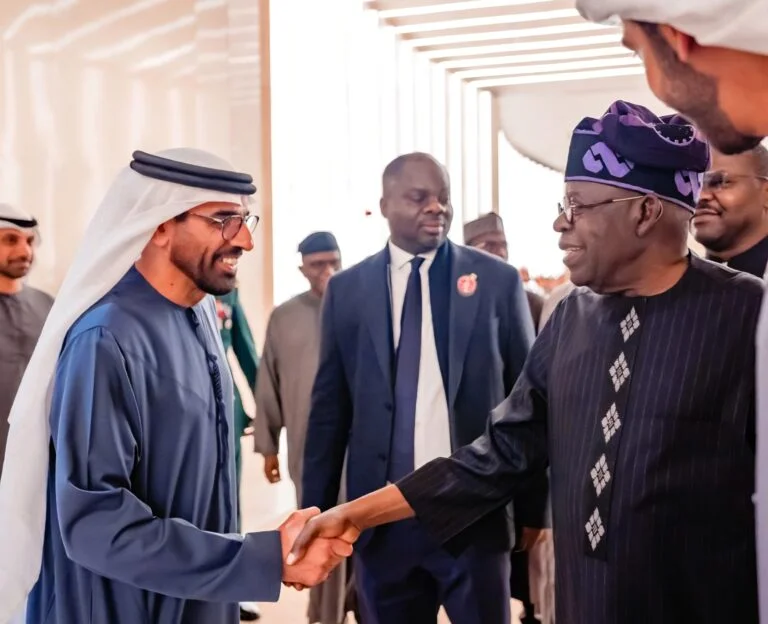
    President Bola Tinubu arrived in Abu Dhabi, UAE, on Sunday night for the 2026 Abu Dhabi Sustainability Week (ADSW), which begins Monday.

    His aircraft landed at the Presidential Wing of Zayed International Airport at 11:30 p.m. local time, according to Presidential Spokesperson Bayo Onanuga.

    Tinubu was welcomed at the airport by Sheikh Shakhboot Nahyan Al Nahyan, UAE Minister of State for Foreign Affairs, and UAE Ambassador to Nigeria Salem Saeed Al-Shamsi, alongside Nigeria’s Minister of Foreign Affairs, Ambassador Yusuf Maitama Tuggar, and other members of the Nigerian diplomatic mission.

    At his hotel, several Nigerian officials received the president, including Minister of Budget and Planning Atiku Bagudu, Minister of Industry, Trade and Investment Dr Jumoke Oduwole, and Director-General of the National Intelligence Agency Amb. Mohammed Mohammed.

    President Tinubu arrived from Europe, where he held consultations with Rwandan President Paul Kagame and French President Emmanuel Macron.

    The 2026 ADSW, themed “The Nexus of Next, All Systems Go,” focuses on sustainable development, climate action, energy transition, and inclusive growth.

    Tinubu’s visit highlights Nigeria’s commitment to global sustainability discussions and aims to strengthen diplomatic and economic relations with the UAE.

  • Stakeholders lagging behind on global warming fight, says UN

    The United Nations has said that the world is not on target to curb global warming, insisting that more action is needed from all stakeholders.

    According to the Global Stocktake report, “The Paris Agreement has driven near-universal climate action by setting goals and sending signals to the world regarding the urgency of responding to the climate crisis,” it said. “While action is proceeding, much more is needed now on all fronts.”

    The report, culminating a two-year evaluation of the 2015 Paris climate agreement goals, distils thousands of submissions from experts, governments and campaigners and will lay the groundwork for the global stock-take discussion at COP28.

    Nearly 200 countries agreed in 2015 in Paris to limit warming to no more than 2 Celsius above pre-industrial levels, and to strive to keep the increase to 1.5 C.

    While each country is responsible for deciding its own climate actions, they also agreed to submit to a progress report by 2023 to see what more should be done.

    Some of the world’s most climate vulnerable countries expect the report to spur action from global leaders.

    The U.N. said existing national pledges to cut emissions were insufficient to keep temperatures within the 1.5 C threshold. More than 20 gigatonnes of further CO2 reductions were needed this decade – and global net zero by 2050 – in order to meet the goals, the U.N. assessment said.

    “With leaders gathering this month for the United Nations Secretary General’s Climate Ambition Summit ahead of COP28, the findings and recommendations of this Report need to be a wake-up call and a trigger for cogent commitments,” chair of Association of Small Island States, Pa’olelei Luteru said.

    The report urged countries to cut the use of “unabated” coal power by 67-92% by 2030 versus 2019 levels and to virtually eliminate it as a source of electricity by 2050.

    Low and zero-carbon electricity should account for as much as 99% of the global total by mid-century, while technological challenges holding back carbon capture must be resolved.

    The report also called for funding to be unlocked to support low-carbon development, noting that billions of dollars were still being invested in fossil fuels.

    “It serves up a bold to-do list for governments to limit warming to 1.5C and protect people everywhere from climate devastation,” said Tom Evans, policy advisor on climate diplomacy at British climate think tank E3G.

    Commitment is needed to phase out fossil fuels, set 2030 targets for renewable energy expansion, ensure the financial system funds climate action, and raise funds for adaptation and damage, he said.

    “Anything less will fall short on the necessary steps laid out in this report.”