Tag: Cost of governance

  • High Cost of Governance as an Impediment to Development

    High Cost of Governance as an Impediment to Development

    By Dr. Sam Amadi

    As Nigeria’s first lawyer, Sapara Williams stated, the lawyer lives for the wellbeing and direction of his society. The obligation to promote the wellbeing of the society is not just for the lawyer. It is for all professionals. There is a special obligation on the professional to work for the good of the society.

    Because Just Friend Club is a club of professional men and women, I think I should say something about professionalism, the professional and the future of Nigeria.

    The Professions, Professionals and the Public Good

    We have many professionals in public and private leadership in the country. With such array of well educated and nurtured people you would expect a high degree of ethics and competence in corporate and public leadership in Nigeria. But that is not the case as shown by Nigeria’s poor rating in corruption perception index and other indicators of public probity. Nigeria is also very poor in the rating of state effectiveness. The Transparency International rated Nigeria 14th out of 180 countries in the world in the 2023 Corruption Perception Index. This comes to 25% where 0 is highly corrupt and 100% is very clean. Nigeria is also doing badly on the Mo Ibrahim Index of African Governance (IIAG) and the World Intellectual Property (WIPO) ranking on Global Innovation Index. In the former, Nigeria ranked 33 out of 54 African countries, with 45.7% out of 100%. On state effectiveness index, Nigeria does very badly. In 2022, Nigeria’s score was -1.04, which was a decline from -1.03. The world average score was -1.05. State effectiveness is a measure of the capacity of the state’s public sector to formulate and implement policies in a manner that achieves good governance and development. An ineffective state means that the bureaucracy is not strong enough to implement transformative policies.

    Nigeria faces an acute crisis of values which reflects in the gross lack of productivity in both its private and public sectors. Nigeria is abundantly blessed in natural resources. As a world leading producer of oil, we ought to be richer than we are. But we know that the wealth of nations does not come mostly from natural resources. Countries like Singapore and South Korea are not so much naturally endowed. In fact, they are geographically constrained in many ways. But Nigeria won the geographical lottery in many ways. Yet are in many ways victim of Dutch Disease. Natural resources have not translated into wealth. They have mostly turned into a curse. Natural resources in themselves are not a curse. They are a blessing. But a blessing that call for more work to turn them into lasting benefit to the people. Some of the Scandinavian countries are endowed with oil like Nigeria. They turned theirs into a blessing through smart policies and management. For them, oil resources have lubricated national innovation system that has made them high income economies. Examples are Norway and Finland.

    Nigeria’s travail is partly the lack of good leadership that can mobilize citizens towards a virtuous path of productivity. Such leadership is often described as transformative or redefining. In his book on public leadership titled ‘The Myth of the Strong Leader, Achie Brown, Oxford University emeritus professor of politics, argues that redefining leaders are those who lead their country away from the unpleasant past and toward a better future. Such a journey requires adaptivity, which could be very difficult. It is the genius of redefining leadership that the people get to learn the hard lesson and embrace new values and practices that will ensure economic development and social transformation.

    At the heart of leadership, whether transformative or redefining, are values and value-based practices. These values and value-based practices are usually sourced from the practice of the professions. The professions are human endeavours that highlight the highest levels of expertise, responsibility and corporateness. These are the three elements of a profession. We expect that a professional is a person of high expertise in a specialized area of human activity. A professional is also a person with overriding sense of responsibility, first to his or her craft, and second to the society which the profession serves. A professional is also guided by a deep sense of corporateness. That is, he or she is trained to subordinate his or her personal interests for collective good. These three elements of professionalism influence the direction of national politics and the economy. Where professionals manifest high levels of technical and ethical expertise and show a high degree of responsibility to the ethics of their profession and able to subordinate the pursuit of personal interest to the good of their profession and society, we see an uplift in the productivity and probity. We see the society rate high in state effectiveness and low on corruption perception index.

    Arising from the above, is the proposition that the problem of high cost of governance in Nigeria relates to the problem of the crisis of value, which is partly a problem of the crisis of professionalism. Anyone who reviews the economic and social indicators of development for Nigeria in the First Republic and early in the Second Republic will see a marked difference with contemporary indicators. There is a great decline in any of these vital indicators of human and social development. These declines are somewhat parallel to the decline in professionalism in the same period. If we measure the quality of professionalism by the ratings of Nigeria’s tertiary institutions and the level of knowledge production and ethical conducts of Nigerian professionals, we can conclude that loss of professionalism leads to stagnation in development.

    It is Bureaucracy, Stupid:

    There are three importance elements of public governance. The first is institution. The second is policy. The third is bureaucracy. Institution is now an important buss word in political economy discourse. Two economists and a political scientist were awarded the 2024 Nobel Prize in economics for their work that illuminate the importance of institutions to economic development. Daren Acemoglu, James Robinson and Simon Johnson argue that the reason for the divergence in economic performance between the developed west and the rest is the quality of political and economic institutions in the different regions. In their view, the cause of sustained economic growth is political and economic institutions that are inclusive and invest in the wellbeing of the people. In a sense, it means that growth equals to democracy or democratic society. The converse is true. Countries with institutions that are restrictive and exclusive and extract from citizens lead to economic stagnation. The predecessor of Acemoglu, Robertson and Johnson, Douglas North, defined institutions as “the rules of the game, humanly devised devices to constrain human action. Institutions provide incentives for actions and disincentives for other action.

    After institutions, we get to policies. The difference between policy and institution is that whereas the former is short-termed and variable, the latter is mostly long-termed and invariable. So, the legal system is an institution. The policy of not prosecuting persons younger than 18years is a policy. Often, institution generates and sustains institutions. Therefore, the quality of institutions matters because of their generative power. Beyond institution and policy, there is the bureaucracy. We often hear about the danger of bureaucracy. The popular language makes it look like bureaucracy is itself a bad thing. But it is not. Bureaucracy is the mechanism that implements the policies generated by institution. Bureaucracy is the implementation arm of the state. Max Weber argues that the main mark of a state is the monopoly of legitimate violence in a defined territory. The state manages this legitimate violence through a government. The government acts through a bureaucracy. The quality of that bureaucracy matters.

    The biggest issue about state effectiveness may be about the quality of the bureaucracy. In layman’s term, bureaucracy means the public service. The colonial authorities understood the importance of the public service to development that the bequeathed to the colonies a model of the form of public service in their home countries. The public service was modelled to be meritocratic, technocratic and politically neutral. In the early years post-independence, Nigeria recorded significant economic growth. The three regions were economically vibrant than the 36 states of the federation are today. Things were so good that the Eastern Nigeria was rated the fastest growing economy in the world. At the root of great economic performance is a bureaucracy that has competence and capacity to formulate and deliver policies and programs. The quality of the Nigerian bureaucracy has both a software and hardware. The software was the quality of public education, especially at the secondary and tertiary level. The report of the Ashby Commission on Higher Education in Nigeria was the first official articulation of policy for university education in Nigeria. The policy was based on providing excellent manpower for economic and social development. Arising from this, we saw many of the regions established universities that rated highly in the world and attracted the best and the brightest scholars and researcher across the world.

    Additional software of public service is the culture of the public service. Many scholars of economic development point to the interplay between institutions and culture as the main determinant of economic development and social change. Both institution and culture reinforce themselves. Culture includes values, beliefs and attitudes. Institutions include the constitution, laws, procedures, norms and standard operating procedures. The quality of the bureaucracy is determined by the software of public education and prevalent culture. The software of the public service runs on the hardware of institutional structure that sustain delivery of public service. This includes departmentalization, manning levels and staffing of the public service. It also goes to the interdependence and interrelationship between different sections of the bureaucracy. The hardware of the high-quality bureaucracy we had in the First Republic is the structure and institutions of the public service. This is what made that bureaucracy able to generate and implement policies and programs that delivered sustained economic growth to a reasonable extent. The bad hardware and software of the contemporary Nigerian bureaucracy is what has failed to deliver sustained economic growth and high human development.

    Today, we have a low-quality public education and a dysfunctional public service structure that weaken the capacity of the Nigerian state to deliver development. Capacity is an important ingredient of development. With low capacity a country may not be able to generate good policies and effectively implement them. Lessons from successful Asian countries underline the importance of state capacity. These countries succeeded because they have capacity to design good policies and implement them with coherence and effectiveness. Development economists have studied what happened in Asia starting with Japan, to South Korea, China and Taiwan, in what is now referred to as developmentalist state economic model. The logic of the developmentalist state is that the state is the champion of public policy. The state, through a central agency, designs and implements the policies and mobilizes the private sector through sundry incentives to enter specified sectors that have potential for higher growth. These countries gradually improved the quality of education, entrenched meritocracy in the public service through quality examinations, enhanced recruitment of the best and brightest, and provided motivation and rewards for continued improvement of the workforce. The recruitment based on merit mattered. The reward for competence and performance also mattered.

    The important point to make is that bureaucracy is an important issue in development. We have to pay good attention to the quality of the public service because it determines the possibility of escape from economic and social stagnation. The bureaucracy is the public service. The notion that what we need for economic development in Nigeria is an entrepreneurial private sector is actually a mistake. We need more of an entrepreneurial public sector. This is the reason we speak today about entrepreneurial states. As the Mariana Mazzucato, University of London economist argues in her book, The Entrepreneurial State: Debunking Public vs. Private Sector Myth (2013) that the economic growth and technological transformation we see in the United and Europe owes more to the role state institutions play in initiating innovation.

    I cannot overstate the importance of a fit-for-purpose bureaucracy for economic and social development in Nigeria or anywhere else. In 2011, i was appointed to a committee to review the public service of Nigeria. Together with Professors MJ Balogun, I issued a minority report to the president where we addressed the key issues of a good public public sector reform in Nigeria. I would like to quote extensively from that report on the importance of well-designed and functional public service.

    “Against the backdrop of the challenges facing Nigeria, the role of the public service cannot but be critical. Not long ago, the service was reputed for effective and efficient discharge of its statutory responsibilities. For decades, it enforced law and order, constructed high-speed expressways, built dams, managed banks and insurance companies, and opened the economy to local and foreign investors. The government worked simply because its public service instrumentalities worked. And the public service worked because it strictly observed the principles transplanted from Whitehall and bequeathed by the British colonial power—notably, those of political neutrality or impartiality, anonymity, integrity, professionalism, merit and security of tenure. So highly regarded was the public service that when the country looked like falling apart in 1967, it was to it that the government of the day turned for support. It provided invaluable policy advice, effectively backstopped the police-cum-military action which finally ended the three-year civil war in 1970, and, all the while—and even in the face of dwindling resources and the mounting war-time commitments–kept the essential services going. The impact of the public service during the immediate post-independence period was felt at both the federal and regional levels. Besides the core civil service operating at the regional level to implement policies and programmes (e.g., works, education, health, agriculture, and cooperatives), development corporations and marketing boards were established to handle commercial and quasi-commercial operations with substantial government interest. The former (the development corporations) invested fiscal surpluses on infrastructure development, the construction of health and educational facilities (including three 40 Universities in Zaria, Nsukka, and Ile-Ife and countless primary and secondary schools), as well as industrial manufacturing and mining.

    The marketing boards organized small-scale farmers into producers’ cooperatives and collaborated with the cooperatives on the construction of storage depots for export commodities (like cocoa and palm oil in the east and the west, and cotton, groundnuts, hides and skins, in the north). The marketing boards also assisted small peasants to explore opportunities in overseas markets and to handle the trade-related paperwork which would have been beyond the capacity of individuals with modest or no formal education.

    At the federal level, the public service designed and implemented programmes targeted at the “commanding heights” of the economy. To correct market failures, the federal (like each regional) public service directly handled key socio-economic ventures, particularly, those characterized by high technical indivisibilities and constantly increasing returns to scale, in other words, enterprises with monopolistic tendencies”.

    The current situation is different. The public service has lost its capacity and competence to drive transformative policies. The public needs rebuilding. To rebuild the public service to become a true engine of economic growth and socioeconomic transformation, we need to re-entrench merit and professionalism in the recruitment, promotion and management of the public service, the rationalization of the structure of the public service and its reauthorization as the engine of development. The latter point requires a reconceptualization of the purpose and merit and rethinking the value of bureaucracy to economic and social development.

    From Utility of Bureaucracy to Cost of Governance:

    Currently one of the major challenges to the re-emergence of an effective bureaucracy at the federal and state levels is the rising costs of governance. We have ballooned the costs of governance such that we cannot free financial resources to invest in capital goods and services that will enhance our productive capacity. The fundamental theory of economic development is based on high capital formation. This means that the government should save and invest in capital goods like infrastructure-physical and social infrastructure. The elementary point about capital formation is that the government should reduce its recurrent expenditure in other to have enough funds for capital expenditure.

    It is important to note that concern for rising cost of governance is not a recent development. Since 1980s there has been significant concern about the rising costs of governance arising from both increase in federal agencies and enhancement of entitlements. The concern for rising cost of governance is influenced by the state of the national economy. When there is economic downturn, there is greater concern about rising cost of governance than when the economy is buoyant. In our 2011 public service reform report, we argued that “Ever since the 1980s when fiscal and macro-economic imbalances warranted the enactment of structural adjustment policies, reducing the cost of governance has been the standard by which progress in public service reform is measured. Consequently, and apart from the focus on the amount expended maintaining the public household, two other issues that have constantly cropped up in recent years’ reform drives are the structure of the public service, and the number on public payroll (otherwise termed “manning level”). Yet, important as cost reduction is in an era of austerity, and regardless of the need to streamline the unwieldy structure, and check the growing size of the public service, not much gain would appear to have accrued from recent rationalization efforts. The efforts failed mainly because of the overwhelming reliance on ad hoc, piecemeal, and retroactive interventions rather than on a coherent and holistic reform strategy. If truth be told, public service structure and manning levels are only two sides of a complex reform story. Following the story requires that the hitherto neglected angle of performance monitoring and productivity management also be pursued.”.

    Why should we be concerned about the rising cost of government. the first reason is that we are in a very poor economic situation that calls for great prudence and fiscal discipline. Today, Nigeria is highly indebted to the point that we service our debts with almost 80-90% of our revenue. We are not just a highly indebted country, we are borrowing to service the debts, further worsening our economic situation. We are stuck in debts after we struggled to free ourselves from debt under President Olusegun Obasanjo’s administration. The first requirement of debt restructuring is to look inwards and restructure public expenditure. This is one reason for worrying about the rising cost of governance.

    Another reason for worrying about the rising cost of governance is how big government affects performance. This is not just about financials costs. It is about lack of optimization and how incoherent an over bloated public service can exhibit. The essence of the public service is performance. If the bureaucracy is over bloated, it affects the efficiency and effectiveness of bureaucratic actions. Optimizing government through de-layering and restructuring is important for efficient performance.

    This last point raises an important issue about the language and concept of cost of governance dominant in public discourse. Oftentimes, the focus is only on the number of ministries and departments of government. There is a call for reduction of the number of departments, agencies and ministries either by merging some of them or shutting them down. That is the approach of the famous Steve Oronsaye Report which recommended merger and elimination of some agencies and departments of government, considered to be duplicitous and unnecessary. This is one aspect of reducing cost. But there are other important aspects of cost reduction beyond the number of ministries, departments and agencies in the federal government.

    It is still true as we argued in 2011 that “The challenges confronting Nigeria in controlling the cost of governance warrant a holistic response. However, in getting to the root of cost escalation, the Federal Government has consistently focused on and questioned only two of the “usual suspects”—that is, the structure of the public service and the number on public payroll. Based on pure administrative considerations, the fixation on structure and, for that matter, on manning levels, is understandable. As an approach to cost-cutting, both appeal to policymakers and senior managers seeking to get a grip on an otherwise unmanageable budgeting process”. Contrarily, the issues to consider in a robust discussion about costs of government should be comprehensive and encompass the following:

    i Institution/agency proliferation;

    ii ii) Distorted and misplaced priorities;

    iii iii) Rising overheads;

    iv iv) Duplication and overlap in the structure of the public service;

    v) Retention of perquisites earlier and purportedly “monetized”

    vi) Budget indiscipline and accountability failure (resulting in miscellaneous leakages); and

    (vii) Lack of accurate and up to date cost data (and early warning mechanisms).

    I intend to take up these issues and use them to illustrate the enormity of the problem we face in reforming government and the superficiality of the solutions peddled by political leaders.

    Institutional Proliferation:

    The kernel of the Orosanya Report is that the federal government over the years have proliferated ministries, departments and agencies such that the cost of administering the federal government has become exorbitant. The report recommended the merger of many departments and agencies that perform similar functions. An example of such agencies are the Bureau of Public Enterprises (BPE) and the Infrastructure Concession and Regulatory Commission (ICRC). Proliferation of institutions is the major driver of rising cost of governance as each of these institutions will be provided with extensive capital and recurrent costs. It is also a major source institutional inefficiency as agencies get caught in turf battles and undercut the coherence and effectiveness of government policy objectives.

    The recommendation of the Orosanya committee that some of the agencies be merged and some eliminated is an important but insufficient approach to reducing costs of governance. There are two problems associated with this. The first is that the rationalization may be haphazard and uninformed by a strategic vision of economic and social transformation such that actions may be taken based on public perception and vested interest. The second problem is the probable lack of political will to push through the reform, especially where it will lead to loss of political and economic power by some bureaucrats and employment for some civil servants. This problem is compounded by time lag which offers opportunity for lobbying. This is what has happened in Nigeria. No government has been bold and committed to push through implementation of Orosanya report. Tinubu promised but has not delivered so far.

    How to Reduce Cost of Governance:

    The problem with managing cost of governance is that it is multidimensional and must be part of a strategic vision of development. The problem of development in Nigeria can be summed by in three phrases- coherence, comprehensiveness and consistence. Incoherence relates to alignment between institutions, policies and bureaucracy. The overarching element of a strategic vision of development is that it must flow from a proper diagnosis of the problem. The problem with the public service is not that we have too many departments, agencies and ministries as much that we have created multiple agencies without clear-cut idea of how each agency reinforces the concept and project of development. Development requires coherent ideas and coherent practice.

    We cannot reduce cost of governance in any systematic and effective manner unless we can articulate a strong and coherent vision of government and design simple processes that enable us to deliver. We have to learn from nature itself. Nature fits organ to function. We have to create structure that matches function. Simplicity is an art of genius. We need simple system that are cost efficient and effective.

    The process of development involves three stages: strategy, operation and tactics. In strategy, you start with diagnosis which correctly captures the social pathology that you want to cure. If we mistake the social pathology we administer the wrong cure. From accurate diagnosis we get to directing policy. Directing policy asks where you want to be, what new state of affair do you want. When you have a clear directing policy which shows what is changing, then you get to coherent set of actions to create the new future. The problem is that Nigeria’s cost of governance reform does not follow this rigorous analysis.

    APC isn't a curse - Sam Amadi - Daily ...
    Sam Amadi, PhD, made the presentation as Guest Speaker at the 6th Annual Lecture of the Justfrends Club on Tuesday, November 5, 2024, Abuja

  • High Cost of Governance Stunts Nigeria’s Development, Experts Warn

    High Cost of Governance Stunts Nigeria’s Development, Experts Warn

    Experts at the 6th Annual Lecture of the social club, Just Friends held today at Bolingo Hotels in Abuja asserts that the escalating cost of governance is a major obstacle to Nigeria’s development.

     The event convened professionals and stakeholders across various sectors to discuss the implications of the high cost of governance on economic growth and social welfare.

    The guest speaker, Dr. Sam Amadi, a notable advocate for ethical leadership, emphasized that the financial burden of governance detracts from the effective allocation of the country’s resources. 

    Referencing Transparency International’s 2023 Corruption Perception Index, which ranked Nigeria 14th out of 180 countries, the speaker pointed out that despite Nigeria’s wealth in natural resources, it continues to grapple with poverty and underdevelopment.

    “The inefficiencies and corruption in our governance systems result in significant resource wastage, hindering economic progress and diminishing the quality of public services,” the speaker stated. “What we require is transformative leadership that prioritizes accountability and professionalism over personal interests.”

    The discussion also highlighted the urgent need for systemic reforms to improve public sector efficiency. Participants agreed that strengthening institutions is vital for creating a favorable environment for sustainable growth. 

    The speaker drew comparisons between Nigeria and countries like Norway and Finland, where effective governance has led to significant advancements in development and quality of life for citizens.

    (From left): Chairman of the Occasion, Olorogun Peter Igho; President of Just Friends Club of Nigeria(JFCN), Mr Fred Ohwahwa; Guest Lecturer, Dr Sam Amadi; Mrs. Eugenia Abu; Mr.Abdulhakeem Mustapha SAN and Managing Director, News Agency of Nigeria (NAN), Mallam Ali M Ali, during the 6th Annual JFCN Lecture in Abuja on Tuesday (5/11/24).

    Earlier, the President of the club, Mr. Fred Ohwahwa told the gathering that the choice of the keynote topic was informed by the Club’s concern for the deplorable condition of the Nigerian state.

    “From whatever angle you look at it, Nigeria is an apology to its vibrant citizens, the African continent, and the Black race. We are far behind in virtually all metrics of development. And this is in spite of abundant human and material resources the country is blessed with,” he lamented.

    Mr. Owahwa, a veteran journalist who was the Editor of the Guardian Newspaper, said apart from the public lectures, the club also indulges in charity works.

    “For us in Just Friends Club in Nigeria, apart from the Public Lecture Series, we place a lot of emphasis on reaching out to the needy in the society. We have made it a duty that every year, sometimes multiple times in a year, to reach out to them.

    We have visited Old Peoples Home in Kado, Orphanages in Gwarinpa, Karu, Kuje; children with disabilities in Kubwa and Anawim Home in Gwagwalada run by Catholic nuns.”

    A panel discussion featuring notable professionals and moderated by legendary broadcaster, Mrs. Eugenia Abu exhaustively deliberated on the subject of cost as well as governance models suitable for Nigeria and concluded that the greatest challenge to development of the Nigerian state was the failure of leadership.

    As the event concluded, attendees were called to action, urging them to advocate for a governance framework that emphasizes ethics and accountability, aligning with the aspirations of the Nigerian populace.

     The Just Friends Club’s initiative to foster such critical discussions reflects an increasing recognition of the essential role of governance in driving national development.

  • Why Oronsaye Report Won’t Reduce Governance Cost — Falana

    Why Oronsaye Report Won’t Reduce Governance Cost — Falana

    A Senior Lawyer and Human Rights Activist, Femi Falana, SAN has stated why the Oronsaye reported adopted for implementation by the Tinubu led federal government will not reduce the cost of governance. 

    Falana, described the 12-year old Steve Oronsaye Report as outdated. 

    In a statement on Tuesday, the Senior lawyer, said the report won’t “substantially reduce the enormous costs of governance in the country as it does not reflect the current situation in the public service,” contrary to the belief in official circles. 

    The Federal Executive Council (FEC) chaired by President Bola Tinubu had on Monday approved the full implementation of the Oronsaye report.

    According to the Special Adviser to the President on Policy Coordination, Hadiza Bala Usman, the move was in line with the need to reduce cost of governance and streamline efficiency across the governance value chain.

    Falana said, “No doubt, the implementation of some of the recommendations of the Panel will take appreciable time as the merger of certain bodies require constitutional amendments or repeal of a number of statutes.

    “The 800-page report of the Steve Oronsaye Panel recommended the reduction of statutory agencies from 263 to 161, scrapping 38 agencies, merging 52, and reverting 14 to departments in different ministries,

    “Since the Goodluck Jonathan administration produced a White Paper on the Steve Oronsaye Report in 2014, the Federal Government has created more ministries, departments and agencies.

    “Whereas the Report recommended the reduction of 263 agencies to 151, the number of ministries, departments and agencies has increased to 1316. Even the current administration has increased the number of ministries and created new agencies. To that extent, the Steve Oronsaye Report is completely outdated.

    “However, in implementing the Oronsaye Report the Federal Government should ensure that the crisis of insecurity is not compounded through the retrenchment of hundreds of thousands of workers.

    “Instead of downsizing the public service the Federal Government should ensure that the two houses of the National Assembly are merged while the number of Ministers, Special Advisers, Senior Special Assistants and Special Assistants is significantly reduced.”

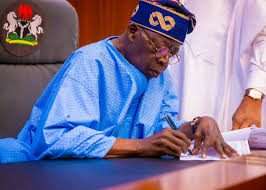
  • Economy: President Tinubu Enforces 60% Cut in Official Travels

    Economy: President Tinubu Enforces 60% Cut in Official Travels

    President Tinubu has taken a significant step towards curbing government expenditure by enforcing a sharp reduction in travel expenses for all government officials.

    This decision, disclosed by Ajuri Ngelale, the presidential spokesman, aims to reduce both domestic and international travel costs by 60%.

    Addressing State House Correspondents on Tuesday at the Presidential Villa in Abuja, Ngelale highlighted that the directive was a cost-cutting measure specifically targeted at official travels.

    The reduction in travel expenditure will not spare any government office, affecting the President, Vice President, First Lady, ministers, and their respective entourages.

    “This directive from Tinubu mandates a substantial reduction in state entourages,” Ngelale emphasized, clarifying that it is not a mere request but a firm directive from the office of the President. The move will impact the President’s office, the Vice President, and all appointees.

    The breakdown of the enforced travel reductions indicates a substantial decrease in the number of individuals allowed on both foreign and local trips:

    Foreign Trips:
    – President: 20 persons
    – Vice President: 5 persons
    – First Lady: 5 persons

    Local Trips:
    – President: 25 persons
    – Vice President: 15 persons
    – First Lady: 10 persons

    This directive signals a proactive effort by the administration to streamline expenses and ensure more prudent use of public funds in official travels, echoing Tinubu’s commitment to fiscal responsibility and efficient governance.