Tag: Dangote
-

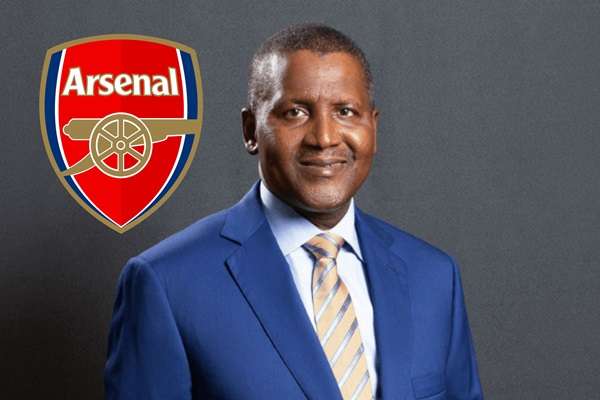
Why I Regret Not Buying Arsenal – Dangote
The President and Chief Executive of Dangote Group, Alhaji Aliko Dangote, has expressed his regret over not seizing the opportunity to purchase Arsenal Football Club when it was valued at approximately $2 billion.In an interview with Bloomberg’s Francine Lacqua, the billionaire businessman shared his aspirations of owning a football club, noting that he wished he had acted sooner on his interest in acquiring the English side.Dangote revealed that his decision to focus his resources on a major refinery project ultimately led him to miss out on the chance to invest in Arsenal, a move he now reflects on with disappointment.He said, “I think that time has passed. The last time when we had this interview, I told you as soon as I finish with the refinery, I am going to try and buy Arsenal.“But you know everything has gone up and the club too is doing very well, Arsenal is doing extremely well right now. That time Arsenal wasn’t doing well.“I think I don’t have that kind of excess liquidity to go and buy a club for $4 billion so to speak and use it as a promotional something.“But what I will do is to continually be the biggest fan of Arsenal. I watch their games anytime they are playing. So, I will remain a major supporter of Arsenal but I don’t think it makes sense today to buy Arsenal.”When asked if he regretted not buying when Arsenal’s value was lower, he said, “Actually, I regret not buying it before but you know my money was more needed in completing my project (Dangote refinery) than buying Arsenal. I would have bought the club for $2 billion but you know I wouldn’t have been able to finish my project. So, It was either I finish my project or go and buy Arsenal.” -
Our Priority Is To Eradicate Youth Unemployment -Dangote
Dangote Group’s Executive Director, Commercial Operations, Hajia Fatima Aliko-Dangote, has reiterated the company’s determination to eradicate the high youth unemployment in the country.
She said, it is only when youths are positively engaged, that the high insecurity problems in the country will fade away.
Fatima, who made this disclosure at the just concluded Lagos International Trade Fair during the “Dangote Day”, said since inception, the desire of the President of Dangote Group, Aliko Dangote, was to assist the three tiers of government in the country, in eradicating poverty, and the best way for Dangote Group to do this, will be to contribute to eradicating youth unemployment in the country.
Noting that Dangote is the highest employer of labour in Nigeria, outside the Federal Government, she said, the priority of the Group is to create more employment opportunities for the teeming Nigerian youths and make them breadwinners of their respective families.
According to her: “The desire of our President, Aliko Dangote, is to ensure that Nigerian youths are ably employed, because it is only when this happens, that they can also contribute their own quota to the growth and development of the county. And once the youths are also positively engaged, the security challenges of the country will abate.”
Fatima, further said the Group is passionate about deepening the Nigerian economy through industrialisation, job creation, provision and rehabilitation of essential infrastructure, and the welfare of the citizens. According to her, “It is the desire to promote industrialisation that informs our decision to become strategic partners with all the major Chambers of Commerce across the nation.”
She also said: “Our investment decisions at Dangote Group, are focused on creating values for all stakeholders. We have invested in several projects which are meant to create jobs and enhance the rapid industrialisation of the Nigerian economy. Dangote Cement Plc remains the continent’s foremost cement producer, with operations in 10 African countries.
“The activities of the cement company through its multiplier effect, provide direct and indirect employment to millions of people across Africa. Through its corporate social responsibility (CSR) interventions, Dangote Cement has touched the lives of thousands of people in host communities across Africa. The company has built schools, hospitals & clinics, roads, markets, and vocational training centres in host communities.”, she stated.
Reacting to what Fatima Aliko Dangote said, Dr Micheal Olawale-Cole, President of the Lagos Chamber of Commerce and Industry (LCCI), said Dangote Group has created jobs more than any known private sector operators in the Country.
He said the foremost indigenous conglomerate has contributed significantly to providing solutions to the problems of unemployment and by extension, to reducing the poverty levels among Nigerians.
He said the decision of the company to venture into oil and gas would permanently put an end to the issue of petroleum scarcity in Nigeria and contribute substantially to the GDP and the overall economic growth and development of Nigeria.
According to him, Dangote Group has been at the forefront of job creation even as its products and services have touched the lives of millions of people across the African continent and beyond. He then enjoined other corporate bodies to toe the line of Dangote in assisting the Government, through the provision of infrastructure, even if it must be through a tax credit scheme, introduced by the Federal Government.
-
Naira Devaluation: Dangote, 8 others take N113.63bn hit
Dangote Cement led eight other companies on the NGX in foreign exchange losses recording a significant foreign exchange loss of N113.63 billion, representing a 179.47 per cent year-on-year increase, the highest in the past five years as a result of the devaluation of the Naira.
The Naira went from N465/$ at the end of May 2023 to N756/$ in June 2023, resulting in a net exchange loss of N116.1 billion on third-party loans and payables within the Nigerian entities.
While some companies experienced significant declines in some performance indicators, others performed relatively better.
A review of the financial performance of Berger Paints, Beta Glass, BUA Cement, CAP, Dangote Cement, MEYER, Notore, and WAPC, reveals that among these companies, Dangote Cement, Notore, and BUA Cement, reported a combined foreign exchange losses of -N129.811 billion, while Beta Glass, CAP, and WAPCO reported an aggregate foreign exchange gain of N3.49 billion.
However, when considering the cumulative impact of foreign exchange fluctuations, it led to an overall reduction of 8.19 per cent in their total pre-tax profit, which amounted to N372.573 billion in the first half of 2023
Dangote Cement led in foreign exchange losses recording a significant foreign exchange loss of N113.63 billion, representing a 179.47 per cent year-on-year increase, the highest in the past five years.
According to the first half of 2023 financial notes, the net exchange loss on foreign-denominated transactions was primarily attributed to the sharp devaluation of the Nigerian Naira in June 2023.
These losses had a direct effect on the decline in pre-tax profit, which decreased from N264.89 billion to N239.86 billion during the reviewed period.
Notore also reported a substantial foreign exchange loss of N14.05 billion in the first half of 2023. Coupled with low revenue and a significant increase in finance costs, this contributed to a pre-tax loss of N38 billion, representing a 1,558 per cent decline.
The company managed to generate revenue of N7.92 billion, a substantial decline of 68.97 per cent for the first half of 2023.
BUA Cement reported a foreign exchange loss of N2.137 billion in the first half 2023, marking a significant year-on-year increase of about 103 per cent.
Coupled with elevated interest expenses, this dampened pre-tax profit, resulting in only a marginal increase of 2.75 per cent to N76.425 billion when compared to the first half of 2022.
WAPCO – Lafarge led the foreign exchange gainers, recording a N2.237 billion gain in foreign exchange. This contributed to a growth of 18 per cent in pre-tax profit.
However, despite this positive performance, the company experienced a year-on-year decline of 5.16 per cent in profit after tax, primarily due to high-income tax expenses.