Tag: Diplomacy

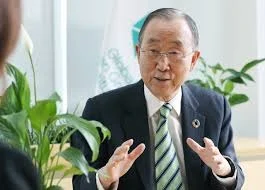
  • Ban Ki-moon Warns UN Risks Irrelevance Without Security Council Reform

    Ban Ki-moon Warns UN Risks Irrelevance Without Security Council Reform

    Former United Nations Secretary-General Ban Ki-moon on Tuesday challenged the Security Council to overcome deep rivalry and distrust, warning that failure to reform its practices, particularly the use of the veto, risks pushing the Organisation toward irrelevance or collapse.

    Speaking during an open Security Council debate on “Leadership for Peace,” Ban called on Council members to look beyond narrow national interests and support UN leadership capable of steering the world away from catastrophe and toward renewed cooperation.

    “The path of each for themselves is no different from the path of mutual destruction,” Ban told the Council.

    Now an emeritus member of The Elders, Ban said global conditions have deteriorated significantly since he left office at the end of 2016, marked by growing confrontation among major powers, weakening multilateralism and persistent conflicts in which civilians bear the heaviest costs.

    “This deeply disappointing situation is characterised by confrontation rather than cooperation among major powers,” he said, citing the war in Ukraine, mass civilian casualties in Gaza and the erosion of international cooperation even as the global climate crisis accelerates.

    Ban said the broader crisis confronting the international system cannot be separated from the Security Council’s own shortcomings.

    “The Security Council’s ongoing failure to properly function constitutes the most egregious cause,” he said, pointing to the repeated use of the veto by permanent members to shield themselves, their allies and their proxies from accountability.

    Without meaningful reform, Ban warned, civilians would remain unprotected and impunity would persist. “Without it, the UN risks lurching towards either collapse or irrelevance,” he said.

    Turning to the selection of the next Secretary-General, Ban urged Member States to consider adopting a single, non-renewable seven-year term, arguing that it would strengthen the independence of the office.

    The current practice of two five-year terms, he said, leaves Secretaries-General “overly dependent on this Council’s Permanent Members for an extension,” even though the arrangement is a convention rather than a requirement of the UN Charter.

    “The General Assembly holds the power to set the terms of the appointment itself,” Ban said, calling on Member States to exercise that authority to empower future UN leaders more fully.

    Secretary-General António Guterres’s second term expires at the end of next year, and the formal selection process is already under way. In November, the Presidents of the General Assembly and the Security Council jointly launched the process in line with General Assembly resolution 79/327, which emphasizes transparency and inclusivity.

    Under established procedures, candidates are nominated by Member States or regional groups and must submit a vision statement, curriculum vitae and disclosures on campaign financing. The President of the General Assembly convenes publicly broadcast interactive dialogues with candidates while engaging closely with Member States throughout the process.

    As of mid-December, Rafael Mariano Grossi, Director-General of the International Atomic Energy Agency, is the only candidate formally nominated, put forward by Argentina.

    Addressing the Council during the debate, Anjali Dayal, Associate Professor of International Politics at Fordham University, said the next Secretary-General would assume office at a moment of unprecedented strain for the United Nations, including a deepening funding crisis that is already reducing the Organisation’s capacity to deliver essential services.

    “That will result not just in shrinking this Organisation, but also in less of the work that only the UN can do at scale,” Dayal said, warning of fewer vaccinations, reduced humanitarian assistance and diminished mine-clearance operations even as global needs continue to grow.

    Dayal said history demonstrates that, even during periods of acute geopolitical division, the Security Council has been capable of selecting leaders who advanced peace and cooperation.

    She recalled the prolonged deadlock that preceded the appointment of Javier Pérez de Cuéllar in 1981 and the criticisms faced by U Thant, noting that both Secretaries-General played key roles in helping to end the Iran-Iraq war, advance peace efforts in Cambodia and Nicaragua, and manage crises such as the Cuban Missile Crisis.

    Those examples, Dayal said, illustrate that the Secretary-General’s influence lies less in material power than in the ability to shape ideas, narratives and long-term cooperation within the international system.

  • Shettima Departs To China For 3rd Belt, Road Forum

    Nigeria’s Vice President Kashim Shettima on Sunday departed the country to represent President Bola Tinubu at the 3rd Belt and Road Initiative (BRI) Forum in Beijing, China which is scheduled to hold between October 16 and 18.

    Mr Stanley Nkwocha, Senior Special Assistant to the President on Media and Communications, Office of the Vice President, disclosed this in a statement in Abuja on Sunday.

    Nkwocha said that Shettima would join world leaders from over 130 countries in Africa, Asia, Europe and Latin America to deliberate on the theme, “High-quality Belt and Road Cooperation: Together for Common Development and Prosperity.”

    According to him, the vice president is expected to avail Nigeria of the platform provided by the forum to woo investors for more developmental projects.

    Nkwocha added that the Vice President would hold bilateral meetings with other world leaders to promote Nigeria’s trade and investment relations in line with the economic development agenda of the Tinubu administration.

    “The 2023 edition of the BRI will mark the 10th anniversary of the Belt and Road Initiative (BRI) championed by the President of China, Xi Jinping, as an initiative for global infrastructure development strategy.

    “Adopted and launched by the government of the Peoples Republic of China in 2013.

    “The initiative seeks international action to enhance cooperation and promote infrastructure investment in nearly 70 countries across Asia, Africa and Europe through land and maritime routes.”

    He recalled that in 2018, former President, Muhammadu Buhari, on behalf of Nigeria, signed the Belt and Road cooperation agreement with China.

    “Nigeria and other partner-countries across the world are to benefit from the initiative in areas of infrastructure investments such as ports, skyscrapers, railroads, roads, bridges, airports, dams and coal-fired power stations.”

    Nkwocha said that the delegation of the vice president to the forum includes the Minister of Foreign Affairs, Amb. Yusuf Tuggar, Minister of Budget and Economic Planning, Atiku Bagudu and the Minister of Transportation, Sa’idu Alkali.

    Others are the Minister of Works, David Umahi, Minister of Industry, Trade and Investment, Dr Doris Uzoka-Anite; the Managing Director of the Nigeria Railway Corporation, Fidet Okhiria, and the Director-General, Infrastructure Concession Regulatory Commission, Michael Ohiani.

    In a related development, Nkwocha said in pursuance of the food security and diversification policy of the Tinubu administration, the vice president will, from China, depart for the United States of America, USA.

    “While in US as the special guest, Shettima will deliver a keynote address at the African Development Bank (AfDB) and World Food Prize – facilitated Norman E.Borlaug International Dialogue slated to commence on October 24th, 2023.

    “Also, he will join other African international leaders, Heads of State and Government who in the past have delivered keynote addresses at the Borlaug Dialogue.

    “They include former United Nations Secretary-General, Kofi Annan; World Food Prize Laureates; Ghana President, John Kufuor, AfDB President, Akinwunmi Adeshina and former President Olusegun Obasanjo and others.”

    The media aide also stated that Shettima was expected to highlight reforms being instituted in the Nigerian Agrifood sector by the Tinubu administration.

    “The vice president will engage several stakeholders, partners and investors in opportunities for investments in Nigeria.

    “Several meetings and engagements have been slated for the vice president who is expected to be back to the country after his commitments in the US.”