Tag: electoral reform

  • Peter Obi, Activists Protest at National Assembly Over Electoral Act Reform Bill

    Peter Obi, Activists Protest at National Assembly Over Electoral Act Reform Bill

    Presidential aspirant Peter Obi on Tuesday joined pro-democracy activists in a protest at the National Assembly, calling for a review of the Electoral Act Reform Bill currently under consideration by lawmakers.

    The protesters, made up of civil society groups and political supporters, gathered at the National Assembly complex in Abuja, expressing concerns that some provisions of the proposed legislation could weaken electoral transparency and accountability.

    Speaking during the protest, Obi urged lawmakers to ensure that any amendments to the Electoral Act strengthen the credibility of elections and protect the independence of the electoral process. He said the bill, in its current form, requires broader consultation with stakeholders.

    The demonstrators also called for greater public input, warning that poorly crafted reforms could erode confidence in future elections.

    Security operatives were deployed around the National Assembly, but the protest remained peaceful, with no reported incidents.

    As of the time of reporting, the National Assembly had not issued an official response to the demands raised by the protesters. Deliberations on the Electoral Act Reform Bill are ongoing.

  • Tinubu’s Silent Domination: A Threat to Nigeria’s Democracy

    Tinubu’s Silent Domination: A Threat to Nigeria’s Democracy

    By

    Editor

    President Tinubu does not need to threaten a “do-or-die” election. By capturing institutions, absorbing opposition structures, and weakening electoral safeguards, he is shaping the outcome long before voting begins. When referees are loyal and rules are rewritten, elections become ritual, not choice.

    The events of last Wednesday at the Nigerian Senate left a bitter and lingering taste in the mouths of many Nigerians. For a public already exhausted by broken promises and eroded trust, the handling of the 2026 Electoral Act Amendment Bill felt less like a disappointment and more like a confirmation of long-held fears. For weeks, citizens waited with restrained hope, believing, perhaps naively, that the Senate might finally take a step toward restoring confidence in governance and the electoral process. Instead, what unfolded appeared to be the final straw, a moment that exposed, in stark terms, where power truly lies and whose interests are being served.

    When Olusegun Obasanjo infamously described the 2003 election as a “do-or-die affair,” he revealed his mindset with startling clarity. It was the language of conquest, not consent; of domination, not democracy. The backlash was immediate, but the damage was irreversible. That election has since become a grim reference point, a reminder of what happens when incumbents abandon restraint and treat democratic competition as a personal survival exercise. Yet for all his brazenness, Obasanjo made one critical error: he spoke too plainly. He announced his intentions. He warned the public. And in politics, forewarning invites resistance.

    President Bola Tinubu has learned that lesson well. He has not threatened Nigerians with “do or die.” He has adopted a far more effective strategy: silent domination. There is no bluster, no dramatic declarations, no rhetorical excess. Instead, there is method, cold, patient, and systematic. Tinubu is not engaging in speculation or theatrics; he is locking down the very mechanisms that decide electoral outcomes. This is not opposition paranoia or conspiracy theory. It is observable, sequential, and intentional. Tinubu is not preparing to contest the 2027 election; he is preparing to control it.

    The foundation of this control is institutional obedience. Elections in Nigeria are no longer stolen primarily by ballot-box snatching; they are shaped long before voting begins, inside institutions that determine how votes are counted, challenged, secured, and enforced. Tinubu has therefore ensured that the most critical offices—the judiciary, electoral management bodies, the police, intelligence services, and military command, are headed by individuals whose loyalty is dependable and whose independence is, at best, compromised. This has nothing to do with merit or federal character. It has everything to do with predictability. When disputes arise, when injunctions are sought, when security decisions must tilt one way or another, the president does not want doubt. He wants alignment. In such a system, instructions need not be given. The expectations are already understood.

    Yet institutions alone do not guarantee victory; geography still matters. That is why the ruling party has pursued a ruthless campaign of political absorption across the country. Governors are defecting not out of conviction, but out of calculation. Nigerian politics is unforgiving to dissent and generous to surrender. Federal power is wielded as a weapon, through control of funds, security pressure, and administrative chokeholds. Faced with these realities, many governors have chosen capitulation over confrontation. The result is a weakened opposition and a ruling party that now controls the very state machinery responsible for administering elections. In Nigeria, whoever controls the states controls logistics, security coordination, and the practical implementation of electoral rules. This is not competitive democracy; it is political enclosure.

    Then came the most decisive move: rewriting the rules themselves. Nigerians had placed what little faith remained in technology as a shield against fraud. Electronic transmission of results was imperfect, but it disrupted decades of rigging culture by limiting human discretion at collation centres, the traditional graveyard of the popular will. That disruption made it dangerous. And so it had to be neutralized. The Senate’s decision to weaken electronic transmission and preserve manual handling of results was not the product of confusion or incompetence. It was deliberate. Lawmakers understood precisely what they were doing. They chose the system that allows figures to “change,” results to “adjust,” and outcomes to “emerge.” They acted openly, confidently, and without fear, because they know the system shields them from accountability.

    Calling the Senate a rubber stamp is no longer rhetorical excess; it is an accurate description. In that moment, the chamber made clear that it represents power, not voters. It did not fail Nigerians by accident, it betrayed them by choice. By dismantling electronic safeguards, it restored the most dangerous phase of Nigeria’s electoral process: the opaque journey between polling units and final collation, where votes lose meaning and manipulation thrives.

    Government defenders will insist, as always, that everything done was legal. They are correct, and that is precisely the danger. Authoritarianism in the modern age does not announce itself with tanks and decrees. It advances quietly, through laws, appointments, and procedural camouflage. It smiles, quotes the constitution, and pretends neutrality while suffocating competition. Tinubu’s approach may be legal, but it is fundamentally illegitimate. It drains democracy of substance while preserving its outward form.

    The real danger is not that Tinubu may win re-election. Incumbents often do. The danger is that Nigeria is sliding toward a system where elections exist without real choice, opposition exists without real power, and voters exist without real consequence. When outcomes are engineered in advance, participation becomes ritual. Citizens vote, but nothing changes. Tinubu does not need to rig ballots if he controls the referees. He does not need to intimidate voters if he controls collation. He does not need to threaten rivals if he absorbs or neutralizes them. This is domination without spectacle, power without noise, and manipulation without fingerprints, cleaner than Obasanjo’s blunt-force tactics, and far more corrosive.

    History is unforgiving to such arrangements. Before they collapse, they extract a heavy toll: public cynicism, voter apathy, institutional decay, and the slow suffocation of accountability. Nigeria has seen this story before, and it never ends well. The warning signs are glaring. The tragedy is not that they are subtle, but that those in power are pretending they do not exist.

  • Senate Approves Electoral Act Bill, Denies Scrapping E-Transmission

    Senate Approves Electoral Act Bill, Denies Scrapping E-Transmission

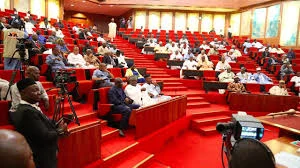
    The Nigerian Senate has approved the Electoral Act (Amendment) Bill, 2026, dismissing reports that lawmakers voted to scrap the electronic transmission of election results.

    The bill was passed on Wednesday after more than four hours of heated debate, particularly over the proposed amendment to Clause 60(3), which sparked widespread speculation on social media that the Senate had rejected real-time electronic transmission of results from polling units to the Independent National Electoral Commission’s Result Viewing Portal (IREV).

    Reacting to the controversy, Senate President Godswill Akpabio described the reports as inaccurate and misleading, insisting that the Senate did not vote against electronic transmission.

    “The Senate has not rejected electronic transmission of results,” Akpabio said shortly after the bill’s passage. “What we did was to retain the provision already in the Act, which permits electronic transmission and was applied in the 2022 elections. This Senate cannot afford to go backwards.”

    Debate on the contentious clause began around 2:00 p.m. and concluded at approximately 6:26 p.m., following concerns that a proposed amendment mandating presiding officers to transmit signed and stamped result sheets electronically to IREV in real time could introduce legal complications.

    Instead, lawmakers opted to retain the existing wording of the Electoral Act, which allows election results to be transmitted “in a manner as prescribed by the Commission.”

    Akpabio stressed that the decision does not eliminate electronic transmission from Nigeria’s electoral framework, adding that the provision remains valid and will continue to guide future elections.

    Similarly, Senate spokesperson Yemi Adaramodu said the Senate did not discard the committee’s recommendation on electronic transmission but avoided provisions that could create legal technicalities during election disputes.

    Adaramodu also disclosed that the amendment removed the power to declare a runner-up as winner in cases where a candidate earlier declared elected by the Independent National Electoral Commission (INEC) is later found to be unqualified to contest.

    Electronic transmission of election results has remained one of the most contentious elements of Nigeria’s electoral reform discussions since the 2023 general elections, with civil society groups and opposition parties advocating clearer legal safeguards to enhance transparency and public trust.

    Following the bill’s passage, the Senate announced the composition of a conference committee to harmonise its version with that of the House of Representatives. The committee will be chaired by Adeniyi Adegbonmire, with Tahir Monguno, Simon Lalong, Adamu Aliero, Orji Uzor Kalu, Abba Moro, Asuquo Ekpeyong, Aminu Abbas, and Tokunbo Abiru serving as members.

    Meanwhile, the Senate adjourned plenary until February 24, 2026, to allow lawmakers focus on the defence of the 2026 budget by ministries, departments and agencies (MDAs).