Tag: EMMANUEL MACRON

  • THE MIRAGE OF A FRENCH MILITARY BASE IN NIGERIA

    THE MIRAGE OF A FRENCH MILITARY BASE IN NIGERIA

    “So, it will seem like it is President Tinubu’s visit to France that is rattling Tchiani and he is scared of the possibility of discussions about Niger by the two Presidents. Since President Tinubu’s visit to France, the media space has been filled with rumors of French troops on our soil. Aside the AP video of 2013 in Mali, there is no evidence whatsoever to this outrageous claim.”

    By Tahir Ibrahim Tahir Talban Bauchi

    2027 has come so early with a groundswell of gimmicks and political manoeuvres that are being used to overheat the polity, and shape political opinion in favor of those angling to contest the 2027 elections. From the Samoa agreement fiasco, through to the tax reforms debates, we are now in the middle of a conversation about french invasion. A certain journalist who is notorious for spreading fake news and ending up presenting as a sick person in court when arraigned, was at his propaganda best, spreading the fake news of a french military presence in Nigeria. He was called out online by a security expert who pointed out to him that the soldiers in the said video were English, and that it was not the first time that the Nigerian military is collaborating with foreign personnel for training and similar programmes. He deleted his post after that. Now the Niger Head of state Abdourahamane Tchiani, President of the National Council for the Safeguard of the Homeland, CNSP, has come forward with allegations that the French government has a military base in Nigeria, and is harbouring and supporting the operations of terrorist cells with the active participation of the Nigerian government. Our ‘sick in court’ journalist and his cohorts have latched onto this once more and are milking it on behalf of the 2027 hopefuls.

    Who is Abdourahamane Tchiani? He is the presidential guard commander that betrayed President Bazoum and forcefully removed him from power on the 26th of July, 2023. Since his ascension to power, Niger has not witnessed meaningful developments that have justified his military coup. His supposed romance with Russia has not yielded any dividends as Russia is embroiled in a war with Ukraine, and practically the whole of Europe (or those that matter) and the US as foes. Tchiani has come to the crossroads where he has to come clean with his people. He has zilch on his scorecard, topped with a battle with rebels that want to ease him out. He is lost for words and ‘lost for action’ and does not have anything promising for his people. He is obviously not the hero he posed to be. He also does not have the support of his neighbouring countries. The economic support that is most crucial to his supposed transition to civilian rule. A drowning man they say will clasp onto a straw. Tchiani is drowning and he is looking for straws to latch onto. He is in search of protagonists to his lost cause. 

    The ECOWAS Commission, and the Nigerian Government have debunked his claims. The Information Minister and the National Security Adviser have also done so eloquently. The National Security Adviser has challenged him or anyone to provide proof of the claims of a french military base in Nigeria. Tchiani’s claims are quite porous anyway. His claims that the former Director of the National Intelligence Agency, Rufa’i Ahmed, is part of the operations linked to a terrorist group is a big lie to the high heavens. He probably thinks Rufa’i is still in charge. Meanwhile Rufa’i left the service in August of 2024. Tchiani is making his claims in December of 2024. Rufa’i is not in charge of the system anymore.

    Also, DailyTrust did us all a favor of fact-checking the video in circulation, which is being referred to as the evidence of French troops in Nigeria, and found out that the video was recorded in 2013 in Mali. The Nigerian troops seen were on a training mission under the auspices of the AU. This video was uploaded on Youtube in 2015. That is almost 10 years after. Nigerians are witnesses to the war on terrorism in Nigeria, including the war waged on the Lukarawa group, who have faced aerial bombardments from the Air Force. This is the group Tchiani is claiming that the Federal Government is using to fight him. Again, Tchiani’s claims do not hold up according to the border communities in Sokoto state who have also debunked Tchiani’s claims. He alleged that there is a forest called ‘Gaba’ where the french have their base in Sokoto. Those communities have denied the existence of any forest called Gaba in their areas. In fact the district head of Ilelah said that the Nigerien military officials come in from Niger to work with their vigilantes in maintaining peace and order in their communities. This was disclosed during a fact check by DailyTrust. There are no french troops in the border communities between Nigeria and Niger.

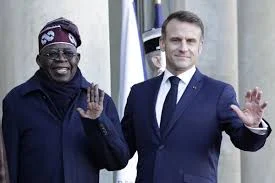
    The US had asked Nigeria for permission to build a military base long ago and it was refused. The UK who are our colonial masters have not built a military base in Nigeria. Nigeria has a better diplomatic relationship with the UK and the US. How will Nigeria entertain a French military base in the country? To incubate and propagate terrorism? The UK would sit and watch such incursion? Mr. President was hosted officially in France recently and his visit was to woo French investors into the country. There were no defence or security pacts. President Tinubu and President Macron have a personal relationship that spans over 25 years, back to when President Macron was a junior officer in the French embassy in Lagos.

    So, it will seem like it is President Tinubu’s visit to France that is rattling Tchiani and he is scared of the possibility of discussions about Niger by the two Presidents. Since President Tinubu’s visit to France, the media space has been filled with rumors of French troops on our soil. Aside the AP video of 2013 in Mali, there is no evidence whatsoever to this outrageous claim. Tchaini feels Nigeria is working with France to oust him. He doesn’t understand that Nigeria’s priority is to quench the fire of terrorism in its homeland, and not Niger’s. Nigeria’s concern is to woo investors, and not partake in military misadventure. As soon as the people of Niger realise that Tchiani has actually nothing to offer them, they will rise against him. If the people don’t, his military constituency will.

  • Ribadu Denies Foreign Military Presence in Nigeria Amid Niger Tensions

    Ribadu Denies Foreign Military Presence in Nigeria Amid Niger Tensions

    Nuhu Ribadu, Nigeria’s National Security Adviser, has dismissed accusations by Nigerien Abdoulrahamane Tchiani that foreign military forces, including those from France, are operating in Nigeria.

     Ribadu’s comments came in response to allegations made by Tchiani, who claimed that Nigeria was collaborating with France to destabilize Niger. 

    This has added to the rising tensions between the two nations, particularly after Niger, along with Mali and Burkina Faso, chose to leave the Economic Community of West African States (ECOWAS).

    Speaking in an interview with BBC Hausa, Ribadu refuted Tchiani’s claims, stating there are no foreign military installations or troops in Nigeria. 

    He encouraged journalists to visit the locations mentioned by the Nigerien leader and speak with local residents to verify the absence of any foreign military presence.

    The National Security Adviser emphasized that the real issue facing both countries is the common threat posed by terrorists, particularly the insurgent group Lakurawa, which has been wreaking havoc in the region. 

    Ribadu further expressed that instead of focusing on accusations, both nations should collaborate to address security concerns that affect their shared borders. 

    He also stressed the long-standing relationship between Nigeria and Niger, describing the people of both countries as “brothers” and calling for unity in tackling mutual challenges. 

    Ribadu reassured that Nigeria would continue to work with Niger in the spirit of regional cooperation and development.

    The diplomatic tension between Nigeria and Niger follows the latter’s decision to leave ECOWAS, which has led to a broader political and economic rift.

     Despite the disputes, Ribadu’s statements reflect Nigeria’s commitment to strengthening ties with its neighbors in West Africa to combat terrorism and foster regional stability.

  • SYRIA AND NIGERIA AT HISTORY’S CROSSROADS

    SYRIA AND NIGERIA AT HISTORY’S CROSSROADS

    Syria’s a classical case of a country that first died in the hearts and minds of its people long before the erosion started manifesting in the physical. It was decades in the making and it was obvious except to those who benefited from the rot. It is about the same thing in Nigeria with the country falling apart in the eyes of everybody except in the eyes of the ruling elite. The demise of a country begins with the erosion of its people’s sense of identity, purpose and connection to the homeland.

    SYRIA is an enigma. It has always been from ancient times including the era preceding the writing of the Holy Bible by some inspired persons. We will have to contend with time and space if we tried to explore the enigmas of that country in detail. In spite of its current travails, Syria remains a mystery notwithstanding its rich history, cultural diversity, and fractious, indeed, tumultuous politics. It might as well be that the aforementioned traits are the reasons for the mystery of that Middle East country. Well before Damascus, the capital of this historic country fell last week to the many rebel groups that besieged it, it had been losing territory inch-by-inch and day-by-day. But the loss of territory on its own does not necessarily lead to the demise of a country or to a regime change. A country or a regime dies faster when there’s a disconnect with the citizens. That was the lot of Bashar al-Assad who suddenly fled from Syria after his family had ruled the country with iron fists for more than half a century.

    Syria’s a classical case of a country that first died in the hearts and minds of its people long before the erosion started manifesting in the physical. It was decades in the making and it was obvious except to those who benefited from the rot. It is about the same thing in Nigeria with the country falling apart in the eyes of everybody except in the eyes of the ruling elite. The demise of a country begins with the erosion of its people’s sense of identity, purpose and connection to the homeland. The clear implication is that the decline of a country is not just a physical or economic phenomenon, but a psychological and emotional one too. There’s no doubt that a country’s strength and resilience are deeply rooted in the collective consciousness of its citizens. When people lose faith in their country, its institutions, and its values, the very fabric of that country is bound to unravel. This was, probably still is, the case with Syria. And it speaks to the situation in Nigeria today. Is our country at risk, given the manifest disconnect between Nigeria’s ruling elite and sections of its population, especially the majority of the younger generation who feel disaffected by the direction the country is headed? Is implosion inevitable given the obduracy of our rulers? Can it yet be headed off? Is anything being done now or has anything been done in the last 25 years of the fourth republic to salvage the country or are more grievous things being done to savage it? Time will tell.

    “…when a country dies in the souls of its citizens, as appears to be the case of Syria under the successive Assad family regimes, and as it seems to be applying to Nigeria, it leads or can lead to a range of negative consequences. It can trigger social unrest and violent agitations as happened in Syria that have led to the fall of the regime and an uncertain future for the country. Citizens become increasingly frustrated, resort to protests, unrest and violence as Nigeria has been witnessing…To many fellow citizens, the Renewed Hope mantra of the Tinubu regime is a bad joke.”

    Let’s attempt to speak to why the fall of the Assad regime in Syria and the uncertainty about the future of that country should be of concern to Nigeria, Nigerians and their rulers. As in Syria but for different reasons, there’s a significant and growing loss of national pride because many Nigerians no longer feel a sense of pride and ownership of their country. It’s increasingly becoming a case of ‘us versus them’. As in Syria also there were things that hitherto held our people together in the past. Now there’s a disconnect from whatever is left of the things that could be considered as values and principles that used to define us. A significant portion of Nigerians are emotionally detached from the country, including from its history, culture, and traditions. You may do well to ask that teenager or tweenager (children in their 20s) next to you who is not an heir to a plum political office or to private wealth what they feel about our country. Kemi Badenoch, leader of the opposition Conservative Party in the United Kingdom, is a typical diaspora Nigerian who holds the citizenship of another country. She has been in a spat with Nigeria’s vice president Kashim Shettima over comments she made about Nigeria. She represents a typical diaspora Nigerian – acute frustration with the state of our country. It’s baffling that Shettima chose to interject in Kemi’s expression of frustration. My people would say that ‘onaghi adinma ka madu di ka ihe ejiri ko ya onu’. You don’t need to behave like a mad person just because someone said that you are mad. The only way Shettima can shame Kemi is for him to be an example of altruistic leadership in our country. For now we’ll ignore Kemi’s expressed Yoruba bonafide and her slur in distancing herself from a part of the country and their sectarian contribution to Nigeria’s lingering insecurity. Could this be a pointer that Nigeria is actually dying in the hearts and minds of its citizens?

    Syria ravaged by war

    And when a country dies in the souls of its citizens, as appears to be the case of Syria under the successive Assad family regimes, and as it seems to be applying to Nigeria, it leads or can lead to a range of negative consequences. It can trigger social unrest and violent agitations as happened in Syria that have led to the fall of the regime and an uncertain future for the country. Citizens become increasingly frustrated, resort to protests, unrest and violence as Nigeria has been witnessing. A disconnection with a country makes people vote with their feet through indiscriminate migrations sometimes through hazardous routes including deserts on foot, and oceans using dinghy boats. Some more desperate ones try to flee by inserting themselves inside tyre and cargo holds of Europe, Asia or American-bound commercial aircraft. It also accounts for brain drain where talented individuals choose to leave the country to seek better opportunities elsewhere. We live in an era where well trained and skillful compatriots abandon their otherwise respectable jobs and businesses here to travel abroad where they waste their talents by engaging in menial jobs. The life of an average Nigerian is defined by frustration, desperation, despondency and lingering hopelessness. To many fellow citizens, the Renewed Hope mantra of the Tinubu regime is a bad joke.

    “Is Seyi also being prepared for the presidency after his father or sometime later. Before Hafez al-Assad died he took Bashar to France and handed him over to the then French president Jacque Chirac. Hafez told Jacque to treat Bashar as his own son and to help the young man become president of Syria. Jacque Chirac delivered when Hafiz died. Now Tinubu enjoys a difficult to explain association with France and romance with its president Emmanuel Macron. And our president has a politically ambitious son, Seyi.”

    When your best brains flee, the country could experience economic decline, a lack of investment, dearth of innovation, and lacklustre entrepreneurship. Indeed, there could be economic stagnation which could spike the crime rate and make individuals and corporations unsafe. Even the government will be compelled to spend more money to combat crime. When this happens investment will be imperiled and the provision of infrastructural facilities will suffer since the money for their provision will be channeled to fighting crime and criminals. It’s a vicious cycle. Our country is showing signs of these ailments. When a country loses its place in the hearts and minds of its citizens, it stands the risk of loss of its sovereignty. This scenario could be far-fetched in the case of Nigeria. But a weakened country in terms of governance and national security could become vulnerable to external influences that could threaten its independence.

    Nigeria is weakened in governance and this is compounded by conjectures that the critical mass of its leadership could be assets of powerful foreign countries. Gradually, Nigeria is ticking the boxes of everything that could prove fatal to its well-being. Not too long ago, no other person than a former military ruler and later an elected civilian president, Olusegun Obasanjo, while in the United States of America warned that Nigeria was barreling towards a failed state. But Nigerian rulers are adept at living in denial. It gives them comfort because it’s blissful. It postpones the day of reckoning. So it was not strange when the extant regime promptly and vigorously dismissed the assertions of Obasanjo. But Obasanjo was not alone in raising concerns about the declining status and stature of our country in the comity of nations, and the emerging signs of state capture. Other prominent citizens have spoken in that regard.

    Syria and Nigeria may share some things in common but they are two different countries, in different parts of the world, and which have followed different trajectories in their aspirations for growth and development. Nigeria’s aspiration to growth and development may actually have been in reverse gear for many years. It was heightened during the eight disastrous years of Muhammadu Buhari (2015-2023). In Syria Hafez al-Assad died of cancer. His preferred son and heir apparent Bassel had died earlier in a car crash in 1994. So his despised second son Bashar was quickly drafted and recalled from his training as a doctor in England, and groomed for rulership. He assumed the presidency when his father died and started off as an economic and political reformer. But when Syrians demanded more freedoms and political reforms, Bashar dropped the baton and returned to the playbook of his father – use of the sledgehammer. For years he maimed and killed his people until he lost grip and fled to Russia for asylum. History is replete with the certain fate of every ruler that resorts to iron fists.

    Nigeria does not yet have a father-to-son-to-grandchild rulership template. But who says it cannot happen here. It starts with state capture and some political commentators are already persuaded that we are headed in that direction. Seyi is the son of president Tinubu. He is said to be preparing to be the governor of Lagos state in 2027. That’s a legitimate aspiration. But of greater note is that he is a permanent fixture in the delegations of the president’s foreign trips. He is often at the head of protocol standings in foreign lands, usually in front of ministers, diplomats and, other Nigerian state officials. Is Seyi also being prepared for the presidency after his father or sometime later. Before Hafez al-Assad died he took Bashar to France and handed him over to the then French president Jacque Chirac. Hafez told Jacque to treat Bashar as his own son and to help the young man become president of Syria. Jacque Chirac delivered when Hafiz died. Now Tinubu enjoys a difficult to explain association with France and romance with its president Emmanuel Macron. And our president has a politically ambitious son, Seyi. But I do not think that there’s any dots to connect. Only that I have since dropped the notion that certain things cannot happen here. I did so for the good of my mental health.

    Ugo Onuoha, Veteran Journalist & Foundation Member of FICAN, He was Managing Director/Editor-in-Chief, Champion Newspapers Ltd

  • Despite rejection by Neighbours, Nigeria Seals €300m Deal with France

    Despite rejection by Neighbours, Nigeria Seals €300m Deal with France

    Even as former colonies disengage from her choking hold, President Tinubu is in a warm embrace with France, signing, on Thursday in Paris, two agreements worth over €300 million.

    Presidential resources reveal that the deal is aimed at advancing critical infrastructure and food security in Nigeria. 

    The agreements were formalized during President Bola Tinubu’s state visit to France, which included a key economic forum at the Palais des Élysée in Paris.

     The event brought together leaders from both countries, including business executives, governors, and top officials, to discuss the future of their partnership.

    The agreements focus on several key sectors, including agriculture, transportation, healthcare, and renewable energy, with the goal of addressing pressing challenges and fostering sustainable growth across Nigeria.

    Nigeria’s Minister of Finance, Wale Edun, and French Minister of Economy, Finance, and Industry, Antoine Armand, signed a Letter of Intent outlining plans for collaboration in these critical areas.

     The package will be distributed across Nigeria’s geopolitical zones, ensuring that all regions benefit from the financial and technical assistance.

    In addition, the financial cooperation will support Nigeria’s ambitious development projects in urban infrastructure, MSMEs, and food security. 

    As part of the deal, the French Development Agency (AFD) committed to funding agro-logistic hubs and other initiatives to improve energy access, agriculture, and small business support.

     The cooperation will also focus on enhancing educational opportunities, especially in STEM fields, to better prepare Nigeria’s workforce for future challenges.