Tag: FDI

  • President Tinubu returns from another foreign trip

    President Tinubu returns from another foreign trip

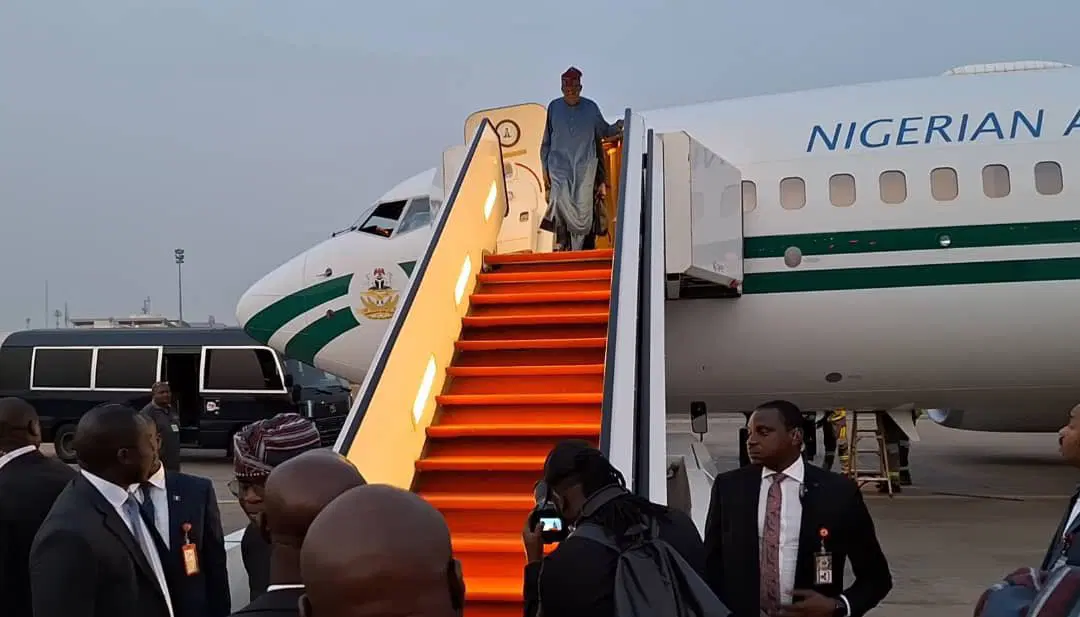
    President Bola Tinubu returned from his three-day official trip to Equatorial Guinea yesterday. This makes it his 22nd foreign trip barely 15 months after assuming office, May 29th, last year.

    Like his predecessors since 1999, the President is reported to be embarking on these trips in hot chase of Foreign Direct Investment (FDI) into various sectors of the resource rich Nigerian ecosystem.

    During this last trip, Tinubu and his Equatorial Guinean counterpart, Teodoro Mbasogo, were reported to have signed an agreement on the Gulf of Guinea Pipeline Project.
    The agreement covers legislative and regulatory measures for the gas pipeline, establishment and operation, transit of natural gas, ownership of the gas pipeline, and general principles.

    In previous engagements, two Nigerian companies were reported to have signed Memoranda of Understanding with German counterparts in November 21, 2023 for gas supplies.

    In one of such agreements, it was stated that a certain Nigerian company named Riverside LNG would collaborate with the German company Johannes Schuetze Energy Import AG to provide 850,000 tons of liquefied natural gas to Germany annually. The president’s office stated that gas exports would rise in the coming years, with the first delivery of gas anticipated in 2026.

    Presidential Spokesperson, Ajuri Ngelale, in an earlier interview on Channel TV talked about how President Tinubu:

    “… is personally conducting an open-door policy to investors from around the world, … to ensure that they have direct access to all of the regulators and government officials that will further enhance the environment in which foreign direct investments will be coming into the country,”

    The President and his team are also seeking investments in other sectors such as electricity, rail transportation, agriculture and others.

    Before President jets out to another oversea destination for what some term as an elusive chase for FDI, experts advise for greater introspection and more strategic outreach, seeing as such forays by previous administrations had remained a wild goose chase.

    As one analyst put it, “investment money is a very discerning guest that goes only to where it is welcome.”


  • Tinubu attending G20 Summit in India to attract FDI – Presidency

    President Bola Tinubu is attending the G20 Summit holding from September 9-10 in New Delhi, India to attract private capital for the development of the nation’s critical infrastructure, the Presidency has said.

    Mr. Ajuri Ngelale, Special Adviser to the President on Media and Publicity, who disclosed this at the weekend, said the summit was predicated on the urgent need to attract Foreign Direct Investment into the country.

    The Group of Twenty (G20) is the premier forum for international economic cooperation.

    It plays an important role in shaping and strengthening global architecture and governance on all major international economic issues.

    Ngelale said that the president would focus attention on meetings with business executives of the world’s most valuable companies to discuss investment in the critical sectors of the economy for the creation of employment.

    “We are focused on engagements that will be dealing with critical sectors of the national economy, involving steel development, electricity generation, transmission and distribution, shipyard building capacity, and several other industries, which we know to be labour intensive.

    “Mr President will be hosting a CEO roundtable, which will be made up of more than 20 chief executive officers of major industries across multiple sectors of the Indian economy to ensure that we leverage on their interest in investing in the country.

    “In addition, there will be at least five meetings with the CEOs of five major industries in India, including Jindal Steel and Power Company, among a few others that would have a very important impact on our ability to develop the steel sector in our country,’’ Ngelale said.

    He said that Tinubu would also meet with the President of Brazil, President da Silva, German Chancellor Olaf Schultz, Indian Prime Minister Narendra Modi, South Korean President Yoon Suk Yeol, and a few other heads of state on the sidelines of the G20.

    “The G20 is a major event for our country at this time and we are going to ensure that we take maximum advantage of the opportunities presented to bring value to the country.

    “To create jobs for our people and ultimately, to generate and expand existing revenues in the country to ensure the government can effectively fund and sponsor its programmes and policies across sectors.

    “When we arrive in India next week, there will be live updates from India, which I will be providing daily to ensure that Nigerians have full access into what our President is doing on their behalf,’’ he said.

  • Nigeria’s FDI drops to $469m in 2022 – AfDB

    Nigeria’s FDI drops to $469m in 2022 – AfDB

    The African Development Bank (AfDB) has said that foreign direct investment inflows into Nigeria fell to $469 million in 2022 from about $8.8 billion in 2011.

    Describing it as the lowest in a decade, AfDB’s Director General, Nigeria Country Department, Mr. Lamin Barrow, noted in Abuja that Nigeria’s private sector is hamstrung by policy inconsistencies and implicit taxation. 

    According to him, “many private sector firms in Nigeria are overburdened byimplicit taxes; they provide their own electricity, sink boreholes to get access to water, and repair roads in their towns and neighborhoods.”

    Speaking on “Trade and Non-Oil: Changing the Narratives for Rapid National Development” at the 2023 Nigeria Employers’ Summit, Barrow said closer collaboration and dialogue between the Federal Government and the private sector is critical to policy making and position Nigeria as an ideal investment destination. 

    The AfDB chief said that a vibrant and competitive private sector can accelerate diversification of the economy and boost exports.

    Over the years, successive administrations have mouthed economic diversification without matching it with action.

     He said that the unification of the exchange ratemanagement system and the removal of fuel subsidies, has shown that the government was ready to engage in bold reforms that will transform the country into an economic powerhouse.  

    “If the Federal Government implements bold strategies to take advantage of investment and market access opportunities. Rising labor costs and technological upgrading in countries such as China, India, and Brazil offer an excellent opportunity to developing economies, including Nigeria, to attract FDI and diversify their exports,” he said.

    Barrow further said that trade offers a great opportunity to further diversify the Nigerian economy.

    According to him, with the coming into force of the African Continental Free Trade Area, Africa is becoming more integrated, with a larger market for exports from Nigeria. 

    “Developing regional infrastructure and putting in place the requisite trade policies are a necessary condition for tapping opportunities in the regional and international markets. 

    “A good starting point is the effective utilization of Trade Agreements to which Nigeria is currently a signatory. However, Nigeria’s trade policies should prioritize the promotion of value-added exports. 

    “The significance of the non-oil exports in driving inclusive growth, sustainable development job creation, especially for the women and youth, cannot be overemphasized,” Barrow explained.