Tag: Nigeria politics

  • NASS Puts INEC on the Spot Over ₦873.78bn 2027 Election Budget

    NASS Puts INEC on the Spot Over ₦873.78bn 2027 Election Budget

    Nigeria’s next general election may be one year away, but the battle over its price tag has already begun.

    The Independent National Electoral Commission (INEC) has projected a staggering ₦873.778 billion to conduct the 2027 general elections — a figure that immediately triggered pointed questions and heightened scrutiny at the National Assembly.

    INEC Chairman, Prof. Joash Amupitan, presented the projection while defending the Commission’s ₦171 billion 2026 budget proposal before the Joint Committee on Electoral Matters. He was emphatic: the ₦873.78 billion earmarked for 2027 is separate from the 2026 allocation, which is meant to fund routine activities such as off-cycle governorship elections, by-elections, voter registration updates, logistics, and administrative operations.

    But lawmakers made it clear that separating the figures does not soften the impact of the headline number.

    Nearly ₦1 Trillion — and Counting?

    Amupitan further disclosed that the ₦873.78 billion projection does not include a fresh request from the National Youth Service Corps (NYSC), which is seeking an upward review of allowances for corps members deployed as ad-hoc election staff.

    That revelation raises a critical possibility: the final cost of the 2027 elections could climb even higher.

    With inflationary pressures, rising logistics costs, security challenges, and technological upgrades expected ahead of the polls, legislators signaled that Nigerians deserve clarity on every naira proposed.

    Lawmakers Draw the Line

    Chairman of the Senate Committee on INEC, Simon Lalong, assured the Commission of legislative cooperation but stressed that support would not translate into a blank cheque.

    He indicated that the National Assembly would rigorously examine the assumptions behind the projection, demanding detailed breakdowns and measurable benchmarks to justify the enormous public expenditure.

    Similarly, Chairman of the House Committee on Electoral Matters, Bayo Balogun, pledged backing for credible elections but delivered a pointed warning: INEC must avoid overpromising and underdelivering.

    Balogun cautioned that operational failures, procurement irregularities, or unrealistic commitments would not be excused under the weight of a near-trillion-naira budget.

    Transparency or Trouble

    Members of the joint committee reiterated that the credibility of the 2027 elections will depend not only on logistics and technology but also on fiscal discipline. With public trust in institutions often tested during election cycles, lawmakers emphasized that transparent budgeting, early planning, and strict oversight are non-negotiable.

    The message from the National Assembly was unmistakable: INEC will get the support it needs, but every kobo must be accounted for.

    As preparations for 2027 quietly gather pace, one thing is clear: the politics of funding the election may prove just as intense as the election itself.

  • NAHCON in Turmoil as Usman Resigns, Stakeholders Demand Total Overhaul

    NAHCON in Turmoil as Usman Resigns, Stakeholders Demand Total Overhaul

    Nigeria’s Hajj industry is once again under intense scrutiny following the resignation of Prof. Abdullahi Usman as Chairman and Chief Executive Officer of the National Hajj Commission of Nigeria (NAHCON), with stakeholders calling for a comprehensive overhaul of the commission.

    Usman’s resignation, which takes effect Monday, was announced on Wednesday in Abuja. He cited personal reasons for stepping down after about 14 months in office.

    However, industry experts argue that his exit reflects deeper structural and political tensions that have continued to destabilize the commission.

    Recurring Leadership Changes Raise Concern

    Within the last two years, NAHCON has witnessed three leadership changes, a trend stakeholders describe as troubling for the stability of Hajj operations.

    Alhaji Zikrullah Hassan served as NAHCON Chairman from December 2019 to October 2023 following his appointment by former President Muhammadu Buhari.

    During his tenure, the commission navigated the challenges of COVID-19 restrictions, introduced the Hajj Savings Scheme, and established the Hajj Institute of Nigeria.

    Hassan was replaced by Alhaji Jalal Ahmad Arabi, appointed by President Bola Tinubu on Oct. 17, 2023, for a four-year term. Arabi was later removed amid an investigation into alleged misappropriation of funds released for the 2024 Hajj exercise.

    Following those allegations, Tinubu appointed Usman in October 2024. His tenure, however, was marked by internal disputes and allegations concerning financial management during the 2025 Hajj, generating public scrutiny and tension within the commission.

    “Campaign of Calumny” — Experts React

    Abubakar Jiddah Usman, a Hajj industry expert, said the frequent leadership changes highlight entrenched discord within and outside the sector.

    “Yes, Prof. Abdullahi Usman has resigned. Whether voluntary or forced is immaterial,” he said.

    “What remains indisputable is that anyone overseeing the Hajj industry in Nigeria faces a campaign of calumny from within and outside the sector. Within two years, NAHCON has changed leadership three times. Shall we continue this way?”

    He dismissed claims that Usman lacked administrative competence, arguing that fluency in Arabic or clerical background had never been a defining criterion for success in managing Hajj operations.

    “To argue that modern Hajj operations require less Arabic fluency is baseless. Were previous chairmen deficient in administrative skills?” he queried.

    He added that past chairmen also faced allegations ranging from abuse of office to political interference, suggesting systemic issues rather than individual shortcomings.

    Call for Sole Administrator

    Another expert, Abdullahi Mohammad, advocated for a radical administrative intervention.

    According to him, NAHCON requires a “no-nonsense” reform strategy, potentially through the appointment of a sole administrator with full authority to restructure the commission.

    “The administrator must insulate the Hajj process from material interests and political interference. Only a radical administrative reset can restore diligence, transparency and service to pilgrims,” he said.

    Concerns Over 2026 Hajj Operations

    Muhammed Ibrahim, Coordinator of Independent Hajj Reporters, described Usman’s exit as unfortunate but not unexpected, noting that most pre-Hajj activities, including registration and airline contracts, had already been completed.

    “Given the discord, it may be best to allow the chairman step down to avoid conflicts affecting pilgrims,” he said.

    He recommended that an experienced insider oversee ongoing operations to ensure continuity until after the Hajj, when a substantive appointment can be made.

    Operators Lament Slot Allocation Issues

    Alhaji Abdullateef Yusuf, President of the Association for Hajj and Umrah Operators of Nigeria, pointed to challenges surrounding the allocation of additional Hajj slots.

    “Many members paid millions for hotels and tickets in Saudi Arabia, amounting to billions of naira. Slots promised were later withdrawn, and there is still no clarity. Our operators are in serious limbo,” he said.

    He urged the government to appoint a calm, reputable and experienced individual with integrity, warning against politically motivated appointments.

    Tinubu Nominates New Chairman

    In response to the resignation, President Tinubu has nominated Ambassador Ismail Yusuf as the new Chairman and Chief Executive Officer of NAHCON.

    The nomination, subject to confirmation by the Nigerian Senate under Section 3(2) of the NAHCON Act 2006, was conveyed in a statement by presidential spokesman Bayo Onanuga.

    The President confirmed that he had written to Senate President Godswill Akpabio seeking expeditious confirmation of the nominee.

    Ambassador Yusuf is a career diplomat who served as Nigeria’s Ambassador to Türkiye from 2021 to 2024.

    As stakeholders await Senate action, many insist that beyond leadership changes, what NAHCON urgently needs is structural reform to restore credibility, transparency and stability to Nigeria’s Hajj operations.

  • Peter Obi, Activists Protest at National Assembly Over Electoral Act Reform Bill

    Peter Obi, Activists Protest at National Assembly Over Electoral Act Reform Bill

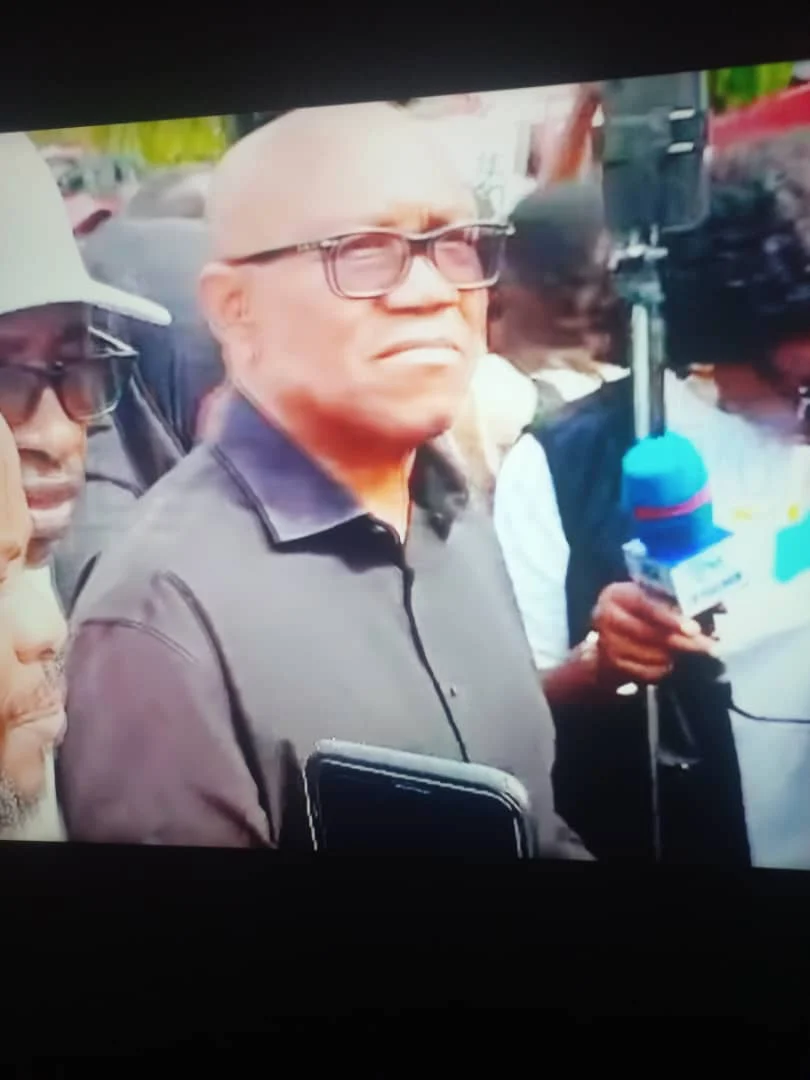
    Presidential aspirant Peter Obi on Tuesday joined pro-democracy activists in a protest at the National Assembly, calling for a review of the Electoral Act Reform Bill currently under consideration by lawmakers.

    The protesters, made up of civil society groups and political supporters, gathered at the National Assembly complex in Abuja, expressing concerns that some provisions of the proposed legislation could weaken electoral transparency and accountability.

    Speaking during the protest, Obi urged lawmakers to ensure that any amendments to the Electoral Act strengthen the credibility of elections and protect the independence of the electoral process. He said the bill, in its current form, requires broader consultation with stakeholders.

    The demonstrators also called for greater public input, warning that poorly crafted reforms could erode confidence in future elections.

    Security operatives were deployed around the National Assembly, but the protest remained peaceful, with no reported incidents.

    As of the time of reporting, the National Assembly had not issued an official response to the demands raised by the protesters. Deliberations on the Electoral Act Reform Bill are ongoing.

  • Senate Moves to Increase FG Revenue Share, Cites Security Burden

    Senate Moves to Increase FG Revenue Share, Cites Security Burden

    The Senate has commenced legislative action to amend the 1999 Constitution in a bid to increase the Federal Government’s share of national revenue, arguing that the current allocation formula is no longer capable of sustaining the country’s mounting national obligations.

    At present, the Federal Government receives 52.68 per cent of the nation’s revenue, while the 36 states get 26.72 per cent and the 774 local government councils receive 20.60 per cent.

    The proposed amendment is contained in a bill sponsored by Sunday Karimi, which passed first reading during plenary on Tuesday.

    Addressing journalists after the session, Karimi said the existing revenue sharing arrangement has become grossly inadequate for the Federal Government, especially in the face of deepening infrastructure collapse and worsening security challenges nationwide.

    He maintained that the formula, which has remained largely unchanged for years, no longer reflects current realities and places disproportionate financial pressure on the Federal Government.

    “The revenue allocation formula is outdated and unsustainable. It fails to provide the Federal Government with sufficient resources to meet its constitutional responsibilities,” Karimi said.

    He pointed to the deplorable state of federal roads across the country, noting that the burden of construction, rehabilitation, and maintenance continues to rest squarely on the Federal Government despite dwindling funds.

    Karimi also highlighted the escalating cost of internal security, stressing that massive resources are being channelled into combating banditry, terrorism, and other violent crimes threatening national stability.

    According to him, persistent funding gaps have weakened the capacity of the military and other security agencies to effectively prosecute the war against terrorism.

    “The Federal Government is stretched thin. The responsibility of safeguarding lives and property, maintaining critical infrastructure, and preserving national unity cannot be met under the current revenue framework,” he said.

    The senator argued that increasing the Federal Government’s share of national revenue would provide the financial leverage needed to reinforce security operations, repair critical infrastructure, and stabilise governance at the centre.

    The move is expected to reignite intense debate within the Senate of Nigeria, as well as among state governments and local councils, many of which have consistently opposed any reduction in their revenue shares.

    If passed, the proposed constitutional amendment would represent a major shift in Nigeria’s fiscal structure and could significantly redefine the balance of financial power among the three tiers of government.

  • Akwa Ibom Assembly Denies Outrageous Bill to Jail Women Over Married Men!

    Akwa Ibom Assembly Denies Outrageous Bill to Jail Women Over Married Men!

    A viral social media post claiming that the Akwa Ibom State House of Assembly is planning to pass a law jailing women for sexual relationships with married men has been categorically dismissed as false and misleading.

    The post, reportedly shared by Facebook user Obiavel Albert Abigo, alleged that Deputy Governor Sen. Akon Eyakenyi was sponsoring the bill, which supposedly would punish women with 10 years in prison and impose a ₦2 million fine on men.

    But the House has hit back hard. In a strongly-worded statement on Monday, Jerry Otu, Chairman of the House Committee on Information, described the report as a “fabrication with no legislative basis”.

    He emphasized that the Assembly has never received, discussed, or considered any such bill, and that the Deputy Governor has no involvement whatsoever.

    “This is a malicious attempt to tarnish the image of both the Deputy Governor and the House of Assembly,” Otu said. “We urge the public to disregard this fake news and any commentaries circulating alongside it.”

    Otu further reassured citizens that the House remains firmly committed to its constitutional role of lawmaking, and warned that such mischievous reports will not undermine its integrity or distract from its legislative duties.

    This incident highlights the growing problem of viral misinformation, particularly on social media, where outrageous claims can spread faster than facts.

    The Akwa Ibom Assembly’s prompt rebuttal is a reminder to always verify news before sharing, especially when it concerns sensitive issues that can damage reputations.

  • Why Nigeria is not working

    Why Nigeria is not working

    By

    UGO ONUOHA

    THE safe thing to do is to say that Nigeria is not working at its optimal best. But that will amount to playing the ostrich. Because the reality is that our country is not working, not at all, not even for the ruling political and economic elites who currently think that they are having a swell time. If only they knew how much more they would be better if the right things were to be done to make this country work for the majority of its citizens. Sadly, the understanding of our elites (and this is a wrong label for them) is limited, warped, myopic, and parochial.

    It has to be acknowledged that the roles of elites, whether political, economic, or intellectual, in nation-building anywhere can be a mixed bag of the good, the bad, and the ugly. The sad reality in our case is that the impacts of Nigeria’s elites on the country over time have gravitated between the bad and the ugly. Any semblance of the elites doing good to the society started and ended in the first republic, 1960-1966. In varying degrees the political elites in that republic represented by the numero uno, Dr. Nnamdi Azikiwe, Chief Obafemi Awolowo, and Sir Abubakar Tafawa Balewa, among others, were the elites who significantly positively impacted the country. Their impact was not just in wresting independence from Britain, but in growing the regions through healthy rivalry and dedication to serving the public good. In this category of service we had Dr. Michael Okpara (Premier of the Eastern region), Chief Dennis Osadebay (Premier of the Mid-Western region), Chief Awolowo (Premier, Western region), and Sir Ahmadu Bello (Premier, Northern region). They have not come any better since then.

    The first republic had its own drawbacks and a plethora of crises one of which led to the military coup and counter coup of 1966, and then to a bloody civil war. But in many respects that period could be described as Nigeria’s golden era. The respective political elites took governance seriously and drove the development of their regions. For instance, the Western region under Awolowo was renowned for the introduction of universal free education at the primary and secondary school levels, a policy which still resonates up till today and which transformed the lives of many, especially the indigent. It was also during that period that the Eastern region with Okpara at the helm was acknowledged as the fastest growing economy of any subregion anywhere in the world. Each region had something that was going for it. Many of the enduring institutions in the country currently can be traced back to that era including universities and teaching hospitals, stadiums, industrial layouts, housing estates, and many more. Of course, human capital formation through access to quality and affordable education at home and abroad remained unrivalled.

    We need to accept that the coups of 1966, and the long stretch of military dictatorships over about 33 years with civilian rule interregnums, took a heavy toll on the building of civil political culture. The lack of trust by the politicians in the military rulers compounded the problem. For instance, in the late 1990s when the last military dictator, Gen. Abdusalami Abubakar, promised to hand over power to civilians, not many people in the political class believed him. The nightmare of the shifting or fluid hand over dates of the military president, Ibrahim Badamasi Babangida, and the attempted transmutation of Gen. Sani Abacha from a military dictator to a civilian president made the political class doubt the sincerity of the juntas. In the wake of the unbelief of traditional politicians in the military’s transition programme ahead of the 1999 elections, some charlatans moved in and seized Nigeria’s political space. Motorpark touts, advance fee fraudsters [419ners], loafers, jetsams and floatsams, persons of dubious and questionable characters, and sundry elements moved in and filled the void. Has it not been proven that nature abhors vacuum.

    These characters got themselves elected into offices wherever the superintending military rulers of the transition, such as the presidency, had no preferred candidates. Early in this republic, a retired ranking police officer who was also a lawmaker said that many of his erstwhile colleagues in the national assembly [NASS] were fraudsters. He claimed that he had participated in probing and arraigning some of them in court. It was also during that period that some Nigerians fled from the United States and other places to Nigeria as fugitives. They contested and won elections mostly into governorship and legislative offices. Once inside government, they started looting the commonwealth, amassing wealth, and consolidating power. Overtime, more of the criminal types joined the early birds in their vice grip on politics, power, and government. Twenty – six years after the start of this dispensation, there are still criminals, especially advance fee fraudsters and fugitives from the law from the US embedded in Nigeria’s Three Arm Zone which houses the National Assembly, Presidency, and the Judiciary. The same applies in some governors mansions in many of our geopolitical zones and state legislatures. This is one other reason why Nigeria is not working.

    Yusuf Musa is the CEO of the Kaduna – based Centre for Contemporary Studies [CCS]. He wrote recently that “nations do not collapse merely because a global power intervenes” as American president, Donald Trump, has been threatening to do to Nigeria. He said that they collapse “because their internal foundations had weakened so badly that intervention (becomes) possible, profitable (and) convenient”. Musa submitted that vulnerable nations were usually first “hollowed out by their own internal contradictions and domestic mismanagement”. If Nigeria is at the precipice, and all indications are that it is, then the problem has to be down to lingering internal contradictions and gross mismanagement of its diversity by the successive ruling political elites. For instance, more than half a century after, the wounds of the Nigeria – Biafra civil war are still festering. Reconciliation has been difficult to attain simply because there has been no commitment to it by the victors. The same applies to rehabilitation of the defeated Biafrans. Of course, lip service had been paid to the reconstruction of the areas devastated by bombs and other munitions during the war.

    Every major component of the country bears one unresolved grudge or the other against the other components. The northern region still will not let go of the killing of their political and military leaders in 1966; untill recently the western region grumbled about being left out of political power in the centre for years; the Midwestern region is suspicious of everybody; and, the many minority nations of the country are perpetually under the fear of being dominated by their bigger neighbours. So Nigeria is essentially made up of centrifugal forces pulling in different directions. Nobody trusts anybody. A nation cannot be forged from a collection of peoples who do not trust one another, a people with almost irreconcilable world views, a people with diverse and contradictory cultural and religious backgrounds, and a people with self-serving and predatory political and governing elites. Primitive accumulation appears to be the only common thread binding the elites.

    How do we expect this country to grow when there’s no Nigerian in the true sense of the word. We are first of all Igbo, Yoruba, Hausa, Efik, Ijaw, tiv, Idoma, Ika etc. before becoming Nigerians. Our rulers do not help the matter. If an Hausa man is born and raised in the heart of Igbo land, say Owerri in Imo state, goes to school there, work in a paid employment or founds a business, marries an Igbo woman, raise a family, pay his taxes there, he remains an Hausa person. He will never be from Imo state. Indeed, the government constantly reminds us of who we are and where we come from. To illustrate, if you have a need to fill a form for any public or private institutions, one of the requirements is likely to be a question on your state of origin. The same applies when filling out a questionnaire for national census or headcount. You may have been born and resident in Maiduguri, Borno state all your life, but you are compelled to write and identify with a state you may not have been to simply because your parents were originally from that state. If as a Yoruba man you’re married to an Igbo woman, and your wife desires to contest for elective position, she will by law including the 1999 Constitution (as amended) be required to go back to her so-called state of origin and seek out the appropriate constituency to consummate her political aspiration. A similar thing also obtains in appointive offices. How do we forge a nation from this incongruities?

    But the more damning evidence that Nigeria is not working is the prevalent attitude of Nigerians to Nigeria. This attitude is worse among the younger generation. To an extent it also applies to the middle aged and the older folks. Nigeria as a country counts for little or nothing in the hearts and minds of many so-called Nigerians. There’s no sense of belonging. There’s no sense of ownership. There’s no stakeholder mentality. To many, Nigeria is a strange place, and there’s a growing feeling of being trapped in a space that’s increasingly becoming unfamiliar and troubling. And our rulers, by commission or omission, do not help the citizen to make a sense of the situation. The prevalent feeling is that this country might just be on a journey to nowhere. In Igbo it appears to be “ebe oku nyuru awusa owa”, or wherever the candle light flickers out, we drop the stick and move on.

  • Give Tinubu benefit of doubt, Uwaleke appeals to Nigerians

    Professor of Finance and the Capital Market at the Nasarawa State University, Uche Uwaleke, has called on Nigerians to give President Bola Ahmed Tinubu the benefit of the doubt.

    The President had in a nationwide broadcast on Monday in Abuja, reeled out a number of measures meant to cushion the effects of the removal of fuel subsidy.

    In his inauguration speech, the President said fuel subsidy was gone forever. According to him, his administration would rather channel the savings from the subsidy removal into other critical sectors of the economy.

    In his broadcast, the President said his administration has proposed the sum of N75 billion to fund enterprises at 9% interest per annum; N125 billion to energize MSME; release 200,000 Metric Tonnes of grains; 225,000 metric tonnes of fertilizer,  seedlings, and other inputs to farmers; and N50 billion each to cultivate 150,000 hectares of rice and maize.

    Also, the federal government will also make available N50 billion each to cultivate 100,000 hectares of wheat and cassava, N100 billion to acquire 3000 units of 20-seater CNG-fuelled buses and review the minimum wage.

    Uwaleke said: “The President’s address to the nation is quite soothing.

    “He spoke in clear terms and I think Nigerians should allow him the benefit of the doubt.”

    The first Professor of the Capital Market in Nigeria was however concerned that President Tinubu failed to tell Nigerians how the executive will also make sacrifices.

    “But it was short on how the three arms of government will share in the pains of the governed, especially with respect to affecting a significant cut in the cost of running government,” he asked.