Tag: political reform

  • Benue South and the Politics of Listening: Inside Hon. David Olofu’s Unusual Town Hall

    Benue South and the Politics of Listening: Inside Hon. David Olofu’s Unusual Town Hall

    By

    Dahiru Ali

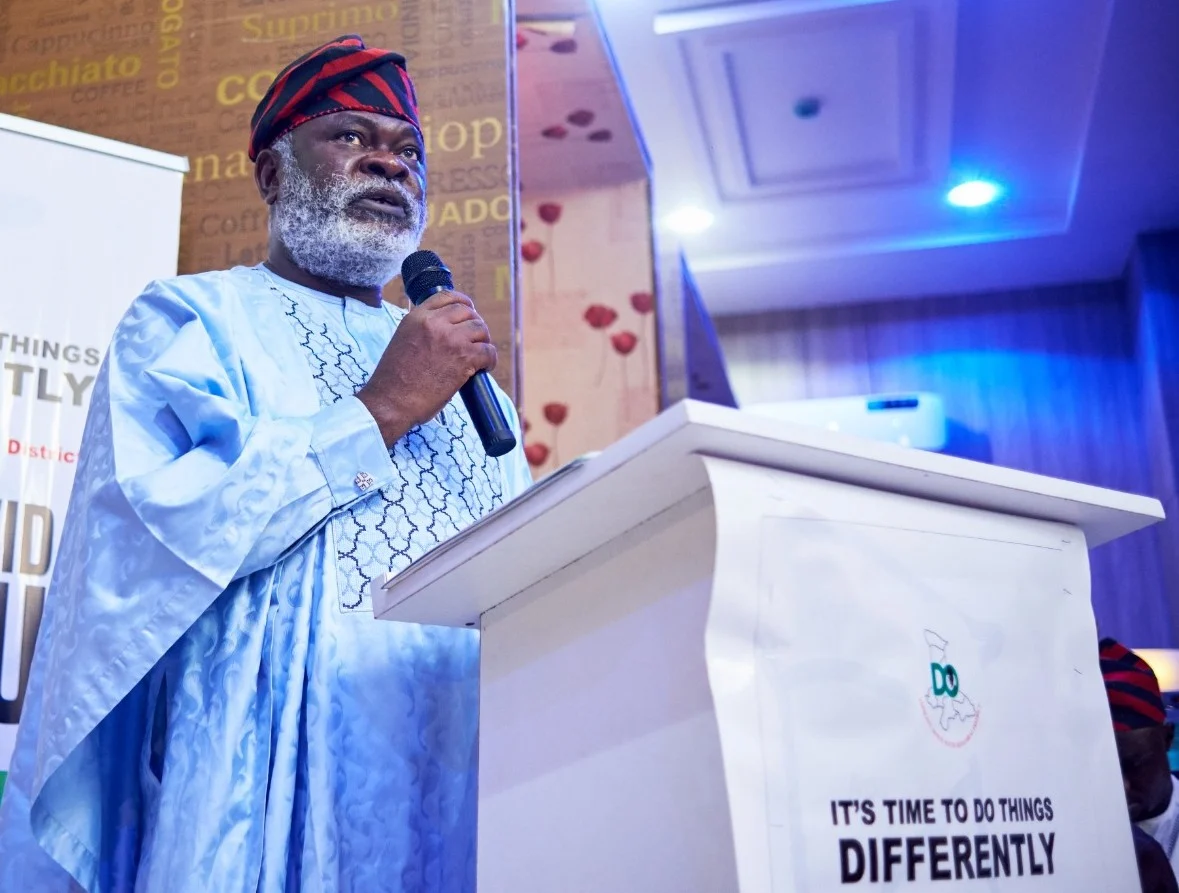
    In a political culture long defined by monologues, Hon. David Olofu’s interactive session held last Friday at the serene Armed Forces Officers’ Mess and Suite, near Lungi Barracks, Abuja felt disarmingly different. It was not a rally. It was not a coronation. It was, quite deliberately, a conversation.

    For many in attendance, that alone marked a departure from the norm. Never before, participants said, had a senatorial aspirant from the district convened such a broad gathering of Idoma elders, former legislators, academics, technocrats, professionals, and youth leaders, not for endorsement, but for interrogation. One participant described the audience as “the crème de la crème of Idoma sons and daughters,” brought together to think, not applaud.

    The meeting carried the mood of a long-delayed beginning, quiet, deliberate, and heavy with expectation. In a country where citizens often encounter power only after decisions have been made, the symbolism of listening first was not lost on anyone in the room.

    A Deliberate Tone

    Proceedings opened with prayers by Pastor Omale, lending solemnity to what would become an unusually reflective political engagement. Dr. Adakole Elaija moderated the session with steady restraint, while respected figures such as Venerable Akp’olofu and Barrister John Ochoga anchored the event with moral and legal weight.

    The welcome address by Prof. David Salifu, former Secretary to the Government of Benue State, set the intellectual tone. Drawing on history, he recalled how the Idoma people began “hearing from the horse’s mouth” as far back as 1865 in Czarist Russia, an evocative metaphor for direct engagement and political awareness. The message was clear: this was not to be politics at a distance.

    Dr. Elaija reinforced that framing, describing Hon. Olofu’s aspiration as rooted in equity, fairness, and justice, values he argued must define any serious effort to reposition Benue South in the national equation.

    Naming the Problem Without Evasion

    When Hon. David Olofu spoke, he avoided flourish. Instead, he offered a blunt diagnosis. Years of moving through communities across Benue South, he said, had revealed a stubborn reality: poverty in its most pervasive form. Poor schools. Weak healthcare. Crumbling infrastructure. Limited opportunity.

    These conditions, he argued, are not isolated failures but symptoms of deeper structural neglect. Benue South’s underdevelopment, in his telling, is less about absence of effort and more about absence of equity. Representation, he insisted, must go beyond presence in Abuja to sustained advocacy that delivers tangible outcomes.

    Equality as a Political Project

    Guided by the principles of People, Power, Prosperity, and Progress, Hon. Olofu outlined a twelve-point legislative and advocacy agenda. At its core is a single, insistent demand: equal treatment of senatorial districts in national policy, budgeting, and resource allocation.

    Although senatorial districts are constitutionally equal, he noted, practice tells a different story. Some districts attract infrastructure, investment, and federal attention; others are left to stagnate. Correcting this imbalance, he said, would be a defining priority of his tenure.

    “There is no fairness, equity, or equality among senatorial districts nationwide,” he stated plainly, promising to press the issue consistently within the National Assembly.

    From Policy to Practical Outcomes

    Beyond advocacy, Hon. Olofu presented a development blueprint that cut across sectors. Education, he said, must be reimagined as social engagement, with a deliberate shift toward science, technology, engineering, and mathematics. Healthcare reform would focus on upgrading Primary Healthcare Centres to strengthen access at the grassroots.

    Agriculture featured prominently, framed not as subsistence but as a pathway to industrialisation and shared prosperity. Mechanised farming, beginning with land clearing, would anchor this shift. Entrepreneurship and SME support, particularly access to capital, were identified as engines for expanding commercial activity across the district.

    The aspirant also placed strong emphasis on ICT, proposing hubs and incubation centres to channel youth creativity into productive enterprise. Infrastructure renewal, local government reforms, and insecurity rounded out the agenda. On security, he called for a review of existing laws and the establishment of a command-and-control coordination system in Otukpo.

    Redefining Representation

    What most distinguished the session, however, was Hon. Olofu’s approach to governance itself. Rejecting the idea of representation as a solo act, he proposed institutionalised citizen participation through the creation of a Benue South People’s Assembly to monitor project implementation, and a Benue South Council to provide advisory input and early warning signals.

    Under these bodies, thematic working groups would help shape legislative priorities, ensuring that governance remains responsive rather than remote. It was an approach many present described as rare in Nigeria’s political space.

    Industry, energy, strategic partnerships, diaspora engagement, and women, youth, and sports development were also highlighted as essential to human capital development and long-term economic revival.

    The audience listens in rapt attention

    The Room Responds

    The floor discussion was candid. Hassan Sale described the agenda as ambitious but urged the aspirant to sharpen priorities and remain focused on district-wide needs rather than narrow community concerns.

    Dr. Odatche, Convener of the Benue Rebirth Movement, commended the interactive format and encouraged sustained focus on agriculture, ICT, sports, and youth development as levers for social change.

    Participants also raised politically charged questions: How many terms does Hon. Olofu intend to serve if elected? What is his position on lobbying for the creation of Apa State? The questions underscored the seriousness with which the audience engaged the process.

    Beyond Party, Toward Purpose

    As the session closed, one sentiment cut across party lines. The Idoma nation, speakers agreed, has an opportunity to make a decisive statement in Zone C, not merely through electoral numbers, but through clarity of purpose and unity of voice.

    In the end, Hon. David Olofu’s interactive session did not promise miracles. What it offered instead was something rarer: the politics of listening, the discipline of inclusion, and the possibility that representation, properly imagined, can still mean something. Whether that promise survives the heat of electoral politics remains to be seen. But for a few hours in Benue South, the conversation itself felt like progress.e South, the conversation itself felt like progress.

  • We must reset our political values to restructure Nigeria -Prof Odinkalu

    The former Chairman of the National Human Rights Commission (NHRC), Prof. Chidi Anslem Odinkalu, has called for a resetting of the country’s value system which, according to him, will culminate in a restructuring of Nigeria.

    Odinkalu argues that the process of resetting Nigeria must start with addressing the country’s values problem, which requires a new kind of leadership that is national in outlook.

    Odinkalu, who is a visiting professor at Harvard University, maintained that for effective resetting to be accomplished, the process must begin with paying attention to political values that underpin coexistence in the country.

    The human rights activist, made these submissions in Abuja while speaking as a guest lecturer at the 10th-anniversary lecture of Just Friends Club of Nigeria.

    Speaking on the topic “Resetting Nigeria” he posited that if we cannot restructure our values, we cannot restructure a Nigeria that is equitable and just.

    The Prof emphasized that the theme, “Resetting Nigeria” is pregnant with more questions than illumination.

    First, it implies that Nigeria was already set without disclosing who did so. Secondly, it suggests also that the initial setting is flawed, imperiled, or spent, without indicating why, when or how this happened. Thirdly, it suggests that this old setting now needs reworking but does not say who will do it, why they are qualified for that task or from whence they derive their mandate to do so.

    He submitted that as a leader, we got to understand the diversity of this country and chose leaders who understand the diversity.

    “Many explanations have been proffered for Nigeria’s current unhappy condition: corruption, violence, impunity, among others. I want to suggest that these are symptoms, not the underlying problem.

    “Two decades ago, Chinua Achebe declared that ‘the trouble with Nigeria is simply and squarely a failure of leadership’, and argued that ‘Nigerians are corrupt because the system under which they live today makes corruption easy and profitable.

    “As a supplement or complement to this, I propose shortly to suggest that we have a structural crisis in our political economy indexed as it is on allocation rather than production.

    “This is an important point to make to a gathering of professionals. The defects of this fundamentally flawed political economy are compounded by a long-established ethics of deliberate political innumeracy”.

     “As a political economy, we specialize in fraudulent counting and accounting, legitimized post-hoc by the instruments and skills of the law.

    “To preserve our innumeracy of public accounts, we have used everything from coercive instruments to commissions of inquiry whose reports have never been seen. In over half a century as a country, we have never held a credible census.

    “To legitimize the outcome without addressing the underlying malfeasances, we establish Census Tribunals. In the same period, we have struggled to undertake credible elections. For each flawed election, we establish an Election Petitions Tribunal, procuring judicial legitimacy for returns that have been – in most cases – fundamentally flawed,” he lamented.

    Odinakalu recalled various past avoided trajectories of the country and the deliberate choice of her leaders not to do the right things and warned of dire consequences.

    “The only way to avoid those consequences is to come to terms with the reality that the country needs to be re-set. That re-setting, however, must begin with attention to the political values that underpin coexistence in the country.

    “But addressing this values problem requires a new kind of leadership that is national in outlook. That is where we must begin and in this, associations like the JFCN have a significant role to play,” he stated.