Tag: President Tinubu

  • UAE President to Visit Nigeria in 2025 

    UAE President to Visit Nigeria in 2025 

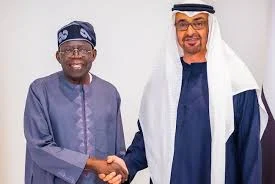
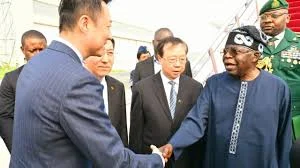
    The President of the United Arab Emirates, Sheikh Mohamed bin Zayed Al Nahyan, will visit Nigeria this year. 

    He accepted an invitation extended by Nigerian President Bola Ahmed Tinubu during a meeting on the sidelines of the Abu Dhabi Sustainability Week 2025.  

    President Tinubu, who arrived in Abu Dhabi on Sunday, participated in the global forum, which addresses challenges such as climate change, water, and energy issues. 

    On Wednesday, he shared Nigeria’s views on these matters and praised the UAE for hosting a successful event.  

    During their discussions, the UAE President expressed interest in strengthening economic ties with Nigeria. Both leaders discussed ways to attract investment into Nigeria. 

    President Tinubu highlighted his government’s recent reforms, which he said have improved the economy and drawn billion-dollar investments from foreign companies.  

    The meeting took place at the Emirates Palace Mandarin Oriental in Abu Dhabi, with top officials from both countries in attendance. 

    The Nigerian delegation included Ministers Yusuf Tuggar and Wale Edun, as well as National Security Adviser Nuhu Ribadu.  

    The UAE delegation featured senior officials like Sheikh Abdullah bin Zayed Al Nahyan and Dr. Sultan bin Ahmed Al Jaber.

  • Remember the sacrifices of your fallen heroes – group urges Nigerians

    Remember the sacrifices of your fallen heroes – group urges Nigerians

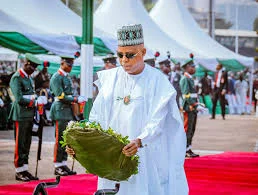
    The Centre for Wounded Servicemen and Fallen Heroes Support Fund (CFWS&FHSF) has urged Nigerians from all sectors to remember the sacrifices and valour of fallen military heroes.

    The group’s Board Chairman, Retired Gen. Cecil Esekhiagbe, made the call in a statement on Wednesday in Abuja, marking the upcoming 2025 Armed Forces Remembrance Day.

    January 15 is observed annually as Armed Forces Remembrance Day to honour fallen heroes who made the ultimate sacrifice for the country.

    Esekhiagbe described the day as an opportunity to reflect on the courage, dedication, and selflessness of these heroes, emphasising that their sacrifices highlighted the true cost of freedom and the high price paid for the nation’s liberty.

    He also encouraged Nigerians to show support for the families of fallen and wounded servicemen.

    Esekhiagbe prayed for the families of the fallen heroes, asking God to provide them with strength and peace.

    “We will never forget the service they gave; we owe them an incalculable gift of gratitude, “he said.

    The Board Chairman commended President Bola Tinubu, the Military Service Chiefs, and other security heads for their role in securing the nation, especially highlighting the successes under Tinubu’s leadership in combating security threats.

    He lauded the military’s efforts in addressing the Lukurawa insurgency in the North-West and noted the military’s success in containing terrorist groups such as Boko Haram.

    Esekhiagbe also acknowledged the sacrifices of soldiers and security personnel, including the Nigerian Army, Police, DSS, and NSCDC, who continue to work tirelessly to protect the nation.

    He expressed heartfelt sympathy for the families of fallen heroes, particularly widows and orphans, underscoring the critical role these individuals played in ensuring the safety and security of all Nigerians.

    “Their sacrifice will never be in vain,” he assured.

  • Tinubu To Grant Presidential Pardons 

    Tinubu To Grant Presidential Pardons 


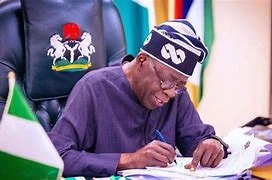
    The Nigerian government has announced its intention to grant presidential pardons to certain convicts in correctional facilities across the country. 

    To implement this, a Presidential Advisory Committee on the Prerogative of Mercy was inaugurated in Abuja on Wednesday.  

    This committee, led by Attorney-General and Minister of Justice Lateef Fagbemi, includes representatives from the police, correctional services, human rights organizations, and religious bodies like the Nigerian Supreme Council for Islamic Affairs and the Christian Association of Nigeria. 

    Legal professionals such as Justice Augustine Utsaha and Prof. Nike Ijaiya are also part of the team.  

    The Secretary to the Government of the Federation, George Akume, explained that the initiative is based on the 1999 Constitution, which gives the President authority to grant clemency to federal offenders. 

    The committee, with a four-year tenure, will guide the President in this process to ensure justice and fairness.  

    Fagbemi noted that many applications for pardons have been submitted and promised a thorough evaluation.

     The committee will also visit correctional centers in different regions to identify cases deserving of clemency.

     After completing their work, they will present recommendations to the President for final decisions.

  • Peter Obi and Tinubu’s APC’s morbid line

    Peter Obi and Tinubu’s APC’s morbid line

    My brother and friend Emeka Duru, a member of the reverred Nze na Ozo fraternity in Orlu, Imo state, said in the title of his article last week in the Niche online publication that ‘Peter Obi is not the issue’ afflicting the floundering regime of Nigeria’s president, Alhaji Bola Ahmed Tinubu and his special purpose All Progressives Congress (APC) clueless ruling party. In the old order, unblemished integrity and fidelity to the truth are some of the irreducible minimums for admission into the Igbo Nze na Ozo clan. Sadly, these requirements for membership appear to be receding as some young men of dubious character and questionable wealth have invaded that rarefied association ostensibly in their quest for legitimacy, relevance and acceptance. Today, many Igbo men and youngsters who are living thousands of kilometres away from the Igbo homeland simply send money home to their relatives to purchase the title of Nze or Ozo, and membership of the club. But I know Nze Emeka Duru. I know he lives here and he associates closely with the people of the ancient Orlu Kingdom where he comes from. He is honest, he is truthful, to the extent that any typical human being can be. If he makes a mistake it will be that of the heart, not the head. And he made a mistake in the title of his article which I referenced above when he wrote that Peter Obi was not the issue. The blurb in the said article which I alluded to said Nigerians needed issues of hunger and poverty holding them down to be tackled. That they needed assurances of a better future for their children. That they needed adequate security for their businesses and properties. That these were the issues that matter to the citizens. The point is that these things enumerated by Duru are exactly the issues that Peter Obi speaks to, and hammers on, to the discomfiture of our current rulers. And because those are the issues that Obi forcefully and relentlessly calls attention to, he has become an irritant to this band of insensitive rulers. He has, therefore, become the issue. So Peter Obi is the issue. They ignore him at their own peril. They take him out also at their own peril. Head or tail they lose. The rulers are in-between and in-betwixt.

    Obi is not a typical Nigerian politician in spite of his being a two -term governor of the south east state of Anambra, and a presidential running mate at another election. So when after the Nigerian Supreme Court legalised the controversial, some would say fraudulent, 2023 presidential election, and Obi said he would not abandon the pursuit of his quest for the realisation of a better Nigeria, not many people took him seriously. The expectation was that he would grumble and make noise for a few months, slip into oblivion, lose traction with his base of mostly young people, go abroad to catch his breath and attend to his health and business, and possibly return close to the next election in 2027 to once more stake his claim to the presidency. None of the expectations came to pass. And no sitting regime, especially that which has been burdened with a lingering perception of illegitimacy, and so many warts and baggage, will not feel irritated and angry at the ‘effrontery’ of Peter Obi. Not many rulers in a third world country like Nigeria will be comfortable with any citizen calling them out for inflicting pains and privations on the vast majority of the people. How can a man whom the electoral agency and the courts had judged that his alternative vision for the country had been rejected by the Nigerian electorate remain so popular and relevant? How could it be that the voice of the same man who was said to have been spurned by the majority of the voters still carried so much weight and resonated across the country two years, next month, after the election? It’s irreconcilable. It just does not make any sense. He should be stopped. The high decibel ‘noise’ from a man with a naturally tiny voice must be muzzled.

    So what happened recently with Felix Morka, national publicity secretary of the APC, was natural and expected, though weird. It’s typical that when one party in a debate loses the argument, they resort to abuse, intimidation, threat, and violence – first verbal and then physical violence. Morka and his band in the APC are at the first stage of verbal violence. And what they have done was to serve a notice that their regime will not be shy in moving to the next phase. The use of the phrase “crossing the line” by Morka on Obi was intentional, thought – through, deliberate, and collectively considered and agreed upon by the APC enforcers and executioners. For them it is enough for Obi. Words carry weight and meaning. It’s especially so in a fledgling anti-democratic dispensation such as ours is rapidly turning into. It does not matter whether the threatening words and warnings were muttered in a sober or in a menacing manner. And in this instance, Morka was menacing. He could not hide the fact that the APC is frustrated by the rankling failures of its successive administrations since 2015, first with that serial bungler and affliction of Nigeria, Maj.Gen. (rtd) Muhammadu Buhari, and now the clueless Tinubu who appears to enjoy the contours of pain on the faces of the majority of Nigerians. We had very early predicted the trajectory of this regime. It is headed by a pseudo -democrat. This has been manifestly obvious since his sojourn in partisan politics. Except for deception or the fun of it, vigorous debates of policies have not been his forte. Baba sope or the master has spoken associated with him since after his governorship was not invented out of thin air.

    So many discerning people knew from the onset that the Lagos democracy template would be exported to Abuja when he was declared the winner and beneficiary of the presidential election about two years ago. It is no surprise, therefore, that the principle of co-equal arms of government in a federal system as ours is designed to be now exists only in name. The Executive approximates the federal government. The national legislature and the judiciary are suborned by an emergent imperial presidency. There could still be remnants of courageous judges but they are a vanishing tribe. The so-called national assembly is now irredeemable. The leadership and followership of the national assembly (NASS) have repeatedly proclaimed that they exist and work at the pleasure of the president, and that whatever the Executive branch asked them to do should be taken as done. The fusion of the Executive, Legislative and Judicial arms of our government into one is virtually concluded. There are no longer opposition lawmakers in NASS in terms of offering alternative visions for governance, or raising their voices against oppressive policies including using public money to fund lavish and ostentatious lifestyles. How can they when they are also beneficiaries of the largesse and the profligacy by their government. By the way, many of the opposition lawmakers, especially of the Labour Party (LP) have since abandoned ship and joined the ruling party. The party and partying must go on.

    Obi’s latest act of ‘treason’, according to the APC, was that he spoke to Nigerians through the mass media to mark the new year. He spoke to many issues affecting Nigerians including insecurity, poverty, inflation, mindless borrowing by the present administration, poor education, dilapidated health facilities, death traps that passed as roads and highways across the country, misplaced priorities by the ruling party, the insensitivity of the ruling elite, grotesque and unconscionable lifestyles of those in government at all levels, a comatose economy, and the prospects of further deterioration in the living standards and living conditions of the vast majority of our people. Almost everybody who is somebody but who’s not at the APC banquet table has said the same or similar things. There’s a consensus that the prognosis for this country in terms of the future material condition of our citizens is not good. If this be the case then, the sin that Obi committed was adding his voice to the possible disastrous outcome from the government’s chosen path and economic policies.

    So many discerning people knew from the onset that the Lagos democracy template would be exported to Abuja when he was declared the winner and beneficiary of the presidential election about two years ago. It is no surprise, therefore, that the principle of co-equal arms of government in a federal system as ours is designed to be now exists only in name. The Executive approximates the federal government. The national legislature and the judiciary are suborned by an emergent imperial presidency. There could still be remnants of courageous judges but they are a vanishing tribe. The so-called national assembly is now irredeemable. The leadership and followership of the national assembly (NASS) have repeatedly proclaimed that they exist and work at the pleasure of the president, and that whatever the Executive branch asked them to do should be taken as done.”

    There was nothing that Obi said in his new year message to the government and the people that was not factual. To illustrate, he had said that as a country, “we have fallen from being the largest economy in Africa, with a GDP of $574bn and a per capita income of over $3,500 in 2014, to now ranking fourth on the continent. Our current GDP is less than 50% of what it was a decade ago, standing at approximately $200bn, with a per capita income of barely $1000”. He said that Nigeria remains ”one of the most insecure and least peaceful nations in the world, with countless communities and families displaced from their homes and now living in (internally displaced persons) IDP camps. According to the Global Peace Index (GPI), Nigeria ranks 143rd out of 163 countries in terms of peacefulness – an indication of a high level of distress”. As usual Obi offered suggestions on what could be done differently. He spoke to the need for signalling by government leaders cutting back on their ostentatious lifestyles. He said for the umpteenth time that borrowing should be for investment in targeted regenerative projects. “This”, he said, “will ensure both productivity and the ability to service and amortize such loans, rather than continuing the current practice of accumulating massive debt with no tangible returns, which places undue strain on future development revenue”.

    There was nothing that Obi said in his new year message that was not already in the public domain. Obi’s only problem with the government is the force of his moral person and Spartan lifestyle. It’s a notorious fact that the current APC regime has been desperate to dig up dirt to sully Obi. And they have serially failed. Whatever they dug up in the past had failed to stick. So they have resorted to verbal violence ostensibly in preparation for physical harm and possibly applying the Italian Solution. This could only be the reason for the APC accusing Obi of being in their cross-hairs. They alleged that Obi was on a mission to incite Nigerians to topple the regime. “Mr. Obi is shooting from the hip. He is not looking or taking an aim. He just shoots widely like Wild-Wild-West movies we used to see back in the day. He is absolutely irrational in his thinking about a man who was governor for eight years and left nothing to remember in Anambra state by way of legacy…he thinks he can bring down the government by simply being maliciously deceptive. I am not somebody to go on the offensive in that manner, but Mr. Obi has CROSSED THE LINE SO MANY TIMES (emphasis mine)…”

    What are the dimensions and implications and consequences of crossing the line as the APC has said about Peter Obi? It means that the person has exceeded the limits of what is considered acceptable, reasonable or decent. And that the person has violated a moral, ethical, or social boundary, and by so doing causing harm, offence or discomfort to others. It could also be overstepping physical or emotional limits, invading another person’s private space, or disregarding their feelings. Crossing the line as APC said of Obi could also be interpreted to mean that Obi in his new year message had exceeded his authority or limits as a citizen in calling out the regime; abused his power, position or influence, and acted beyond his legitimate scope or authority. APC is accusing Obi of engaging in unacceptable behaviour which it considered inappropriate, immoral, unprofessional and dishonest. In essence the APC has served a warning to Obi that his frequent crossing of the line will henceforth be addressed through confrontation and/or conflict. What a ruling party! It’s only an immoral and an insecure regime that criminalises free speech and that threatens to use the sledgehammer on a citizen for criticising the government and offering alternative viewpoints on governance. Nigerians will not be intimidated, they will not be silenced either. They have seen off wannabe dictators whether military or civilians. And this regime will not be different.

    UGO ONUOHA, Veteran Journalist, was the Managing Director/Editor-in-Chief, Champion Newspapers Limited

  • Good governance is required to end terrorism – CDS

    Good governance is required to end terrorism – CDS

    As part of efforts to boost the morale of the forces, the CDS disclosed that starting this year, the annual Armed Forces Remembrance Day shall be changed to Armed Forces Celebration and Remembrance Day in order to reward the gallantry of existing combatants.

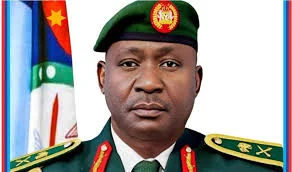
    The Chief of Defence Staff (CDS), General Christopher Musa has attributed the delay in winning the war against terrorism to the absence of good governance at the sub-national levels.

    He said the armed forces’ efforts must be complemented by good governance at the federal, state, and local government levels.

    He also revealed that the armed forces is mainstreaming welfare packages to motivate the combatants.

    In that regard, he said there is a proposal to change the annual Armed Forces Remembrance Day to Armed Forces Celebration and Remembrance Day.

    He said the name change is informed by the objective “of celebrating both the dead and the living.”

    According to him, “this year’s event of Armed Forces Day entails celebrating those combatants on active duty, families of the deceased and the dead officers.”

    Speaking this morning on Arise TV’s The Morning Show, General Musa said a situation where some Nigerians live in conditions that make it seem like they are not part of an organised modern society makes them vulnerable to the manipulation of those that come to recruit them into violent crimes like terrorism, banditry, and kidnapping.

    The CDS therefore, calls on leaders at the sub-national levels to up their games to make it sync with governance efforts at the federal level.

    “So when you go and see people living in a manner as if they are not part of an organised modern society, they will be open to other interests to manipulate,” he said.

    Another factor, he said had made the war to linger is the access of the terrorists to foreign funding.

    He said the Nigerian armed forces had found a cache of foreign currencies on some of the arrested terrorists.

    In a bid to eliminate this causative factor, he said the armed forces are collaborating with relevant government agencies to track the source of these funds.

    “So, that’s the oxygen we want to cut off,” the CDS disclosed.

    General Musa also cited “the nature of the enemy the army is dealing with” as another reason why the war on terror has lingered. According to him, the enemy appears like every normal citizen.

    He explained that this was the reason the army adopted “the non-kinetic approach that is based on the understanding that the war can not be fought by the armed forces alone but by all citizens and other stakeholders.”

    “Also, there are saboteurs who provide support for the non-state actors just to make it seem as though Nigeria is ungovernable.”

    General Musa disclosed that it was based on these discoveries that the country is working closely with countries in the Sahel to fortify the international boundaries.

    He said the window was still open on the possibility of convincing the three member countries that recently left the ECOWAS to reconsider their stance.

  • Tinubu Hosts Wang Yi, Chinese Foreign Minister in Abuja

    Tinubu Hosts Wang Yi, Chinese Foreign Minister in Abuja


    President Bola Ahmed Tinubu is hosting China’s Foreign Affairs Minister, Wang Yi, at the Presidential Villa in Abuja. 

    The visit, part of Wang’s two-day mission to Nigeria, builds on commitments made during the 2024 Forum on China-Africa Cooperation (FOCAC) Summit in Beijing.  

    Discussions are focused on strengthening partnerships in areas such as the economy, politics, and energy. The session also involves Nigeria’s Foreign Affairs Minister, Ambassador Yusuf Tuggar. 

    The ministers are expected to address the media after their private talks.  

    Wang Yi was welcomed at the Nnamdi Azikiwe International Airport by Dunoma Umar Ahmed, the permanent secretary of the Ministry of Foreign Affairs. 

    This meeting underscores the deepening ties between Nigeria and China.

  • Tinubu’s Cabal More Dangerous Than Buhari’s – Dalung

    Tinubu’s Cabal More Dangerous Than Buhari’s – Dalung

    Former Youth and Sports Minister Solomon Dalung has raised concerns about a powerful inner circle within President Bola Tinubu’s administration.

    He described this group as highly skilled and more influential than the cabal that operated under former President Muhammadu Buhari.  

    Dalung noted that members of Tinubu’s cabal possess advanced knowledge of governance and power, enabling them to control access to the president and manipulate government processes.

     He contrasted this with Buhari’s cabal, which he characterized as less experienced and limited in strategy.  

    Criticizing the denial of cabals in Nigerian politics, Dalung warned that their unchecked influence undermines governance and negatively impacts ordinary citizens. 

    He questioned the government’s commitment to improving citizens’ well-being, citing widespread frustration among Nigerians.  

  • Nigerians Condemn New Retirement Package for Army Generals

    Nigerians Condemn New Retirement Package for Army Generals

    The internet has gone into a frenzy as Nigerians curse and swear in condemnation of a new retirement package approved for Service Chiefs and other generals by President Bola Tinubu.

    The highlight of the package include bulletproof SUVs, annual medical allowances of up to $20,000, and domestic aides.

     The package provides luxury benefits like personal assistants, security escorts, and free local and international medical treatments.

    Top-ranking officers, such as the Chief of Defence Staff, will receive bulletproof SUVs, Peugeot backup vehicles, and five domestic aides, while lieutenant generals will get Toyota Land Cruisers and similar perks. 

    Lower-ranking officers, such as brigadier generals and colonels, will receive lesser benefits, including medical care and cars.

    Medical associations, including the Nigerian Medical Association (NMA), criticized the allowance for foreign medical treatment. They argue that officials should receive healthcare in Nigeria to strengthen the local health sector.

    The public has raised concerns over the fairness of these benefits, especially given Nigeria’s economic challenges. Critics believe government funds should be used to improve healthcare, infrastructure, and social services rather than offering luxury retirement perks to retired officers.

  • Ribadu Denies Foreign Military Presence in Nigeria Amid Niger Tensions

    Ribadu Denies Foreign Military Presence in Nigeria Amid Niger Tensions

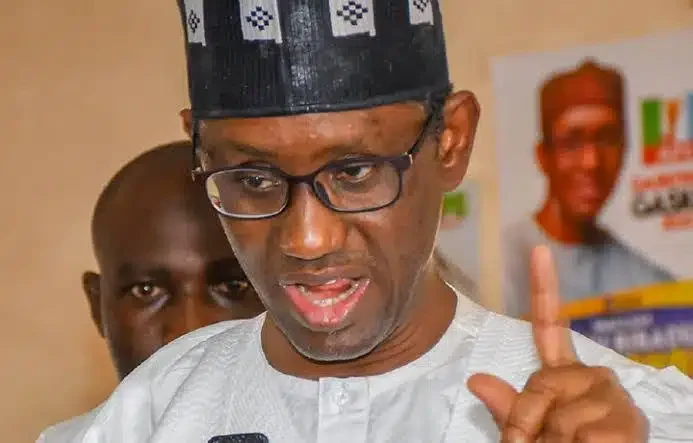
    Nuhu Ribadu, Nigeria’s National Security Adviser, has dismissed accusations by Nigerien Abdoulrahamane Tchiani that foreign military forces, including those from France, are operating in Nigeria.

     Ribadu’s comments came in response to allegations made by Tchiani, who claimed that Nigeria was collaborating with France to destabilize Niger. 

    This has added to the rising tensions between the two nations, particularly after Niger, along with Mali and Burkina Faso, chose to leave the Economic Community of West African States (ECOWAS).

    Speaking in an interview with BBC Hausa, Ribadu refuted Tchiani’s claims, stating there are no foreign military installations or troops in Nigeria. 

    He encouraged journalists to visit the locations mentioned by the Nigerien leader and speak with local residents to verify the absence of any foreign military presence.

    The National Security Adviser emphasized that the real issue facing both countries is the common threat posed by terrorists, particularly the insurgent group Lakurawa, which has been wreaking havoc in the region. 

    Ribadu further expressed that instead of focusing on accusations, both nations should collaborate to address security concerns that affect their shared borders. 

    He also stressed the long-standing relationship between Nigeria and Niger, describing the people of both countries as “brothers” and calling for unity in tackling mutual challenges. 

    Ribadu reassured that Nigeria would continue to work with Niger in the spirit of regional cooperation and development.

    The diplomatic tension between Nigeria and Niger follows the latter’s decision to leave ECOWAS, which has led to a broader political and economic rift.

     Despite the disputes, Ribadu’s statements reflect Nigeria’s commitment to strengthening ties with its neighbors in West Africa to combat terrorism and foster regional stability.

  • Tinubu Unveils 2025 Budget

    Tinubu Unveils 2025 Budget

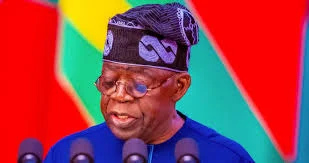
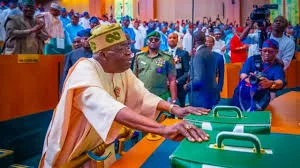
    President Bola Ahmed Tinubu has presented the 2025 budget proposal to the National Assembly, marking a pivotal step in his administration’s efforts to stabilize and transform Nigeria’s economy. 

    Dubbed “The Budget of Restoration: Securing Peace, Rebuilding Prosperity,” the plan lays out strategic investments to tackle economic challenges and rebuild critical sectors.  

    The proposed N47.90 trillion expenditure includes key allocations for defense, infrastructure, education, and healthcare.

     Tinubu emphasized bolstering security, improving infrastructure, and fostering self-sufficiency in agriculture. Revenue projections stand at N34.82 trillion, while the budget deficit is pegged at N13.08 trillion.  

    The president highlighted significant milestones achieved under the 2024 budget, such as a 3.46% economic growth rate in Q3 and robust foreign reserves nearing $42 billion. 

    For 2025, the focus shifts to reducing inflation, enhancing trade, and driving industrial output.  

    With plans to reduce dependency on food and oil imports while boosting exports, Tinubu assured Nigerians of a brighter future, calling for collective action to overcome challenges and build a more prosperous nation.