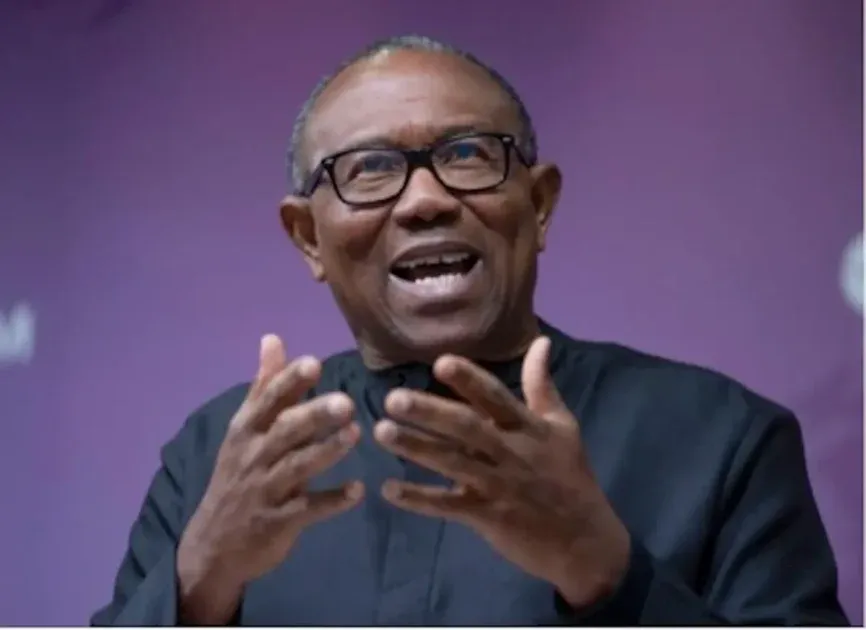
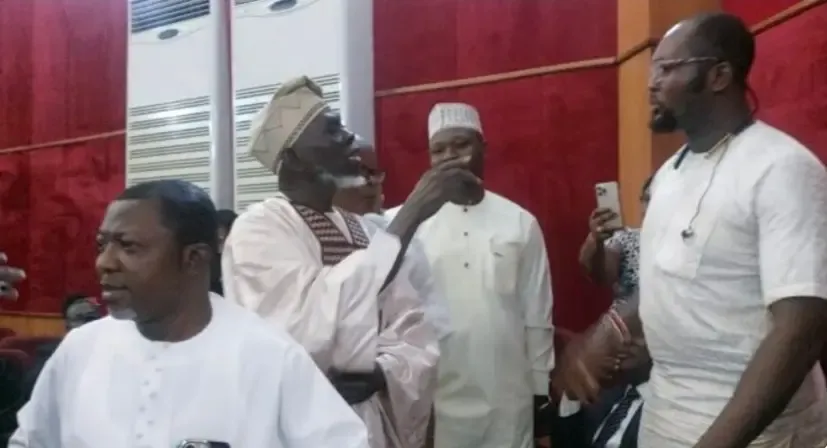
There was palpable tension on Wednesday at the Court of Appeal premises, venue of the Presidential Election Petition Court as two factions of the Labour Party clashed.
NIGERIA ANCHOR had reported earlier how both factions engaged in a war of words over who was the authentic Labour Party (LP) representative in court.
Trouble started when Lamidi Apapa, factional chairman of the party, walked into the court premises alongside some of his supporters.
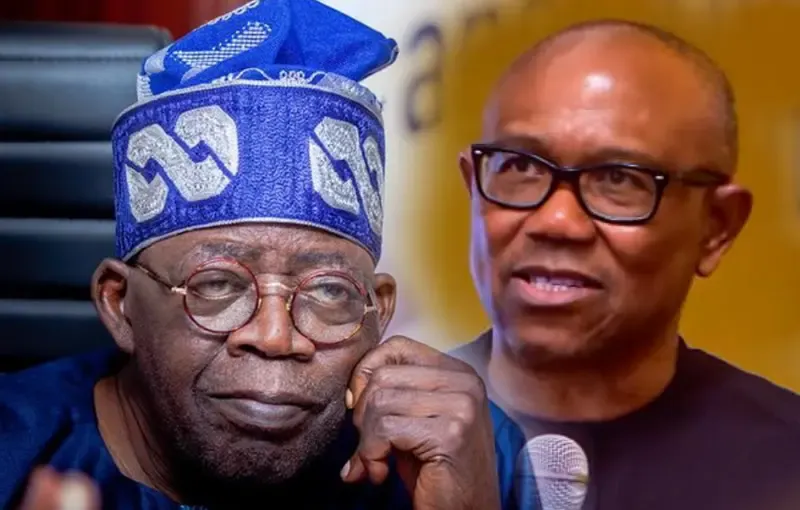
Apapa, who is locked in a battle with Julius Abure, suspended chairman of the party, had arrived the court for the case of a petition that Peter Obi, Presidential Candidate of the party, filed against the victory of President-elect Bola Tinubu.
He made an attempt to sit where Labour Party officials were and a shouting match ensued.
“Who are you?” a party official asked Apapa, who fired back saying, “You don’t know me? Look at the way you are talking, who are you too?”
As the argument continued, Apapa raised his voice, saying, “Get up, you can not sit down here!”
Secretary of the Presidential election court, Josephine Ekperobe, quickly moved in to ensue normalcy.
Later when the Labour Party matter was called, Obi and the party’s Women Leader, Dudu Manoga, introduced themselves on the record of the court.
But when Apapa stood up to introduce himself as the National Chairman, the presiding justice of the court, Justice Haruna Tsammani, requested him to stop the introduction as the court would not recognise the ‘National Chairman’ on record.
Abure, who sat next to Obi, did not, however, attempt to introduce himself.
Apapa had earlier vowed to take control of the party and to withdraw the petition and motions before the court ahead of the sitting following the ruling of an FCT High Court sustaining Abure’s suspension. The LP has since appealed the ruling.
During Wednesday’s sitting, the LP’s lawyers, the lawyers to Bola Tinubu, the APC and the Independent National Electoral Commission (INEC) are expected to show the extent of their harmonisation of non-contentious issues and motions to be relied upon during the main hearing.
Shortly after the proceedings, as journalists were about to conduct an interview with the factional Chairman of the Labour Party, Lamidi Apapa, they were met with stiff resistance from loyalists of Julius Abure, another factional leader of LP.
The faction loyal to Abure shouted and dragged Apapa up and down, shouting “You must not talk, you are an impostor, thief, thief, thief…”.
It took the intervention security operatives to contain the pandemonium as they battled to liberate Apapa from the irate Abure loyalists.
At the time of this report, Apapa had been taken into protective custody by the police.
Signs of trouble started when Apapa wanted to announce his appearance in court after the LP National Women Leader, Mrs. Dudu Maluga had announced her name.
However, when the Chairman of the PEPC, Justice Haruna Tsammani noticed the faction in the courtroom, he refused to record their appearance again.
Nigeria’s headline inflation rate increased to 22.22 percent on a year-on-year basis in April 2023, The National Bureau of Statistics (NBS) has said.
This is according to the NBS Consumer Price Index (CPI) and Inflation Report for April 2023 released in Abuja on Tuesday.
According to the report, the figure is 0.18 percent points higher compared to the 22.04 percent recorded in March 2023.
It said on a year-on-year basis, the headline inflation rate in March 2023 was 5.40 percent higher than the rate recorded in April 2022 at 16.82 percent.
“This shows that the headline inflation rate (year-on-year basis) increased in April 2023 when compared to the same period in April 2022,’’ it said.
The report showed that contributions of items on the divisional level increase in the headline index are food and non-alcoholic beverages at 11.51 percent.
While housing, water, electricity, gas and other fuel at 3.72 percent.
Others are clothing and footwear at 1.70 percent; transport at 1.45 percent; furnishings, household equipment, and maintenance at 1.12 percent and education at 0.88 percent, and health at 0.67 percent.
“Miscellaneous goods and services at 0.37 percent; restaurant and hotels at 0.27 percent; alcoholic beverage, tobacco and kola at 0.24 percent; recreation and culture at 0.15 percent and communication at 0.15 percent.”
It said the percentage change in the All-Items Index in April 2023 was 1.91 percent on a month-on-month basis.
“This indicates a 0.05 per cent increase compared to the 1.86 per cent recorded in March 2023.
”This means that in April 2023, on average, the general price level was 0.05 percent higher relative to March 2023.”
The percentage change in the average CPI for the 12 months ending April 2023 over the average of the CPI for the previous 12 months period was 20.82 percent.
“This indicates a 4.37 percent increase compared to the 16.45 percent recorded in April 2022.’’
It said increases were recorded in all Classification of Individual Consumption by Purpose (COICOP) divisions that yielded the headline index.
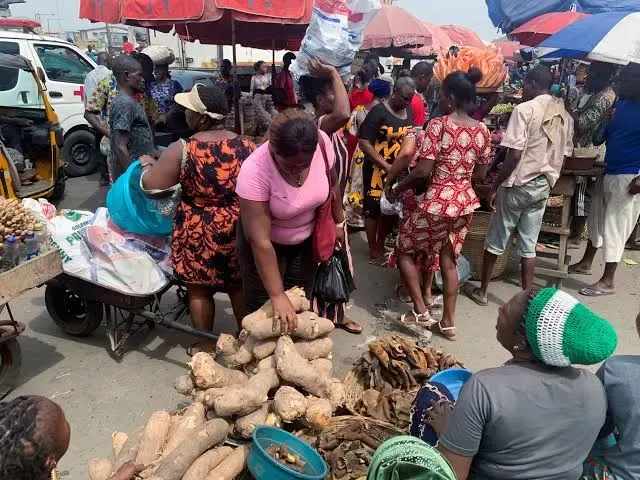
The report said the food inflation rate in April 2023 was 24.61 percent on a year-on-year basis, which was 6.24 percent higher compared to the rate recorded in April 2022 at 18.37 percent.
“The rise in food inflation is caused by increases in prices of bread and cereals, potatoes, yams and other tubers, and oil and fat, fish, vegetable, fruits, meat, and spirits.”
It said on a month-on-month basis, the food inflation rate in April was 2.13 percent, which was a 0.06 percent rise compared to the rate recorded in March 2023 at 2.07 percent.
The report said the “All items less farm produce’’ or Core inflation, which excludes the prices of volatile agricultural produce stood at 20.14 percent in April 2023 on a year-on-year basis.
“This increased by 5.96 percent compared to 14.18 percent recorded in April 2022.’’
“On a month-on-month basis, the core inflation rate was 1.46 percent in April 2023, which was a 0.78 percent drop compared to what it stood at in March 2023 at 1.84 percent.”
According to the report, the highest increases were recorded in prices of gas, passenger transport by Air, liquid fuel, fuels, lubricants for Personal transport equipment, and vehicles spare parts.
“Others are maintenance and repair of personal transport equipment and solid fuel, medical services, and passenger transport by road, among others.
“The average 12-month annual inflation rate was 17.91 percent for the 12 months ending April 2023, this was 4.23 percent points higher than the 13.68 percent recorded in April 2022.”
The report said on a year-on-year basis in April 2023, that the urban inflation rate was 23.39 percent, which was 6.05 percent higher compared to the 17.35 percent recorded in April 2022.
“On a month-on-month basis, the urban inflation rate was 2.05 percent in April 2023, representing a 0.05 percent rise compared to March 2023 at 2.00 percent.’’
It said the corresponding 12-month average for the urban inflation rate was 21.50 percent in April 2023.
“This was 4.49 percent higher compared to the 17.01 percent reported in April 2022.’’
The report said on a year-on-year basis in April 2023, the rural inflation rate was 21.14 percent, which was 4.82 percent higher compared to the 16.32 percent recorded in April 2022.
“On a month-on-month basis, the rural inflation rate in April 2023 was 1.78 percent, which increased by 0.06 percent compared to March 2023 at 1.72 percent.’’
It said the corresponding 12-month average for the rural inflation rate in April 2023 was 20.18 percent, which was 4.27 percent higher compared to the 15.91 percent recorded in April 2022.
On states’ profile analysis, the report showed in April 2023, all items inflation rate on a year-on-year basis was highest in Bayelsa at 26.14 percent, followed by Kogi at 25.57 percent, and Rivers at 24.95 percent.
It, however, said the slowest rise in headline year-on-year inflation was recorded in Borno at 19.60 percent, followed by Taraba at 19.64 percent, and Sokoto at 19.90 percent.
The report, however, said in April 2023, all items’ inflation rate on a month-on-month basis was highest in Cross River at 3.05 percent, Bayelsa at 2.92 percent and Rivers at 2.62 percent.
“Katsina at 0.52 percent, followed by Jigawa at 0.74 percent and Osun at 0.96 percent recorded the slowest rise in month-on-month inflation.”
The report said food inflation in April 2023, on a year-on-year basis, was highest in Kogi at 29.50 percent, followed by Kwara at 29.48 percent, and Bayelsa at 29.38 percent.
“Sokoto at 19.55 percent, followed by Taraba at 20.20 percent and Jigawa at 20.68 percent recorded the slowest rise in food inflation on a year-on-year basis.’’
The report, however, said on a month-on-month basis, April 2023 food inflation was highest in Cross River at 4.65 percent, followed by Bayelsa at 3.61 percent, and Ekiti at 3.49 percent.
”With Jigawa at 0.14 percent, followed by Katsina at 0.44 percent and Osun at 0.62 per cent recorded the slowest rise on month-on-month inflation.’’
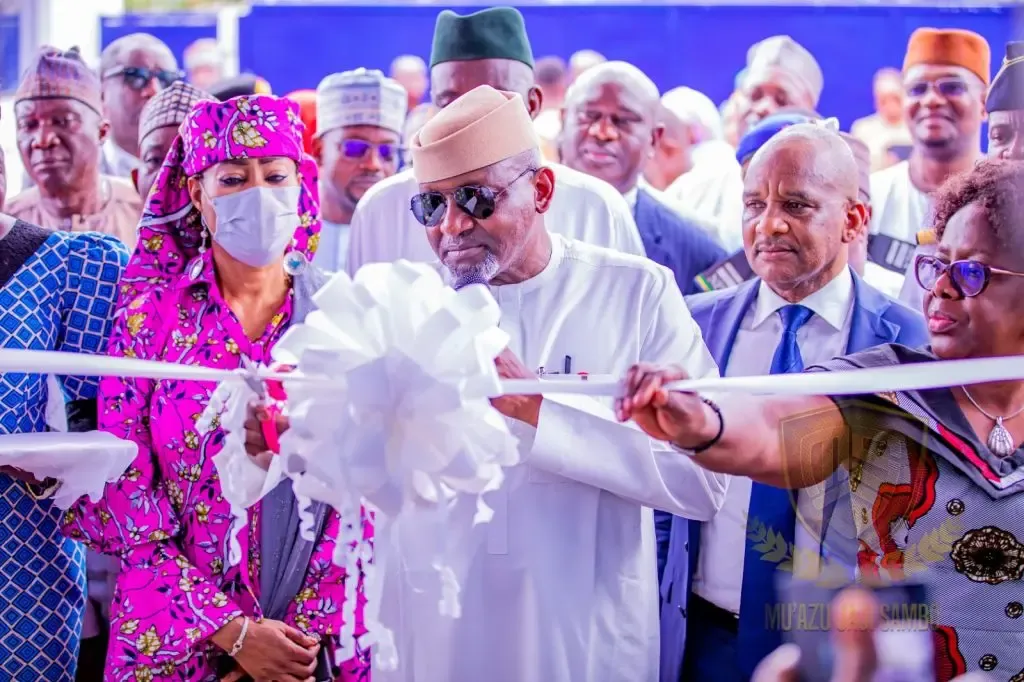
The Minister of Transportation, Alhaji Mu’azu Sambo, has urged members of staff of the Nigerian Maritime Administration and Safety Agency (NIMASA) to double their efforts to ensure improved service delivery and economic development.
Sambo gave the advice while inaugurating the new NIMASA Abuja Liaison office.
He said that establishing a permanent Zonal office for the agency was imperative because of its strategic role in the sector.
“Apart from the reduction of cost of governance, the New Abuja Zonal Office will serve as the centre piece of government relations on matters with bilateral and multilateral implications on international trade and cooperation.
“It will enable the agency to host foreign diplomats and other key maritime stakeholders in the Federal Capital Territory, thereby helping the agency to speedily achieve its mandate.
“All these led to the acquisition of the office and served as further proof of the growth in capacity of NIMASA due to its deepened role in Nigeria’s economic development,” the minister said.
While expressing the ministry’s commitment to NIMASA and all other departments under it, Sambo said this project was a pointer to its determination in that regard.
He commended President Muhammadu Buhari-led administration for approving the procurement of the office, the NIMASA Chief executive and all who made the project a reality.
Sambo thanked everyone who contributed to the realisation of the project, saying more of such projects would subsequently be inaugurated in the country
Earlier, the Director-General of NIMASA, Dr Bashir Jamoh, thanked the minister and the Federal Government for ensuring the acquisition of the state-of-the-art edifice.
Jamoh said the project signaled the agency’s commitment to providing conducive, favorable and supportive working conditions to boost staff productivity.
The Director-General said,” Today’s ceremony is just one more step in living up to what the world has come to expect from us.
“If we train our staff internationally, we must provide them with a working environment that matches with those international standards.
“This edifice reflects management’s commitment to providing a world-class working environment in addition to the recently reviewed and improved conditions of service for all employees.
“With this investment, we have taken things up and made them top-notch by providing support, infrastructure environment, regarding safety and security.’’
He, however, pledged NlMASA’s commitment to ensure a culture of maintenance to extend the lifespan of the building.
Gunmen have killed over 30 persons in Bwoi District of Mangu Local Government Area of Plateau, DSP Alfred Alabo confirmed in a statement.
Alabo said the Commissioner of Police in the state, Bartholomew Onyeka, who described the incident as unfortunate has directed immediate deployment of armed personnel to the area.
”The commissioner of police expressed sadness over the unfortunate incident that has claimed the lives of yet-to-be-identified persons from various villages within the area.
”At about 11:56 p.m. on Tuesday, we received a distress call from one of our Police officers in charge of Tanknale village of Mangu, that some gunmen were shooting sporadically in a nearby village.
”The commissioner immediately mobilised all assets in the command to the scene to ensure that the suspects are arrested and brought to book.
”Further information from the Assistant Commissioner of Police in charge of the Criminal Investigation Department (CID), ACP Bawa Sale, who was also present at the scene, reveals that with help from other security agencies in the command, the hoodlums were chased away,” he said.
He explained that due to the superior firepower of the security personnel, the hoodlums abandoned four motorcycles, a Sharon vehicle, and some items used for their nefarious activities.
”As we speak, the culprits are on the run while our officers are still on their trail with the aim to ensure that they are neutralized and arrested,” he added.
Alabo maintained that the commissioner of police has called on residents of the area to remain peaceful adding that security agencies have modalities available to stop the criminals.
He also called on the residents with useful information to avail it to the security agencies for prompt action.
The National Security Adviser (NSA), retired Maj.- Gen. Mohammed Monguno, has tasked state governors with the regular engagement of stakeholders and proper management of conflicts to enhance the security of their respective states.
The NSA made the call at the ongoing three-day 2023 induction program for re-elected and newly elected governors organised by the Nigeria Governors’ Forum (NGF) in Abuja.
Munguno, represented by Mr. Joseph Dashwuep, a senior officer in the NSA’s office, also called on State Governors to adopt both the kinetic and non-kinetic models in tackling insecurity in their states.
Monguno who was the lead discussant at a panel session on “Managing security in the states: Ungoverned spaces and regional security” said that security agencies would always do their best to keep Nigeria safe.
He said that there was the need for state governors to adopt policies that meet the aspirations of the people and ensure proper management of conflicts.
“The way you manage conflicts go a long way in determining the peace and security of your state,” Monguno said.
He also advised them to regularly meet with security agencies, media, civil societies, non-governmental organizations, citizens, and traditional and religious leaders.
Also speaking, the Director-General of the Department of State Service (DSS), Yusuf Bichi who was a discussant, advised governors to act promptly on intelligence reports and early warning alert.
”You are expected to act promptly once you receive intelligence or early warning reports.
“Do not neglect these reports. Sometimes governors will receive intelligence report and hand it over to a special adviser or aide,” he said.
The Inspector-General of Police, Usman Baba, who was also a discussant, advised governors to work with existing security architecture to secure their state.
Baba said that establishing a new security outfit would cost more than improving of the existing ones
He also advised governors to tackle the issue of unemployment and poverty as well as adopt advanced technology in fighting crime.
Contributing, Gov. Charles Soludo of Anambra, said that state governors should be empowered to tackle security challenges at the local level because the federal security agencies were not localised.
“The central point here to make is that security or insecurity is largely a local issue. Every locality has its own peculiarities.
“I think for those of us who are governors and the governors-elect, a major concern that we need to address is that the national security architecture places much emphasis on kinetic architecture which is almost exclusively on the shoulders of the Federal Government.
“Whereas the governors are called chief security officers (without troops); we must have to learn how to cope for survival in a dysfunctional system,” he said.
Soludo expressed happiness that the President-elect, Sen. Bola Tinubu had expressed his commitment to state police saying that is really the way to go in a federal structure.
“The vigilante services of various states are backed by law. The one of Anambra is doing well but we are operating on a tight constraint as it were,” he said.
Also, Gov. Hope Uzodinma of Imo, said instead of establishing new security outfit at the state, governors should key into efforts by federal government.
He said that federal security agencies were functioning, but in adequate fund remain a big challenge that states can step into to fund their operations.
“If we can tackle the funding gap that exists among these security agencies and fund them early enough, the idea of having a general without a troop will disappear because you know as we always say, who plays the piper dictates the tune,” he said.
Uzodinma called for partnership and cooperation between the state and federal governments
“I am also aware that given the economy and revenue sources available to the states, it may not be very easy now for some states to fund the cost of setting up an independent security architecture that will be effective and efficient in their various states.
“Rather, an inter-dependent relationship between the federal establishment and provincial authorities will also work,” he added.
On managing the process of governance, Gov. Babajide Sanwo-Olu of Lagos State advised incoming governors not to abandon any project because they were not the initiators.
Sanwo-Olu said the completion of a project was more important to the people than who started it.
“If a project is 86 per cent completed and abandoned, no body will take the credit. What the people are concerned about is to enjoy the facilities,” he said.
Gov. Seyin Makinde of Oyo State also advised governors not to abandon projects.
Former Governor of Cross River, Donald Duke, urged governors to deliver on their by promises saying “politics is over. You emerged one way or the other, it is time to work.
“I will congratulate you for winning election but the bigger congratulations will come at the end of your tenure,” he said.
The Federal Government has warned members of the National Association of Resident Doctors (NARD) to shelve their planned five-day warning strike.
The Minister of Labour and Employment, Chris Ngige, gave the warning on Tuesday in Abuja, shortly after receiving the letter of notification from the NARD executive on the planned strike.
Ngige said this in a statement signed by Mr Olajide Oshundun, Director, Press and Public Relations in the ministry while the planned strike as illegal.
The impending industrial action is billed to begin by midnight of May 16.
Ngige who was reacting to the letter, delivered to his office at about 5pm same day, said he contacted the Minister of Health, who informed him that a meeting has been scheduled with the resident doctors on Wednesday.
He therefore advised the doctors to avail themselves of the opportunity for social dialogue with their employer, rather than embark on a warning strike, which is unknown to the law.
According to him, “I will advise them to attend the meeting with the Minister of Health tomorrow. I will also advise them very strongly not to go on a five-day warning strike.
“There is nothing like a warning strike. A strike is a strike. If they want to take that risk, the options are there. It is their decision. They have the right to strike. You cannot deny them that right.
“But their employer has another right under Section 43 of the Trade Dispute Act, to withhold their pay for those five days. So, if the NARD has strike funds to pay their members for those five days, no problem.
“The Health Minister will instruct the teaching hospitals to employ ad-hoc people for those five days and they will use the money of the people who went on strike to pay the ad-hoc doctors.
“That is the ILO principles at decent work, especially for those rendering essential services. Lives should be protected. One of my sons is a resident doctor, I will advise him to go to work and sign the attendance register,” he said.
He added that, the people seen at work are the ones to receive their pay. If you don’t work, there will be no pay.
On the five demands of the doctors, Ngige said the Federal Government lacks the powers to compel the states to domesticate the Medical Residency Training Fund (MRTF).
He added that since health is on the residual list, where both the federal and state governments have the powers to legislate.
The minister also stated that the job of the Federal government was to make policy and where the states disagree, they were at liberty to make their own policy.
He noted that the Federal Government cannot bully the states into domesticating the MRTF if they do not want to.
Regarding the issue of immediate payment of the MRTF to their members, he said it was appropriated in the 2023 budget but has not been released, as the 2022 budget was still running, adding that those in 2022 have all been paid.
Ngige denied the claim by NARD that the Federal Government did not pay minimum wage consequential adjustment arrears to their members.
He added that, all workers in the Education and Health Sectors, and even the defense agencies benefited from the adjustment.
He noted that the doctors cannot declare a nationwide strike because some states were owing their members, pointing out that the federal government cannot also dabble into the issue, being a state matter.
Ngige also said the Federal Government as the Executive arm of government cannot intervene in the bill at the National Assembly to bond doctors for five years, as it is a private member’s bill.
According to him, any intervention by the executive on the matter impinges on the autonomy and independence of the legislative arm of government.
Ngige noted that the bill has passed through first and second reading, he was sure it would be shot down at the public hearing, since the law prohibits forced labour.
He advised the doctors not to talk about 200 per cent pay rise, as it was not feasible.
“Besides all the government has done for doctors and other workers in the health sector, such as upward review of hazard allowances, the Nigeria Medical Association (NMA) was already negotiating with the Federal Ministry of Health, National Salaries, Incomes and Wages Commission and the Presidential Committee on Salaries on pay rise for doctors.
“It is incongruous for student doctors to embark on strike when consultants training them were already negotiating with the Federal Government,” he said
25 million people, more than half the population of Sudan need humanitarian aid and protection
The United Nations humanitarian response plan is seeking nearly $2.56 billion to help people affected by the crisis in Sudan, a senior U.N. official said on Wednesday.
Meanwhile, the U.N. refugee agency is also seeking more funding to assist those forced to flee.
“Today, 25 million people, more than half the population of Sudan, need humanitarian aid and protection.
This is the highest number we have ever seen in the country,” said Ramesh Rajasingham, head of the U.N. Office for the Coordination of Humanitarian Affairs in Geneva and director of the Coordination Division
“The funding requirements of nearly 2.6 billion dollars are also the highest for any humanitarian appeal for Sudan.’’
The plan, a revised version of the annual humanitarian plan for 2023, is designed to target 18 million people in need.
The conflict between the Sudanese army and the paramilitary Rapid Support Forces (RSF) has caused a humanitarian crisis that threatens to destabilise the region, displacing more than 700,000 people inside Sudan and forcing about 200,000 to flee into neighbouring countries.
The United Nations High Commissioner for Refugees (UNHCR),is making a joint appeal with the aid agency on Wednesday, said it was seeking 472 million dollars to assist more than 1 million people over the next six months.
“Sadly, we once again need to call on countries and individuals with the means to step up for innocent people who have lost everything through no fault of their own,’’ said Raouf Mazou, Assistant High Commissioner for Operations at UNHCR.
President Muhammadu Buhari has approved the appointment of Dr Baba Haruna as the Rector, Federal Polytechnic, Bida.
This is contained in a letter signed by the Minister of Education, Alhaji Adamu Adamu and made available to newsmen in Bida on Wednesday.
The appointment which took effect from May 21 was for five years.
“I write to convey to you the approval of Mr President, His Excellency, Muhammadu Buhari, GCFR, for your appointment as Rector of Federal Polytechnic, Bida, Niger State”
“The terms and conditions of service including remuneration and fringe benefits shall be as approved for Rectors of Federal Polytechnic,” he added.
Buhari congratulated the new rector and wished him a most successful tenure in office.
Until his appointment, Haruna was the Director, Quality Assurance at the polytechnic.
Labour Party Factions clash in Court on Wednesday morning over who is the authentic party
There seems to be more legal fireworks brewing as factions of the Labour Party (LP) were at each other’s jugular this morning at the Presidential Election Petition Court, engaging in war of words over which faction is the authentic one.
The Lamidi Apapa-led faction of the LP was questioning why members of the party loyal to the Julius Abure are in court for the suit against Tinubu
They insisted that the ruling of a High Court of the FCT, suspending the Abure-led faction remains in force as consequently, they have no business being in Court this Wednesday morning.
The court rose on the last adjourned date for continuation of pre-hearing of the Peter Obi’s petition, however, with this melo-drama, and the mood in court already, there seem to be more fireworks brewing.