Author: admin

  • Genocide: Trump, Tinubu, and the Islamic State of Nigeria

    Genocide: Trump, Tinubu, and the Islamic State of Nigeria

    By Ugo Onuoha


    Donald Trump’s warning to President Tinubu over alleged genocide against Christians has reopened Nigeria’s deepest wounds — exposing again the country’s uneasy balance between faith, power, and politics.


    A Red Herring in the Nigerian Tragedy

    Red herring. That is the one phrase that best captures the flurry of debates following former U.S. President Donald Trump’s threat to “deal with” those he accused of waging a genocidal war on Christians in Nigeria.

    Trump’s statement was stark: President Bola Ahmed Tinubu must act decisively against sectarian Islamist terrorists seeking to Islamise the country — or face dire consequences. His warning, dramatic as it sounded, reignited a familiar national anxiety.

    The Nigerian government, characteristically, has swung between denial and reluctant acknowledgment. Officials first dismissed talk of genocide as exaggerated propaganda; then, in the next breath, admitted that while killings exist, they are not state-sanctioned.


    The Denial Industry

    Some Muslim groups and clerics have been especially vocal in rejecting the label of “genocide,” particularly regarding violence in the Middle Belt. But their rebuttals struggle against visible reality.

    “We live in a global village; the world sees everything,” the author notes.

    In the age of smartphones, satellites, and citizen journalism, atrocities cannot easily be buried. The world watches Nigeria — just as Nigerians watch the world. Even North Korea, despite its iron censorship, has not fully silenced global scrutiny.

    Governments everywhere understand that information is power. Nations spy on allies and enemies alike. The 2010 WikiLeaks scandal merely confirmed what the powerful already knew: diplomacy is as much about gathering intelligence as exchanging pleasantries.

    From Lagos cocktail receptions to cultural events like the Argungu Fishing Festival or Ojude Oba, Nigeria is never beyond the gaze of foreign observers. Agents arrive disguised as tourists. The truth always finds its way out.

    So when it comes to the question of whether genocide against Nigerian Christians exists, the argument itself has become redundant. The evidence is in plain sight.


    Before the Beginning: Seeds of Division

    Nigeria’s religious fault line is not new — it was inscribed into the country’s DNA long before independence.

    In 1957, Sir Ahmadu Bello, the Sardauna of Sokoto, famously declared:

    “We the people of the North will continue our stated intention to conquer the South and dip the Qur’an in the Atlantic Ocean after the British leave our shores.”

    Twelve days after independence in 1960, Bello told The Parrot newspaper:

    “Nigeria should be an estate of our great grandfather Uthman Dan Fodio… We must use the minorities in the North as willing tools and the South as a conquered territory.”

    Abubakar Tafawa Balewa, Nigeria’s first Prime Minister, echoed that sentiment as early as 1947:

    “If the British quit Nigeria now, the Northern people will continue their uninterrupted conquest to the sea.”

    More than sixty years later, not one major northern political figure has publicly renounced these views.


    Christians in Power — or So It Seemed

    Some argue that Christian presidents like Olusegun Obasanjo (1999–2007) and Goodluck Jonathan (2010–2015) disproved the claim of Islamic domination. But events during their administrations tell a different story.

    Under Obasanjo, nearly all northern states (except parts of the Middle Belt) adopted Shari’a law, creating parallel legal systems and semi-autonomous religious jurisdictions. Under Jonathan, the backlash from northern elites was ferocious. His presidency was haunted by conspiracy and ultimately drowned by a wave of coordinated opposition — much of it driven by religious sentiment.

    Now, some of those same northern actors are courting Jonathan again, hoping to exploit his credibility to patch the cracks left by Tinubu’s struggling Muslim–Muslim ticket.


    Trump’s Threat and Nigeria’s Reality

    Was Trump properly briefed before making his threat? Perhaps not. Yet his blunt accusation touches on an uncomfortable truth: Nigeria, for all intents and purposes, already behaves like an Islamic state.

    The Constitution says otherwise, but the system tells a different story. Nigeria operates two codes of law — Criminal in the South and Penal in the North — reflecting deep-rooted ideological divides.

    More revealing, however, is what the 1999 Constitution itself contains. Analysts like Pastor Femi Emmanuel and U.S.-based researcher Dr. Josephine O. Soboyejo have shown how heavily it leans toward Islam.

    “Shari’a Law was never enacted into the Constitution — it was inserted,” Soboyejo asserts. “It appears 73 times. Islam, 28 times. Muslim, 10 times. Grand Khadi, 54 times. The Constitution contains no mention of Christ, Christianity, or Church.”

    She calls this “a dual ideology” — one that gives lip service to secularism while institutionalising religious imbalance.


    A Fragile Secular Dream

    Nigeria’s so-called secular state is built on contradictions. Section 38 guarantees freedom of religion, but Section 6 embeds Shari’a jurisdiction, creating a legal paradox that has become “calamitous for Christians,” as Soboyejo puts it.

    This reality is not academic. It plays out in blood and fear across the Middle Belt and Northern Nigeria.

    In 2019, CNN honoured Imam Abubakar Abdullahi of Plateau State, who risked his life to shelter 262 Christians in his mosque during an attack by Muslim herdsmen. His bravery made global headlines — but his story underscored the perilous truth: those who defend Christians often do so at the edge of death.

    From Gideon Akaluka to Deborah Yakubu, countless Nigerians have been lynched for alleged blasphemy. Their killers remain free, unpunished, and emboldened.

    “It will finally be game over,” the writer warns, “when radical Islam fully captures the Yoruba nation — a process already underway.”

    The stakes could not be higher. With the Yoruba population split almost evenly between Christians and Muslims, the struggle for Nigeria’s soul may yet end where it began — in the collision between faith and power.


    Final Word

    Donald Trump’s bombastic threat may be another red herring, but it has dragged into daylight a truth Nigerians prefer to whisper about: the slow erasure of secularism and the steady march toward a theocratic state.

    The question now is not whether the world is watching — it is whether Nigerians are awake enough to see what their country is becoming.

    Nigeria #Tinubu #DonaldTrump #Genocide #ReligiousFreedom #ChristianPersecution #IslamicState #FaithAndPolitics #HumanRights #MiddleBeltCrisis


    About the Author:
    Ugo Onuoha is a veteran journalist, former MD/E-in-C, Champion Newspapers Ltd, columnist, and public affairs commentator. His writings explore politics, religion, and governance in Nigeria and Africa with an unflinching eye for truth and justice.

  • Dr. Musa Adamu Aliyu, SAN, to Deliver Realnews 13th Anniversary Lecture

    Dr. Musa Adamu Aliyu, SAN, to Deliver Realnews 13th Anniversary Lecture


    As Realnews Magazine and Publications Limited marks its 13th anniversary, it has chosen a theme and a speaker that reflect Africa’s most pressing developmental challenge — the security of its digital and financial frontiers.

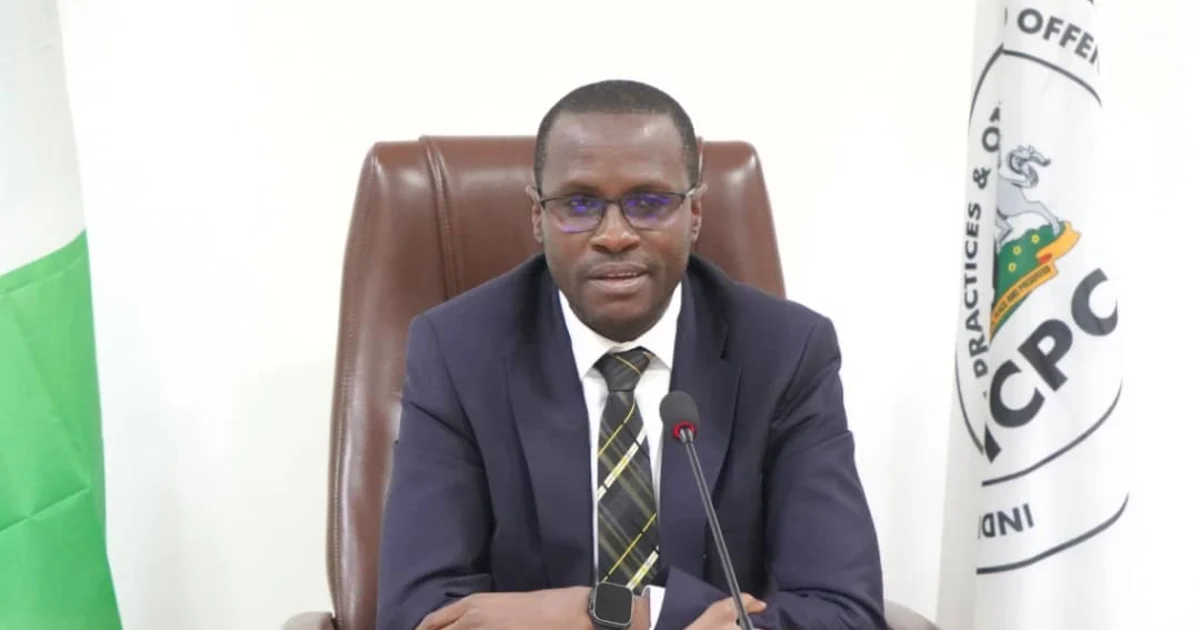
    The Chairman of the Independent Corrupt Practices and Other Related Offences Commission (ICPC), Dr. Musa Adamu Aliyu, SAN, will headline this year’s Realnews Anniversary Lecture, delivering a keynote address on “Cybersecurity, Illicit Financial Flows and Achieving Agenda 2063 in Africa.”

    The lecture is scheduled for Wednesday, November 19, 2025, at the Radisson Blu Hotel, Ikeja, Lagos.

    Dr. Aliyu’s acceptance to speak at the landmark event was first conveyed to Realnews in March 2025. In his response to a follow-up message from the magazine on October 31, 2025, he reaffirmed his attendance, writing simply but assuredly: “I will attend by God’s grace.”

    It was a fitting affirmation from a man whose steady rise through the legal and public service ranks has been defined by diligence, integrity, and a strong sense of purpose.

    Appointed as ICPC Chairman by President Bola Ahmed Tinubu on October 17, 2023, Dr. Aliyu has since been steering the Commission with a renewed sense of direction and energy.

    Barely a few days before that appointment, on October 12, 2023, he attained the highest professional recognition for legal practitioners in Nigeria — the rank of Senior Advocate of Nigeria (SAN) — crowning years of commitment to law, governance, and public accountability.

    Before assuming national duties, Dr. Aliyu had served as Attorney General and Commissioner for Justice in Jigawa State between 2019 and 2023, where he initiated far-reaching reforms in the justice sector. His tenure left behind a strong imprint of institutional accountability and legal innovation.

    He was instrumental in setting up the Public Complaints and Anti-Corruption Commission of Jigawa State, a pioneering structure that deepened transparency and citizen engagement in governance.

    He also worked closely with the United Nations Office on Drugs and Crime (UNODC) to strengthen legal frameworks for anti-corruption and justice administration.

    Beyond the courtroom and government offices, Dr. Aliyu has also walked the corridors of academia. He lectured at the Jigawa State College of Islamic Legal Studies, Ringim, and at the Faculty of Law, Nigeria Police Academy, Wudil, Kano State, contributing to the grooming of Nigeria’s next generation of legal minds.

    He has authored scholarly articles in national and international journals and presented papers at conferences around the world.

    At the ICPC, Dr. Aliyu’s leadership has been marked by quiet transformation. He has repositioned the Commission as a more credible and collaborative institution, one that commands respect both within and outside Nigeria’s borders.

    His emphasis on ethics, professionalism, and adherence to international best practices has not only boosted morale within the agency but has also attracted high-level partnerships with development organizations and civil society actors.

    Born in Birnin-Kudu, Jigawa State, on December 27, 1977, Dr. Aliyu’s journey has been one of steady and purposeful progress.

    From Central Primary School, Birnin-Kudu (1983–1989) to Government College, Bauchi (1990–1995), and on to Bayero University, Kano (LL.B, 2003), Nigerian Law School (B.L, 2004), Ahmadu Bello University, Zaria (LL.M, 2011), and ultimately a Ph.D. in Law from Universiti Utara Malaysia (2019), he has built a formidable academic and professional foundation that continues to define his approach to leadership.

    The 13th Realnews Anniversary Lecture will be chaired by Hon. Justice Ayotunde Phillips, former Chief Judge of Lagos State and former Chairman of the Lagos State Independent Electoral Commission, who will also moderate the panel session.

    As Africa pushes toward the ambitions of Agenda 2063 — the African Union’s blueprint for inclusive growth and sustainable development — Dr. Aliyu’s lecture promises to explore how the continent can safeguard its economic future by tackling illicit financial flows and strengthening digital governance.

    It is, without doubt, a conversation whose time has come — and one that only a voice like Dr. Aliyu’s can lead with both clarity and conviction.


  • The Alternative Bank Unveils Risk-Sharing Agrifinance Strategy, Targets Women, Youth

    The Alternative Bank Unveils Risk-Sharing Agrifinance Strategy, Targets Women, Youth


    At this year’s Agriculture Summit Africa (ASA) in Abuja, one announcement drew the attention of policymakers, investors, and smallholder farmers alike. The Alternative Bank, Nigeria’s pioneering non-interest financial institution, unveiled a bold agrifinance strategy that could reshape how agriculture is funded — and who gets to lead it.

    Putting Inclusion at the Center

    Speaking at the summit, Korede Demola-Adeniyi, Executive Director (South) of The Alternative Bank, said the institution is expanding its non-interest agricultural facilities to target women and youth, two groups often excluded from traditional banking and agribusiness finance.

    “Our goal is to ensure that women and young people don’t just participate but thrive across the agricultural value chain,” Adeniyi said. “We don’t call what we do loans because we work hand-in-hand with beneficiaries. We provide facilities at next to nothing, particularly for women. Since we share both the risk and the profit, our focus is on creating lasting impact for all parties.”

    That principle — shared risk, shared reward — underpins The Alternative Bank’s model, setting it apart from conventional lenders that rely on interest-based credit. By investing alongside its clients, the bank aims to build mutual accountability and long-term sustainability rather than short-term debt.

    From Kano’s Roads to Kaduna’s Farms

    The bank’s agrifinance vision isn’t theoretical — it’s already on the ground. In Kano State, The Alternative Bank launched a tricycle empowerment programme for women, providing 120 participants with new tricycles to generate income and improve community safety.

    “The women in Kano, who were previously underserved, now have a steady source of income,” Adeniyi said. “Beyond economic empowerment, the initiative has improved safety, as women now transport other women and children, reducing the risk of assault and kidnapping.”

    In Kaduna, the bank has taken the model further with a ginger production pilot exclusively for women farmers. Through partnerships with development institutions, the project tackles market access and pricing challenges, ensuring participants receive fair compensation for their produce.

    Staying Close to the Grassroots

    Expanding access to finance in rural Nigeria often hits one major hurdle — physical distance. To close that gap, The Alternative Bank has built a network of empowered local agents serving as real-time links between the bank and farming communities.

    “We want to remain effective in rural areas where banks can’t always be physically present,” Adeniyi explained. “Our agents help us stay connected and responsive.”

    These agents do more than facilitate transactions. They provide financial literacy, gather feedback, and help tailor the bank’s products to local realities — ensuring that rural entrepreneurs aren’t left behind.

    Looking Ahead: A Blueprint for Agrifinancing

    Before the end of the year, The Alternative Bank plans to introduce a dedicated agriculture finance product designed to integrate women and youth into key value chains across Nigeria. The product will be unveiled alongside what Adeniyi described as the bank’s “Blueprint for Agrifinancing” — a roadmap for sustainable, inclusive agricultural funding.

    “For launch updates and to access our current facilities, visit our website or any branch nationwide,” she said. “And keep an eye out for our Blueprint for Agrifinancing — coming soon.”

    As Nigeria works to unlock the full potential of its agricultural sector, initiatives like this signal a shift toward more inclusive, participatory finance — one that views women and youth not as beneficiaries, but as the drivers of transformation.

    And if The Alternative Bank’s recent track record is anything to go by, the seeds of that transformation are already taking root.


  • The Alternative Bank Puts Farmers First with New Ethical Finance Framework

    The Alternative Bank Puts Farmers First with New Ethical Finance Framework

    Bank calls for a shift from profit-driven lending to purpose-driven partnerships across Africa’s food system.

    Lagos, Nigeria – November 2025.
    The Alternative Bank is setting a fresh direction for agricultural finance in Africa with the launch of an ethical financing framework that places farmers, not financiers, at the heart of the continent’s food future.

    Speaking at the Agriculture Summit Africa 2025, themed “Survival of the Greenest: Reclaiming Africa’s Food Destiny,” the Bank’s Executive Director (North), Garba Mohammed, represented by his Chief of Staff, Azeez Badru, said Africa’s prosperity depends not just on how food is grown or processed, but on how it is financed.

    “Africa’s food destiny won’t be reclaimed by technology alone,” Mohammed said. “It will take the courage to finance differently — to make money serve humanity, not the other way around.”

    With food insecurity deepening across Nigeria, The Alternative Bank is championing a model of finance built on ethics, transparency, and shared value.

    Mohammed described agriculture as “a sacred trust,” explaining that the Bank’s goal is to fund productivity and resilience rather than speculation.

    “We are financing purpose, not just profit,” he added. “Every loan, every partnership should feed families, protect the land, and strengthen communities. That’s the heart of ethical finance.”

    The framework draws inspiration from non-interest financing systems such as Mudarabah (profit-and-loss sharing), Musharakah (equity partnership), Ijara (lease-to-own), and Murabaha (cost-plus trade).

    These approaches share risk and reward more fairly across the agricultural value chain — from farmers to processors — while promoting long-term sustainability.

    For too long, Mohammed noted, those who feed Africa have borne the greatest risks while financiers walked away with the largest gains. “That imbalance must end,” he said.

    Beyond funding, The Alternative Bank is investing in renewable energy and green innovations — solar-powered cold rooms, irrigation systems, and waste-to-value solutions — all designed to help farmers cut costs, reduce waste, and improve their livelihoods.

    “The survival of the greenest reminds us to build systems that reward stewardship over speculation,” Mohammed said. “We must finance not just growth, but good.”

    In closing, he commended the organisers of Agriculture Summit Africa 2025 and reaffirmed the Bank’s commitment to reshaping Africa’s food economy through finance that empowers rather than exploits.

    “We’re leading this charge,” he said. “And we invite farmers, off-takers, partners, and everyone who believes finance should serve people — not profit — to join us.”


  • Obla’s Cry for Justice and Benue’s Uncomfortable Truth

    Obla’s Cry for Justice and Benue’s Uncomfortable Truth


    When a people are denied leadership for nearly five decades, anger stops being noise — it becomes history knocking for fairness.

    By Dahiru Ali


    “Obla didn’t curse Benue — he challenged it to grow up.”


    When Chief Godwin Obla, SAN, sat before the camera and poured out his heart, it wasn’t the rant of a bitter man.
    It was the lament of someone who has carried the weight of silence for too long.

    His viral video — where he decried the systematic exclusion of the Idoma people from leadership in Benue State — was less a provocation and more a cry for justice.

    But, in a familiar twist, that cry was met with accusation.

    Majagara Bem Ugoh, convener of the Takuluku Anyam Azenga Advocacy Organization (TAAOR), released an open letter titled “An Advisory to Chief Godwin Obla, SAN, on His Hate Speech and Venomous Diatribe Against the Tiv People.”
    In it, Ugoh accused Obla of divisive rhetoric and claimed that Tiv political dominance was simply “democratic reality” — a function of population and voter choice.

    It was a tidy rebuttal. But tidy arguments don’t erase truth.


    Democracy Without Fairness Is Just Numbers

    Ugoh’s defence leans heavily on demographics. Yes, the Tiv are the majority.
    But democracy is not only about numbers; it is also about justice.

    When one group wins power every time for nearly half a century, something is fundamentally wrong with the system — not with the minority that dares to question it.

    Since 1976, Benue has had six governors. Every one of them Tiv.
    Not a single Idoma or Igede person has held the state’s top office.
    That’s not coincidence. That’s a pattern.

    And so, when Obla says the Idoma are marginalised, he’s not stirring trouble — he’s stating a fact.


    The Cry Behind the Accusation

    Let’s be honest: Obla’s words were passionate, even fiery. But anyone listening beyond the tone would hear a wounded truth — the frustration of a people who have contributed, cooperated, and compromised for decades, yet remain perpetually sidelined.

    Those quick to brand him a tribalist forget that political inequality, when left unaddressed, breeds the very division they fear.
    The Idoma are not asking to replace the Tiv. They are asking to be recognised as full citizens of Benue — not guests in their own home.

    “Obla’s emotion was not hatred. It was heartbreak.”


    Ugoh’s Letter and the Comfort of Power

    In his open letter, Ugoh pointed to Idoma figures who have held positions such as Chief Judge, SSG, and Commissioner.
    Fair enough. But inclusion isn’t about a few appointments — it’s about access to the centre of decision-making.

    Tokenism cannot replace equality.
    Giving someone a seat at the table does not mean they are allowed to speak.

    Ugoh’s appeal to “peace” and “mutual respect” sounds noble, but peace without fairness is merely quiet oppression.
    Asking the Idoma to be calm while every meaningful position remains out of reach is not unity — it’s control disguised as harmony.


    Benue’s Peace Is Built on Idoma Patience

    Benue loves to describe itself as peaceful and united.
    But that so-called peace is fragile because it relies on the patience of the excluded.

    Every time an Idoma leader speaks up, they’re told to tone it down — to protect “unity.”
    But unity without justice is simply a truce.

    What Obla did, uncomfortable as it was, is to call the bluff.
    He reminded Benue that a state cannot move forward when one group is perpetually leading and the other perpetually waiting.

    “Ugoh’s camp calls for calm; Obla calls for correction.”
    The first preserves comfort; the second invites change.


    The Truth in the Mirror

    Chief Obla did not attack the Tiv — he attacked inequality.
    And for that, he deserves engagement, not condemnation.
    His message was not “we against them.” It was “we deserve better.”

    Benue needs to hear that message without fear.
    The state’s progress depends on honesty — the kind that forces us to confront the imbalance we’ve normalised for decades.

    Ugoh’s eloquent letter may have satisfied political correctness, but it didn’t answer the core question:
    When will Benue be led by all its people, not just some of them?


    Obla’s Cry Is Not a Curse

    Chief Obla’s words may have been raw, but they were real.
    He spoke the truth that polite politics has long buried under courtesy and compromise.
    His message wasn’t about division; it was about dignity.

    Benue’s future will not be decided by who shouts the loudest, but by who listens longest.
    And if those in power truly believe in unity, they must start by sharing it.

    Obla didn’t curse Benue — he challenged it to grow up.


    #BenuePolitics #GodwinObla #MajagaraUgoh #IdomaInclusion #TivIdomaRelations #NigeriaOpinion #DemocracyAndJustice


  • A Tribute to a Visionary Educator and Leader: Chief Sale Andrew Idakwo (1945–2025)

    A Tribute to a Visionary Educator and Leader: Chief Sale Andrew Idakwo (1945–2025)


    Honouring the life and legacy of a pioneer principal, mentor, and community builder

    By Dahiru Ali

    The passing of Chief Sale Andrew Idakwo, the pioneer Principal of Government Secondary School, Ulayi, has left a deep void in the hearts of all who knew him. His death marks the end of a golden chapter in the story of education, discipline, and community leadership in Benue State and beyond.

    When Government Secondary School, Ulayi, opened its gates in 1976, Chief Idakwo stood as its first principal — a young, visionary educator determined to shape not only a school but a generation. Through his firm leadership and boundless energy, he transformed GSS Ulayi into a beacon of academic excellence and moral discipline. To him, education was not merely about books and classrooms; it was about nurturing character and preparing young people to lead with integrity and courage.

    Chief Idakwo was a seasoned administrator, a respected community leader, and an exemplary patriot. He was also an alumnus of the prestigious National Institute for Policy and Strategic Studies (NIPSS), Kuru, Jos, Plateau State, where he deepened his understanding of governance, national integration, and strategic leadership. The lessons he drew from that experience reflected in everything he did — from managing institutions to guiding young minds and fostering unity in his community.

    My personal encounter with him remains one of the defining experiences of my life. In 1976, I approached him as a young, hopeful boy seeking admission into Government Secondary School, Ulayi. I did not possess a First School Leaving Certificate, having advanced to college ahead of my time. (My late Headmaster, Mr. J. A. Anteyi, haven decided at the time, that some of the very outstanding students should be encouraged to proceed to secondary school, if they could pass the Common Entrance Examination.) When he reviewed my papers, he looked up at me sternly and said, “Young man, you don’t meet the requirement.” My heart sank.

    But after a moment of thoughtful silence, he looked at me again and said, “You seem determined — let us see what you can make of this opportunity.” That act of fairness and insight changed the course of my life. He almost denied me admission, yet his ability to see potential where others might not prevailed. It was under his mentorship that I learned the virtues of hard work, humility, and perseverance — lessons that have guided me ever since.

    Yet, behind his strictness was a man of warmth, humour, and humanity. Chief Idakwo was an athlete — a passionate footballer who often joined us, his students, on the field, running, cheering, and sharing in the camaraderie of youthful energy. Those moments revealed another side of him — approachable, lively, and genuinely interested in our growth beyond academics. He also never failed to socialise with us during weekend parties at the school dining hall, where he would sit among students, share laughter, and remind us that life’s discipline must be balanced with joy. His presence at those gatherings made us feel valued and seen — a rare quality in a man of his position.

    After his pioneering years at Ulayi, Chief Idakwo joined the Federal Civil Service, where he continued to distinguish himself through diligence, integrity, and professionalism. His service to the nation spanned various capacities, culminating in his retirement as a Director in the early 2000s. Even in public service, he carried the same principles that defined his teaching career — commitment to excellence, fairness, and public good.

    Our paths crossed again in Abuja, where Chief Idakwo was a life-time member, Patron, and Chairman of the Board of Trustees of the Ofu K’Idoma for Unity and Development Association, a community service organisation devoted to promoting unity, education, and social advancement among the Idoma people. When I joined the association, I had the honour of serving as General Secretary for over five years, working closely with him once more. Even there, his leadership shone brightly — calm, wise, and grounded in service. He inspired us to give back to our community and reminded us often that “true leadership is not about power, but about purpose.”

    Beyond education and public service, Chief Sale Andrew Idakwo was a traditional leader and man of peace — a figure whose words carried weight and whose example inspired trust. He was a bridge-builder between generations, a listener to all, and a steady moral compass in turbulent times.

    Last Friday, the quiet town of Ogwule, in Agatu Local Government Area of Benue State, witnessed a deluge of personalities — government officials, educationists, traditional rulers, former students, and community leaders — who converged to pay their last respects. It was a fitting farewell to a man whose influence had touched so many. After the funeral service, he was laid to rest at his family compound at Ogwule-Kaduna, where the earth embraced one of its finest sons — a teacher, mentor, and nation builder.

    To his students, Chief Idakwo was more than a principal; he was a father, coach, and friend. To his colleagues, he was a mentor and a model of professional integrity. To his community, he was a pillar of unity and peace.

    As we mourn his passing, we also celebrate a life beautifully lived — one defined by service, discipline, and love for humanity. His legacy will continue to shine in the lives of those he taught, mentored, and inspired.

    May Almighty God grant his noble soul eternal rest and comfort his family, friends, and all who mourn him.

    Rest well, Chief.
    You built more than a school — you built a people, and your light will never fade.


    About the Author:
    Dahiru Ali is an alumnus of Government Secondary School, Ulayi, and one of the pioneer students who studied under Chief Sale Andrew Idakwo. He later served as General Secretary of the Ofu K’Idoma for Unity and Development Association, Abuja. He writes from Abuja.


  • Why all Yoruba must support Tinubu except…

    Why all Yoruba must support Tinubu except…

    By

    UGO ONUOHA

    EXCEPT for the “Omoluabi”, every Yoruba person at home, and in the diaspora, should fiercely support the regime of Nigeria’s president, Alhaji Bola Ahmed Tinubu. So far, he is doing well for them, especially his Yoruba “boys” from Lagos, many of whom actually are not indigenes of the state. Anyway, Tinubu himself is also said not to be an indigene of Lagos. The inevitable question then will be: why the attempt to exclude some Yoruba from being part of the permanent choristers for Tinubu for the perceived good things he is doing for the Yoruba nation? We will explain.

    Meanwhile I could have asked any of my many Yoruba friends for the meaning of “Omoluabi”, the group that I excluded from chanting the incantation “On your mandate” Tinubu personal anthem that could in time supplant the old/new national anthem. I deliberately refused to, but instead opted to consult Meta AI. And it described it thus: “Yoruba ‘Omoluabi’ is a concept that refers to a person of good character, someone who embodies traditional Yoruba values such as respect, honesty, and integrity. It’s about being a good human being, showing empathy, kindness, and strong moral principles”. It went further to explain that “in Yoruba culture, an Omoluabi is highly respected and admired for their virtues and behaviour”. This concept, I believe, also exists in other nations that make up our country. It can be compared to ‘ubuntu’.

    In recent times, and for as long as it lasted, some members of Afenifere, a Yoruba socio-cultural group, which was led by Chief Ayo Adebanjo approximated the virtues of Omoluabi, two of which are sensitivity to fairness and equity. In the run up to the presidential election in 2023, the group stoutly advocated for equity in the consideration for access to power at the topmost level for a critical section it believed had been left out of the power loop for too long. And according to the Adebanjo group that section was not its own Yoruba nation. For that faction of the Afenifere, it did not matter that a Yoruba personage was canvassing and had been adopted as the presidential candidate of the ruling All Progressives Congress [APC] political party. It adopted and endorsed Peter Obi, an Igbo who was running on the ticket of the opposition Labour Party [LP].

    It took courage, though not unusual, to take such a stand in the politics of Yoruba land. But it spoke to the stuff Adebanjo and those who stuck with him in spite of the dangers were made of. Like elsewhere, partisan politics in the south west region can be vicious, deadly, and bloody. But Pa Adebanjo, a renowned nationalist, elder statesman, and lawyer was unfazed by the potential consequences of the position that he took. He had known danger, having played significant roles in Nigeria’s political evolution from colonial time. A lawyer, Adebanjo had served as the organising secretary of the Action Group, one of the leading political parties in the First Republic dominated by the Yoruba. Before he died last February 14 at 96, he had told Nigerians that he would not be around when they would face the consequences of their political choice. How prescient he had been.

    Tinubu has been in office for a little over two years. Or 30 months to be precise. And it was obvious from Day One on May 29, 2023, that his rulership will be consequential for the country. First, he removed petrol subsidy, a policy he had vehemently preached against as an opposition politician. Then he devalued the Naira in a precipitous manner. He imposed taxes on everything ahead of setting up a committee to review and reform Nigeria’s tax laws. The new tax laws are ready and will come into effect from January 1, 2026, about two months hence. The new tax laws can be likened to an elephant in the midst of blind people. Each person describes it from the feel of the part the person touches. But as the elephant is heavy and massive, so will be the burden of new taxes on Nigerians. Even ahead of the implementation of the new tax laws,

    Tinubu has approved the implementation of a 15% tax on imported petroleum products. He said the tax was to protect local refiners of petroleum products. Nigerians say that the tax will worsen the already biting cost of living crisis because a litre of petrol will shoot above N1,000. Nigeria’s informal economy estimated at above 60% depends on petrol for its lubrication. The formal economy is largely driven by diesel fuel. That explains why Nigeria is derisively described as a generator economy. So whatever happens in the petroleum products sector has rippling effects on Nigerians. The other day, a notable critic of this regime said Nigerians should brace up for a tax by Tinubu on the oxygen they inhale. He said that the president, said to be an accountant, is so ignorant that he believes that he can use taxation to to bring the country to the path of sustainable development.

    What should be clear and obvious in this dispensation of Tinubu in the years since his advent, and in the remainder of his tenure is that his policies, programmes, and actions have been tailored to reimagine Nigeria in his own image, to his personal advantage, to the benefits of his cronies and acolytes, to empower his Yoruba of Lagos, and to the advantage of the Yoruba nation. It used to be that many Nigerians were singing from the same hymn book with Tinubu on the restructuring of this country while he was the governor of Lagos state, and then opposition politician. But the restructuring vision and form we once shared with the man, and the other self-styled ‘progressives’ got lost in the shuffle immediately our progressive comrades assumed office at the centre in 2015.

    The irony: the face of the ‘progressives’ at the time was one Muhammadu Buhari, an arch-convervative, sectarian, Fulani Muslim irredentist. Of course, and as expected, Buhari promptly disclaimed the party’s [APC] manifesto promising political and economic restructuring of the country. But he pretended to come back to the issue of restructuring ahead of his reelection campaign in 2019. He set up a committee headed by the then governor of Kaduna state, Nasir el-Rufai, to revisit the matter. It was a ruse. Immediately he ‘won’ reelection, the matter died a natural death. The Rufai Report had served its purpose as a vote catcher especially in the southern parts of Nigeria.

    Buhari scoffed restructuring. Tinubu is redefining and aggressively implementing his own version. Almost every nation within Nigeria is aware of Tinubu’s peculiar and self-serving restructuring even if they appear helpless in challenging him. But the present political leadership of the Igbo nation which suffers from an acute myopia does not realise it because they are like “ndi nzuzu na ndi iberibe na amaghi mgbe ekechara nku ukwa”.

    Tinubu is actively empowering the Yoruba nation to hit the ground running when the inevitable proper restructuring of the country happens or when Nigeria folds under the weight of its many contradictions. Anybody who believes that what obtains currently will be sustainable is being delusional, and living in a fool’s paradise. There’s so much that any president of this country can do to help Nigeria turn the corner, but certainly not the one with a baggage as Tinubu’s. Any other president who is sold to servant leadership could mend Nigeria to an extent but only by the force of a moral personal example.  And there are not many today in the cadre of those now jostling for the office of the presidency.

    Now let’s take a glimpse into the future of Nigeria and how Tinubu is positioning the Yoruba for dominance. As much as we can we will try to sidestep the issue of appointments into critical and sensitive top government positions across board because the matter has been overflogged. Tinubu’s supporters have failed miserably in their attempts to gaslight Nigerians with counter arguments about the overwhelming dominance of the Yoruba and associated Yoruba in leadership in key positions in the military, para-military, maritime, financial, and other sectors. The faces and mannerisms of those who speak the same or similar language, dress and behave the same way may not be a sufficient measure to accuse Tinubu of a barely hidden agenda. For an irrefutable evidence of Tinubu’s designs, ignore the appointments and follow the flow of the money from the central purse to the geopolitical zones. The regime is adept at obfuscation. They would rather we follow the physical counts of the projects allocated to each of the six zones. To do that will be to fall into their trap. At an engagement last July, the Arewa Consultative Forum, a northern pressure group, ignored the project counts and followed the money to accuse the Tinubu regime of sleigh-of-hand in resource allocations.

    The ACF chairman, Alhaji Bashir Dalhatu, cited figures from the federal ministry of works of May 2025 to highlight the disparities in federal allocations for road projects alone. He claimed, for instance, that the figures showed that the south west was allocated N1.394 trillion; south east, N205 billion; north west, N105 billion; and north east, N30 billion. Dalhatu also alleged that Lagos and parts of the south west got the lion’s share of a $21.5 billion loan request with projects in the south west including the Lagos Green Line, Western Super Grid, Lagos – Calabar coastal highway, and Lekki Access Roads, getting eye-popping allocations. The ACF did not cite figures for the south south and north central subregions.

    The proposed hundreds of billions of Naira investments in the Lagos airport and the Lagos seaports at Tin Can Island and Apapa fall into the same category of a Tinubu agenda for the Yoruba nation in a future Nigeria which will not resemble what we have now. That future could also include ‘to your tents o’ nations of the erstwhile Nigeria. But we will digress from the huge investments in the entry ports to expand on how the Investments in the Lagos – Calabar and the Sokoto – Badagry highways are essentially structured to benefit the south west. The two highways will separately or jointly pass through each of the states in the south west except Osun. The federal government said the highways will, among other benefits, stimulate economic activities, ensure free movement of persons, as well as goods and services. In other words, all the states in the south west region are potential beneficiaries except Osun. Since the cost of the Lagos – Calabar road is indeterminate, President Tinubu as a Father Christmas, could still order that a spur be added to link Osun state to the largesse. It has been reported that he has directed that Edo state be linked to the road. It’s also our understanding that the same gesture had been extended to Ebonyi, the home state of David Nweze Umahi, the minister of works.

    The Lagos airport involves an upgrade costing a staggering N712.3 billion. The same airport was renovated with billions of Naira in 2022, on the eve of Buhari’s departure from office as president. The contract will see to the overhaul of Terminal 1, expansion of terminal 2, and the construction of a new apron and access roads. The investment is happening at a time that many of the geopolitical zones do not have any international airport worth its name. Perhaps, the most brazen yet of the Tinubu agenda is the recently announced plan to invest $1 billion in Lagos seaports. When the regime was called out for the concentration of investments in the seaports in Lagos to the neglect of other ports in other parts of the country, it suddenly remembered that those other ports will also benefit from the $1 billion. But the regime still dug in even after being reminded of the social, security, economic, and political implications of putting all of Nigeria’s eggs in one basket. It closed its ears to salient arguments in favour of developing the seaports in Onne, Rivers state, Koko in Delta state, and Calabar in Cross River state. Or even building a brand new port in Imo state, in the heart of Igbo land. Of course, that should be a taboo because a section of Igbo youngsters are clamouring for self determination for the region. For successive rulers of our country, it is of no consequence that a sizeable population of users of the ports everywhere in this country are the Igbo.

  • Trump’s Threat of Military Attack: Tinubu Should Not Kiss the Ring

    Trump’s Threat of Military Attack: Tinubu Should Not Kiss the Ring


    By

    Wale Alonge

    Here is my take on President Trump’s recent bombastic threat of military action against Nigeria — supposedly to stop alleged targeted killings of Christians, a narrative that is largely unsubstantiated.

    There is little doubt that Trump, from intelligence briefings, knows the claim that Nigeria is complicit or inactive in these killings is false. So why is he spreading it and using it to justify military threats?

    For any foreign-policy analyst, the pattern is familiar. When facing domestic political crises, Trump’s playbook is to create or amplify external crises to distract and confuse. With a paralyzed U.S. government, tanking poll numbers, and mounting legal pressures, he is overwhelmed. A foreign-policy provocation aimed at Nigeria — especially one framed to appeal to the religious-right wing of his base — serves his domestic political objectives.

    Trump’s foreign policy is erratic, incoherent, and often driven by immediate domestic political calculations. Many within the U.S. State Department and national-security apparatus learn of major policy shifts only after seeing his social media posts, with little prior consultation or deliberation.

    Nigeria has now found itself in the eye of Trump’s foreign-policy hurricane. Dealing with it is like having a wasp land on one’s scrotum: ignoring it risks an excruciatingly painful bite, while overreacting risks collateral damage. One thing that gets under Trump’s skin is being ignored. Yet, dealing with this effectively requires strategic calm — the sort of tactical ignoring and discreet consultation exemplified by China’s Xi Jinping. President Tinubu would do well to adopt a similar approach.

    If Tinubu rushes to Washington to perform public obeisance, he risks a humiliating scene — a “Zelensky-style” dressing down staged for global cameras. The correct response is measured diplomacy, careful consultation, and a focus on protecting Nigeria’s sovereignty and interests.

    There is precedent.

    In December 2020, Trump designated Nigeria a “Country of Particular Concern” (CPC), a designation reversed under Secretary of State Antony Blinken in 2021. Aside from timing, little is new in this round of bombastic declarations. Trump’s posture is meant to bolster his domestic credibility, distract from U.S. political crises, and highlight U.S. discomfort with Nigeria’s emerging role in Africa and its increasing engagement with China and other partners. At the same time, a small but vocal cottage industry of Nigerian actors benefits from amplifying the narrative of state-sanctioned attacks on Christians.

    Domestic political undertones are also present. The controversy over Tinubu’s Muslim-Muslim ticket remains exploitable as Nigeria prepares for the 2027 presidential elections. External claims of religious persecution can be repackaged and used as leverage in internal political contests.

    Bottom line

    Tinubu must handle this “crisis” with calm, deep contemplation, and strategic subtlety — not with reactive gestures driven by social media hype. The Trump “wasp” has landed on Nigeria’s scrotum; it requires careful, skillful handling to prevent pain and collateral damage. High-profile displays of subservience or panic will only serve Trump’s domestic political interests. Quiet diplomacy, joint fact-finding, and engagement through ECOWAS and the African Union remain the best tools to defend Nigeria’s dignity and national interest.

    Adewale Alonge, PhD, Founder & President, Africa Diaspora Partnership for Empowerment and Development. www.adped.org, writes in from Dadeland, Miami, Florida, USA.

  • Natasha moves to thaw frosty relations with Akpabio

    Natasha moves to thaw frosty relations with Akpabio

    Strong indications appeared, Thursday in Abuja that the frosty relation between Sen Natasha Akpoti-Uduaghan and Senate President Godswill Akpabio had thawed.

    This follows an invitation extended to the latter to attend her project commissioning event.

    Senator Akpoti-Uduaghan had scheduled the inauguration of projects executed to the benefit of her constituents in Kogi Central to take place sometime next week and extended an invitation letter to the Senate President and other colleagues.

    The invitation from Natasha to fellow Senators , was contained in a letter personally signed by her and read in plenary by the President of the Senate .

    Natasha in the letter invited the entire Senators to join her in projects commissioning in Ihima Kogi State on Sunday to mark her second year in the Senate .

    ” The letter reads in part : ” In marking my second year anniversary as serving Senator of the Federal Republic of Nigeria , I wish to invite fellow Distinguished Senators to join me for projects commissioning in Kogi State”

    Meeting point for the event as stated in the letter , is Senator Natasha Akpoti – Uduaghan residence at plot 101 Jimoh Akpoti Street Ihima , Okene Kogi State .

    As announced by the President of the Senate , she added in the letter that for Senators traveling by Air for the event , Obajana Airstrip can be used for landing before proceeding to Ihima by road .

    Apparently pleased with the invitation, Akpabio after reading the letter , congratulated Natasha in advance , saying ” Congratulations in advance ” .

    Recall that the feud between the duo over seat re-allocation in the hallowed chambers of the Senate in February this year , snowballed into wider crisis and suspension of Senator Natasha Akpoti – Uduaghan for six months by the Senate on the 6th of March this year .

    Uon her resumption from the six months suspension on the 24th of last month , Senator Natasha has been interfacing with Akpabio in plenary through contributions to proceedings.

    One of such instance was an additional prayer she made to resolutions adopted on Criminal Code Act ( Amendment) Bill , 2025, considered in the Senate on Tuesday last week ; but her letter to all Senators , read by Akpabio on Thursday, is the closest of all so far .

  • Presidency reacts to Senate’s confirmation of Service Chiefs

    Presidency reacts to Senate’s confirmation of Service Chiefs

    In a gesture akin to parting each other’s back, the Presidency has commended the senate for smooth confirmation of the President Tinubu’s Service Chief nominees.

    Few hours after confirmation of appointments of new Service Chiefs by the Senate on Wednesday , the presidency reacted to it with elation .

    Specifically the Special Adviser to President Bola Tinubu on Senate Matters , Senator Basheer Lado in a personally signed statement, expressed his happiness on the smooth screening and confirmation of appointments of the Service Chiefs by the Senate .

    Senator Lado in the statement said : “As the Special Adviser to the President on Senate Matters, I facilitated this crucial interface to ensure a smooth and coordinated engagement between the Executive and the Legislature, in line with President Bola Ahmed Tinubu’s unwavering commitment to effective governance and national security.

    “The appointment of Lt. Gen. Olufemi Oluyede (Chief of Defence Staff), Major Gen. Waidi Shaibu (Chief of Army Staff), AVM Sunday K. Aneke (Chief of Air Staff), and Rear Admiral Idi Abbas (Chief of Naval Staff) by President Bola Ahmed Tinubu, represents a strategic step towards strengthening Nigeria’s security architecture and fostering synergy among the Armed Forces for the protection of our nation’s sovereignty and citizens.

    “I extend my profound appreciation to the President of the Senate, the Senate Leadership, and Distinguished Senators for the prompt and thorough consideration that led to the confirmation of the new Service Chiefs.

    “Their commitment underscores the strong collaboration between the Executive and the Legislature in advancing the national interest and ensuring the security and stability of our dear nation”