
Category: Opinion

  • Why Nigerians should not pay tax

    Why Nigerians should not pay tax

    By

    Madaki O. Ameh

    Introduction

    The evolution of the Nation-State in pre-historic times brought with it some attributes, which was designed by early thinkers to make it easier for the State authorities to carry on its assigned roles in society.  As the citizens of the Nation-State subdued their individual rights to that of organised civil society where they agreed to be governed by uniform rules and regulations of human conduct, and also confer on the State some rights to sanction deviant behaviour, the modern day society as we know it today gradually evolved from the “Hobbestian state of nature”, where life was nasty, brutish and short, and might was right. 

    One of the mechanisms through which the State, not being itself engaged in any income generating ventures, was expected to generate resources with which to provide for the common good of all, was to take a little of that income which accrued to individuals, and create a pool of funds from which common amenities like security, roads, utilities, schools, healthcare, etc., could be provided.  Thus evolved the concept of taxation, as we know it today.  From humble beginnings when taxation was no more than 5% of average income of individuals, the appetite of the State to more funds grew as the needs of society became more complex.  Different taxes and levies started being imposed on individuals and corporate organisations, and what initially started as a voluntary contribution to the State gradually assumed a compulsive nature, such that laws were made to punish evasion of taxes by different governments. 

    To date, the average direct tax rate the world over is 30% of earned income, with variations from country to country.  Tax relief became a tool of manipulation and political campaigns at election times.  The governments which promised the most tax relief were more favoured by the citizenry, who often paid taxes under duress, obviously having better things to do with their incomes than handing it over to a bogus apparatus called the State, as they were not always able to tell the direct benefits they obtained from the government for payment of those taxes.

    The level of resistance to taxation in different places differs in degree and complexity.  Whereas citizens of most underdeveloped and developing countries rely on the non availability of population and income data in the hands of the taxing authorities to evade taxes, thereby leaving the burden of taxation to be borne by a few in regular employment, in the more advanced and sophisticated economies, people rely on the services of tax planners and other experts to cleverly avoid tax through lawfully recognised means.  One common feature in resistance to taxation is however the perception of the populace towards their governments in the area of effectiveness in meeting their common needs.  In areas where the governments are perceived to be up and doing, and people can visibly assess the impact of government on their daily lives, governments have been more able to rely on taxes as a major chunk of their national income than other places where governments are perceived as non-performing.  

    It must however be borne in mind that the basic justification of the state in collection of taxes remains the need to raise funds to provide amenities for the common good.  Where those amenities are either lacking completely, or where they exist, are largely provided by the citizens themselves without any input from government, then the moral or legal right of the State to impose such taxes becomes suspect.

    This essay attempts to examine the various facets of life in Nigeria from the point of view of the respective obligations of the citizens to pay their taxes, and the duty of the State to provide amenities, and comes to the inevitable conclusion that nowhere in the world is there a better justification for evasion of taxes than in Nigeria, as the governments here have done little or nothing to deserve any form of contribution from the citizens by way of taxes.  That being so, the paper advocates a well articulated and structured resistance to taxation, especially by workers in the oil and gas industry in the country, who are undoubtedly the most unjustly taxed sector of the Nigerian economy.

    For the purpose of this essay, the amenities legitimately expected from Government can be classified into Personal Security, Roads, Public Utilities, Schools, Social Security, Medicare, Housing, and a general enabling environment for economic and social activities to thrive, as would be expected of any civilised human setting.  These different aspects will be discussed in turn, to establish that in all these areas, successive Nigerian governments have failed woefully in its social contract with the citizenry, and that any form of taxation in Nigeria is unjustified and amounts to blatant stealing by government.

    Personal Security

    It is a generally accepted fact that Nigeria is a very insecure place to live in.  Crimes are committed against decent and law-abiding citizens on a regular and routine basis, and there are no effective avenues to redress those wrongs.  The sense of insecurity pervades the living pattern of the people, and reflects even in the way they build their houses.  Unlike most places in the developed world or other saner environments in neighbouring African countries where people just build their houses without needing to erect fences, in Nigeria, when one thinks of building a house, the first thing that comes to mind is putting up a high fence.  Apart from helping you to secure the land from encroachment, which in itself is a criminal offence, the high fence gives a feeling of obtaining at least a temporary reprieve in the event of an attack by hoodlums, which is sure to come.  Thus, in many cases, the fences are higher than the houses themselves, giving the feeling of living in prison. 

    This essay attempts to examine the various facets of life in Nigeria from the point of view of the respective obligations of the citizens to pay their taxes, and the duty of the State to provide amenities, and comes to the inevitable conclusion that nowhere in the world is there a better justification for evasion of taxes than in Nigeria, as the governments here have done little or nothing to deserve any form of contribution from the citizens by way of taxes.

    Even after those fences are erected and the houses are built, they have to be fortified with burglary proofs, which pose a real hazard in the event of fire.  Entire families have been known to roast to death in such houses, but because of the pervading feeling of insecurity in the land, there is hardly any house in Nigeria which does not have re-enforced burglary proofs, with all the added costs. 

    This essay attempts to examine the various facets of life in Nigeria from the point of view of the respective obligations of the citizens to pay their taxes, and the duty of the State to provide amenities, and comes to the inevitable conclusion that nowhere in the world is there a better justification for evasion of taxes than in Nigeria, as the governments here have done little or nothing to deserve any form of contribution from the citizens by way of taxes.   At the end of the month, these persons have to be paid from the after tax income of the citizen, thereby further reducing his purchasing power.   In an environment where everyone is up and doing, there would be no need for the individual to be put to the extra expense of providing his own security, as such roles properly belong to the State.  But alas, not in Nigeria.

    Even when crimes are committed, the lack-lustre attitude of the Police to investigation and prosecution of the offenders leaves so much to be desired, and even emboldens prospective criminals.  The rate of success in criminal prosecution in Nigeria is abysmally low, as the Police, not being interested in the prosecution process, usually abandons it midway, leading to the escape of known criminals from justice.  But for the total lack of crime data in Nigeria, the country could easily pass as the one with the highest number of unsolved crimes in the world!  People are murdered daily and their corpses left on the roads to decay and disappear into the dust, often in very close vicinity to Police checkpoints where they perpetually stop to collect bribes from law-abiding but helpless citizens. 

    The state of insecurity and decay is so much that most Nigerians have resigned to their fates and come to realise that as far as their personal security and safety of their lives is concerned, they are entirely on their own.  Meanwhile, bogus budgetary votes are made yearly for security agencies, but the impact is not felt anywhere.  The only time heinous crimes attract attention is when prominent Nigerians are involved.  Even then, the outcry lasts only for a few days, and pales into insignificance as the days go by and other more important news takes their place.  As soon as the public outcry disappears, the interest of the Police in the case also disappears, often after parading some people they allege to be the suspects, which most people know to be false!  To date, the brutal murder, in his own house, of the former Chief Law Officer of the country, Chief Bola Ige, remains a subject of politicking, with one of the principal suspects having been sworn in as a serving Senator of the Federal Republic of Nigeria, having won his election while in detention for the offence of murder!  That feat is almost certainly a world first, and a sure material for the Guinness Book of Records!

    The Police checkpoints which have sprung up everywhere, as a show of government effort at providing security, has more often than not, served as avenues for brutalisation of Nigerians.  It is a known fact that in spite of the much touted and sermonised anti-corruption posture of the present Nigerian government, the country remains one of the most corrupt in the world, with Policemen openly extorting money from citizens on the roads, with the threat of being shot with guns purchased with taxpayers money, should they be bold enough to refuse.  Demands for all imaginary manner of documents and “particulars” are used as the guise for extortion by the Police, thereby making road travel within Nigeria a major nightmare.  Meanwhile, the criminals, who are all well known to the Police, roam the streets and hold the people to ransome, whereas the law-abiding citizens live in perpetual fear of the Police, who are forever able to come up with all manner of mischievous guises to deny them their legitimate rights to liberty.

    Extra judicial murders are rampant in Nigeria, even in the so-called democratic dispensation.  Innocent citizens who dare to stand up to the extortionist tendencies of the Nigerian Police, are routinely arrested and detained on trumped up charges.  It is not unusual for such people to be shot dead while in detention, and be branded armed robbers who were killed in a shoot out with the Police!  Even when that happens and there is public outcry, as is sometimes reported in the papers, there is never any investigation conducted to ascertain the truth or otherwise of the story.  The Police carries on with business as usual, and terrorises the citizenry at will!

    It is possible to go on and on, but suffice it to say that life, not really having progressed from the Hobbestian state of nature in Nigeria, there is no justification on the part of any government to demand and collect any taxes from Nigerians for provision of an amenity like security, which is clearly non-existent at the moment, or grossly inadequate.

    Roads

    Another aspect of public infrastructure which governments are expected to provide in the civilised world, are motorable roads.  Roads link different places to each other and facilitate commerce, social interaction and the wellbeing of the citizenry.  In times of emergency, roads are also used to access areas of distress to bring help and succour to distressed people. 

    In Nigeria, due to the largely unplanned nature of most settlements, there are no roads, or where they exist, they are mere death traps and tracks created by the residents to be able to get to their places of abode, no matter how miserable the process may be.   In Rivers State where I live, work and pay my taxes, there are hardly any roads of note in the entire place.  Even where the few tarred roads exist, there are no drains, so whenever it rains, the whole place is flooded, with residents practically needing canoes and flying boats to get by!  When this occurs along major tarred roads, one wonders what the fate of those who live in other places with untarred roads would be.  The houses are flooded, and people live under sub-human conditions, amidst captivating government propaganda that all the problems of the people have been solved!  The situation is not any better in other parts of the country. 

    To ameliorate their suffering, it is not unusual for residents to come together and contribute money to construct their roads, and at least provide access to their houses.  Due to the swampy terrain of most areas, such exercises are usually very expensive but ineffective, as the next major rain is sure to wash away such roads and return the people to their erstwhile misery.  The funds contributed for such community development efforts in the face of government neglect are not tax deductible, thereby further reducing the disposable income of the taxpayer on a service, which the government has already been paid through taxes to provide.

    Public utilities

    This comprises of electricity, potable water, sewage and refuse disposal systems. There is no doubt that these amenities, which are largely taken for granted in other places, are hardly in existence in Nigeria.

    Electricity supply in Nigeria has been as epileptic as it can ever be.  Most of the country is still not connected to the National grid.  In the few towns and cities which enjoy this facility, the service is more often than not, never available.  Governments have, from time to time, paid lip service to improving the availability of electricity, and recognised the fact that genuine development will continue to elude the county as long as power remains epileptic.  Different deadlines have been set by the government to provide stable power.  The last of those deadlines, announced by President Obasanjo himself on National television, was 31st December 2001.  Almost two years since that deadline expired, Nigerians have continued to witness more epileptic power supply, even as so much money has been squandered on the National Electric Power Authority (NEPA), which is generally recognised as a haven of official corruption.  Electric transformers bought by government to aid in electricity distribution are routinely sold to individuals and residents of layouts, and the monies shared by NEPA officials.  Residents of areas who genuinely need these transformers are denied their installation, unless they comply with the demands of NEPA officials and pay huge sums of money to them.  When they have to comply, such payments are not tax deductible and further impoverishes the taxpayer and reduces his purchasing power on an item the government should legitimately provide. 

    In the meantime, individuals are forced, due to the epileptic nature of power supply, to spend huge sums of money on generators.  Apart from the initial cost of purchasing the sets, the cost of maintenance and fuelling, especially in the never ending regime of fuel price increase and black marketeering in Nigeria, further serves to impoverish the taxpayer. 

    As for potable water, the story is even a more sorry one.  Unlike most places in the civilised world where public water works exist and are taken for granted, in Nigeria, plans for house construction are never complete without provision for a private borehole.  Any attempt to overlook this very important item will result in dreadful consequences, as there will be no water to take care of basic needs in the house.  And to rub salt in an already sore injury, some Local Governments go about demanding payment for private water borehole licenses, when the failure of government to provide this all-important natural resource is responsible for people embarking on the needless expense of providing private boreholes for themselves!

    Sewage and refuse disposal systems are also non-existent in Nigeria, even though these are legitimately within the purview of government to provide.  Every house has to have its private septic tanks, and the cost of regular dislodgement is borne by the individual residents.  The same goes for refuse disposal systems.  Failure to make private arrangements, at own costs, for these items means that the residents are on their own, and will therefore bear the consequences of any ailments that arise as a result, including the cost of Medicare.  In other civilised countries where the government is alive to its responsibilities to the citizens, integrated sewage systems are provided, and run by the state as part of public utilities.

    Schools

    Education is recognised the world over as a veritable tool for economic, social and political advancement of the people.  Since the discovery of education in its modern form, responsible governments the world over have invested heavily in this invaluable resource, as the only sure way to salvage their peoples from the trappings of poverty, ignorance, and want.  No amount of funding and efforts is seen to be too great in this area, since the benefit to society at large is immense.  In many counties, education is either absolutely free, or heavily subsidised by the government.  Expenditure properly incurred in the education of one’s children and wards is treated as tax-deductible, to encourage people to give their children the very best education possible, in the sure realisation that the larger society stands to benefit immensely from it.

    However, in Nigeria, the story is entirely different.  Everyone is on their own as far as education is concerned.  The few available public schools are never known to have functioned well in a long time.  Instead of things improving with time, the Nigerian educational system has deteriorated over time.  The schools are poorly equipped; teachers are very poorly motivated, and are hardly paid their salaries in time, if at all.  The popular saying in Nigeria is that the reward of teachers is in heaven, after they would have long died from starvation on earth!  Successive governments have paid little or no attention to education, thereby leaving majority of Nigerians ignorant and illiterate, with no hope in sight. 

    Schools are closed most of the time because the teachers are embarking on one strike action or the other to press home demands for something as basic in other places, as salaries, wages, allowances, and teaching aids!  And the government officials are not bothered because most of their children are not affected, since they can afford to send them to expensive Ivy League schools outside the shores of this country on funds stolen from the public purse! 

    It has also been argued in some quarters that the neglect of education in Nigeria is a deliberate design by government officials to ensure that the people are kept in the dark, so that only their own children and relations will be equipped with the requisite knowledge capital to take over from them when they die off in old age!

    As a result of government neglect of education, private schools have sprung up everywhere, some of them with suspect practices and curricula.  Due to near total absence of supervision to ensure that standards are maintained, these schools are allowed to carry on the way they please, but the parents have no option than patronise the schools, because the public schools are non-existent.

    The school fees charged by the private schools, starting from the pre-nursery schools to the few private universities, are at best embarrassing, and bear no relationship to the services rendered to students in these schools.  The average school fees in a private Nursery/Primary school in Port Harcourt which boasts of any standard at all, as at the time of writing, is N30,000.00 a term!  How can the average Nigerian worker, who earns less than N10,000.00 a month afford to pay for his children’s school fees at such schools?  And what choice does he have, when the public schools are not functioning?  At the end of the day, most children of eligible school age are sent by their parents to hawk wares in traffic jams, just to make ends meet.  As time wears on, these children join the ranks of the uninformed and illiterate, and more often than not, veer into crime out of frustration.

    Meanwhile, the exorbitant school fees paid by the few who can afford it is not tax deductible, as the State does not care whether the parents are paying for the education of their children or not.  Since the taxes paid by the citizenry are meant for provision of amenities like education, which does not exist or is grossly inadequate, where then lies the justification of continued taxation of the people?

    Social Security

    In caring societies, the government provides a sense of belonging to all its citizens, irrespective of whether they are strong or weak.  Those who are strong and able to work are consciously encouraged to engage in gainful ventures, which create wealth.  Others who are not so lucky, either due to ill health or other causes, are recognised as such by the society and provided for in a caring manner.

    In Nigeria however, the reverse is the case.  The few people in government consume most of the national wealth through a bogus government bureaucracy, which adds next to no value to the lives of the people.  Government recently admitted that 85% of the national budget is spent on recurrent expenditure, leaving only 15% for all other expenditure that touches the lives of the people.  Meanwhile, less than 1% of the total population of the country works for government, and another very few are engaged in any form of meaningful employment.  The irresponsible manner in which the national wealth is frittered away without any form of accountability to the people, makes public office very attractive in Nigeria.  Government officials do not have to do anything for the people.  If a Governor constructs a road, people hail him as having tried!  They fail to realise that provision of such common amenities, is the reason for the existence of government in the first place. 

    The National Social Insurance Trust Fund is another drain pipe where workers in the organised sector are compelled to make contributions, without any hope of being able to reap any benefits from it whenever they lose their jobs, or become unable to earn an income, for any reason, as is the case in other societies where the idea was borrowed from. 

    In Nigeria, unless you are strong and able to fend for yourself, no one cares for you.  Your daily meal is entirely your responsibility, and if you are unable to provide it for any reason, you may as well starve to death!  In any event, the government does not even know that you exist!  Due to complete lack of data on its citizens, Nigerians are of no statistical importance. Census figures are always fraudulently manipulated to serve some mischievous ends, thereby leading to a situation where no useful data is available for any form of planning. In the event of natural disasters, casualty figures are only estimated, as no one knows for sure who is alive or dead at any point in time.  After the bomb blast disaster in Lagos, over 1,000 people were estimated to have died, because that figure was close to the number of the actual dead recovered from the swamps! This situation can be contrasted with the unfortunate disaster at the World Trade Centre on September 11 2001, where every casualty, to the last man, is today known by name!

    In an uncaring society such as ours in Nigeria, one wonders what the purpose of taxation is.  The money realised from taxes are not put to any use that people can see, and those who are unable to provide for themselves are completely neglected and left to die, or eke out a living by inconveniencing others.  Destitutes are all over the place on the streets, begging for money to eat, with no hope of any provision from the social welfare departments, as is the case in other saner societies.

    Medicare

    The state of healthcare delivery in Nigeria is legendary, in its neglect of the people.  Government officials only parrotise the general saying that health is wealth without knowing or caring what its underlying meaning should be. 

    Most hospitals in Nigeria are an eye sore, to say the least.  The environments are smelly, with suffering and pain everywhere.  One of the most harrowing experiences a person can face is to be ill and go to a public hospital in Nigeria, or have to attend to a relation who is ill in hospital.  Nothing is available!  Even water, which is quite basic, has to be bought by the sick person or his relations before operations are performed on them.  This is certainly true of the Braithwaite Memorial Hospital in Port Harcourt, which is supposed to be a centre of medical excellence in Rivers State.  When water is not available, how can one talk of drugs?  The doctors are disgruntled, either from poor pay or inadequate conditions of service, or the frustration that flows from not having the most basic tools to work with.  Most of them resort to referring patients to their private hospitals, where they can at least earn some money from them, and also provide some semblance of Medicare, albeit at exorbitant costs!

    In view of this, most Nigerians meet their untimely deaths from ailments which can be easily treated, and from other ailments which they contact while waiting in the unhygienic environments of the public hospitals, waiting in vain for never available healthcare.

    As is always the case where public services fail, many private hospitals have sprung up, to cash in on the non-availability of healthcare from the public sector.  These private hospitals are however either too expensive, or due to lack of standards, end up being as bad as the public ones.  It is not unheard of for people who are not even doctors, to set up “hospitals” in Nigeria, and even perform surgical operations!

    For years, governments have touted the idea of health insurance, as a way of introducing some sanity to healthcare delivery.  But like all other things Nigerian in nature, health insurance, which works so well in other countries, and is private sector driven, remains perpetually at the conceptual stage, with huge sums of money being wasted annually on setting up its bogus infrastructure, which will never work as currently conceived.

    Housing

    A shelter over one’s head is one of the basic necessities of life, and responsible governments the world over, strive to provide this amenity, or encourage its provision through private enterprise.   Thus, functional mortgage institutions whose responsibility it is to build houses and sell the same to people at affordable rates, exist in different countries, and serve as the main ways through which people own houses in other places.  Where houses are sold to people, the interest rates are made very affordable and spread over a long period of time, for ease of payment.  It is therefore an aberration in most of the civilised world, to see homeless people, who are not being provided any form of care by the social welfare authorities. 

    In Nigeria however, the sight of people sleeping under the bridges, in uncompleted buildings and under the open sky, even in peacetime, is very common.  Embarking on a building project is one of the most harrowing experiences in adult life.  Apart from the high cost of the land and the intrigues surrounding land ownership which has led many unlucky people to fall victims of fraudsters and land speculators, the actual experience of supervising a building project, from inception to completion is both exhausting and harrowing.  The cost is also quite another thing, and one has to live in debt for a long time afterwards, if you are not a government official who just takes the money from the public coffers to embark on such private project. 

    In a sane environment where government is interested in planning for its people, mortgage payments are tax deductible, and people who embark on such projects do not have to unnecessarily strain themselves and their families before being able to live in their own houses.  In Nigeria, you can hardly, if ever get tax rebates for money borrowed to build houses, and there are no organisations ready to lend money for such long-term ventures.  In the end, most Nigerians live in shanties called houses, with no visible efforts by government to put policies in place to encourage home ownership.  The National Housing Fund remains a tool for political gimmicks, and in spite of the many years since its conceptualisation, it remains a thought process yet to deliver any houses to Nigerians, either now in the foreseeable future.

    General enabling environment

    Amidst all the numerous bottlenecks highlighted above, survival in Nigeria is difficult for the citizens, thereby resulting in many of them jetting out of the shores of this country, even if in search of menial jobs in other places, at least to be able to fend for themselves.  This trend, which the government is very much aware of but has done nothing to stem, has led to the loss of very good brains who would otherwise be in Nigeria today contributing to its development.  Government pays lip service to desiring development for the country, without putting any concrete plans in place to ensure that this happens in a transparent and auditable manner.   Year in year out, huge sums are budgeted by the government, but there are always complaints of funds not being released for projects, even by the government agencies.  Many vital government agencies, such as the National Drug Law Enforcement Agency, the Immigration Service, the Nigerian Prisons Service, to mention a few, are starved of funds, and are therefore unable to play their assigned roles in addressing specific areas of national need. 

    Meaningful tax reliefs

    The tax structure as it currently operates in Nigeria today is outdated, and offers

    no meaningful relief to taxpayers.  The point has already been made that government cannot justify tax collection in Nigeria because no services are rendered in exchange for the taxes paid by the citizenry.  But even if taxation is not entirely eliminated because government has somehow become used to this source of unjustified revenue, then meaningful tax relief which bear a relationship with actual expenditure outlays of taxpayers should be introduced.  The following are suggested areas which must be looked at as a matter of urgency:

     All expenditure necessarily incurred by an individual tax payer in the provision of amenities which should have been provided by government, such as roads, security, water, Medicare, education, houses, etc. as outlined above, should be fully deductible before computation of tax liability;

    The rates for personal allowances should be drastically increased from the current rate of 15% of earned income, to 70%, to take care of the numerous responsibilities the average worker in Nigeria has to shoulder in taking care of brothers and sisters, relations, aged parents, etc., all of which are part of the burdens which in African tradition, are required to be borne by those who are perceived to be doing better than others and should therefore be their brothers’ keepers in an environment of an uncaring government.

     The balance of the taxable income, after all the deductions suggested above, should then be subjected to taxation at a graduated rate which results in a maximum tax rate of 10% of earned income.

    Government performance should be constantly measured against its set roles, in line with the concept of social contract, with the provision that the tax rates may be reviewed upwards or downwards, depending on how well government is adjudged to be performing in providing basic amenities for the people.

    Accountability to the people should be the watchword of government, such that the present neglect and distance from the people by those in government should be discouraged.  People should have free access to those they elected, to complain about inadequacies in their lives, and seek redress.  Failure to comply with such minimum such minimum standards should be a good ground for recalling such elected officials, no matter how highly placed, in a process devoid of fraud, intimidation and rigging, as is usually witnessed in Nigeria’s electoral processes. 

    Conclusion

    Nigeria is a potentially great nation, so we have heard, and have been told for years.  Those potentials are however never going to be realised, the way we are carrying on at the moment.  The journey of a thousand miles begins with the first step, if only in the right direction.  We are currently headed in no direction at all, and since we cannot remain stagnant, we are actually retrogressing. Drastic changes therefore need to be made by honest and dedicated leaders, who do not merely pay lip service to issues, but are genuinely interested in seeing to the emancipation of the citizenry, from a largely hopeless people, to those who can wake up with confidence, knowing that their problems, even though many, are in capable hands and are therefore sure to be solved with time.

    • The article was first published in 2001. Twenty-four years after, the points argued in the essay remain relevant to the ongoing national debate on tax reforms.

    Madaki O. Ameh, Managing Partner at Bbh Consulting is a lawyer and former Management staff of Shell Petroleum. He can be reached via email: madakiameh@gmail.com

  • Peter Obi and Tinubu’s APC’s morbid line

    Peter Obi and Tinubu’s APC’s morbid line

    My brother and friend Emeka Duru, a member of the reverred Nze na Ozo fraternity in Orlu, Imo state, said in the title of his article last week in the Niche online publication that ‘Peter Obi is not the issue’ afflicting the floundering regime of Nigeria’s president, Alhaji Bola Ahmed Tinubu and his special purpose All Progressives Congress (APC) clueless ruling party. In the old order, unblemished integrity and fidelity to the truth are some of the irreducible minimums for admission into the Igbo Nze na Ozo clan. Sadly, these requirements for membership appear to be receding as some young men of dubious character and questionable wealth have invaded that rarefied association ostensibly in their quest for legitimacy, relevance and acceptance. Today, many Igbo men and youngsters who are living thousands of kilometres away from the Igbo homeland simply send money home to their relatives to purchase the title of Nze or Ozo, and membership of the club. But I know Nze Emeka Duru. I know he lives here and he associates closely with the people of the ancient Orlu Kingdom where he comes from. He is honest, he is truthful, to the extent that any typical human being can be. If he makes a mistake it will be that of the heart, not the head. And he made a mistake in the title of his article which I referenced above when he wrote that Peter Obi was not the issue. The blurb in the said article which I alluded to said Nigerians needed issues of hunger and poverty holding them down to be tackled. That they needed assurances of a better future for their children. That they needed adequate security for their businesses and properties. That these were the issues that matter to the citizens. The point is that these things enumerated by Duru are exactly the issues that Peter Obi speaks to, and hammers on, to the discomfiture of our current rulers. And because those are the issues that Obi forcefully and relentlessly calls attention to, he has become an irritant to this band of insensitive rulers. He has, therefore, become the issue. So Peter Obi is the issue. They ignore him at their own peril. They take him out also at their own peril. Head or tail they lose. The rulers are in-between and in-betwixt.

    Obi is not a typical Nigerian politician in spite of his being a two -term governor of the south east state of Anambra, and a presidential running mate at another election. So when after the Nigerian Supreme Court legalised the controversial, some would say fraudulent, 2023 presidential election, and Obi said he would not abandon the pursuit of his quest for the realisation of a better Nigeria, not many people took him seriously. The expectation was that he would grumble and make noise for a few months, slip into oblivion, lose traction with his base of mostly young people, go abroad to catch his breath and attend to his health and business, and possibly return close to the next election in 2027 to once more stake his claim to the presidency. None of the expectations came to pass. And no sitting regime, especially that which has been burdened with a lingering perception of illegitimacy, and so many warts and baggage, will not feel irritated and angry at the ‘effrontery’ of Peter Obi. Not many rulers in a third world country like Nigeria will be comfortable with any citizen calling them out for inflicting pains and privations on the vast majority of the people. How can a man whom the electoral agency and the courts had judged that his alternative vision for the country had been rejected by the Nigerian electorate remain so popular and relevant? How could it be that the voice of the same man who was said to have been spurned by the majority of the voters still carried so much weight and resonated across the country two years, next month, after the election? It’s irreconcilable. It just does not make any sense. He should be stopped. The high decibel ‘noise’ from a man with a naturally tiny voice must be muzzled.

    So what happened recently with Felix Morka, national publicity secretary of the APC, was natural and expected, though weird. It’s typical that when one party in a debate loses the argument, they resort to abuse, intimidation, threat, and violence – first verbal and then physical violence. Morka and his band in the APC are at the first stage of verbal violence. And what they have done was to serve a notice that their regime will not be shy in moving to the next phase. The use of the phrase “crossing the line” by Morka on Obi was intentional, thought – through, deliberate, and collectively considered and agreed upon by the APC enforcers and executioners. For them it is enough for Obi. Words carry weight and meaning. It’s especially so in a fledgling anti-democratic dispensation such as ours is rapidly turning into. It does not matter whether the threatening words and warnings were muttered in a sober or in a menacing manner. And in this instance, Morka was menacing. He could not hide the fact that the APC is frustrated by the rankling failures of its successive administrations since 2015, first with that serial bungler and affliction of Nigeria, Maj.Gen. (rtd) Muhammadu Buhari, and now the clueless Tinubu who appears to enjoy the contours of pain on the faces of the majority of Nigerians. We had very early predicted the trajectory of this regime. It is headed by a pseudo -democrat. This has been manifestly obvious since his sojourn in partisan politics. Except for deception or the fun of it, vigorous debates of policies have not been his forte. Baba sope or the master has spoken associated with him since after his governorship was not invented out of thin air.

    So many discerning people knew from the onset that the Lagos democracy template would be exported to Abuja when he was declared the winner and beneficiary of the presidential election about two years ago. It is no surprise, therefore, that the principle of co-equal arms of government in a federal system as ours is designed to be now exists only in name. The Executive approximates the federal government. The national legislature and the judiciary are suborned by an emergent imperial presidency. There could still be remnants of courageous judges but they are a vanishing tribe. The so-called national assembly is now irredeemable. The leadership and followership of the national assembly (NASS) have repeatedly proclaimed that they exist and work at the pleasure of the president, and that whatever the Executive branch asked them to do should be taken as done. The fusion of the Executive, Legislative and Judicial arms of our government into one is virtually concluded. There are no longer opposition lawmakers in NASS in terms of offering alternative visions for governance, or raising their voices against oppressive policies including using public money to fund lavish and ostentatious lifestyles. How can they when they are also beneficiaries of the largesse and the profligacy by their government. By the way, many of the opposition lawmakers, especially of the Labour Party (LP) have since abandoned ship and joined the ruling party. The party and partying must go on.

    Obi’s latest act of ‘treason’, according to the APC, was that he spoke to Nigerians through the mass media to mark the new year. He spoke to many issues affecting Nigerians including insecurity, poverty, inflation, mindless borrowing by the present administration, poor education, dilapidated health facilities, death traps that passed as roads and highways across the country, misplaced priorities by the ruling party, the insensitivity of the ruling elite, grotesque and unconscionable lifestyles of those in government at all levels, a comatose economy, and the prospects of further deterioration in the living standards and living conditions of the vast majority of our people. Almost everybody who is somebody but who’s not at the APC banquet table has said the same or similar things. There’s a consensus that the prognosis for this country in terms of the future material condition of our citizens is not good. If this be the case then, the sin that Obi committed was adding his voice to the possible disastrous outcome from the government’s chosen path and economic policies.

    So many discerning people knew from the onset that the Lagos democracy template would be exported to Abuja when he was declared the winner and beneficiary of the presidential election about two years ago. It is no surprise, therefore, that the principle of co-equal arms of government in a federal system as ours is designed to be now exists only in name. The Executive approximates the federal government. The national legislature and the judiciary are suborned by an emergent imperial presidency. There could still be remnants of courageous judges but they are a vanishing tribe. The so-called national assembly is now irredeemable. The leadership and followership of the national assembly (NASS) have repeatedly proclaimed that they exist and work at the pleasure of the president, and that whatever the Executive branch asked them to do should be taken as done.”

    There was nothing that Obi said in his new year message to the government and the people that was not factual. To illustrate, he had said that as a country, “we have fallen from being the largest economy in Africa, with a GDP of $574bn and a per capita income of over $3,500 in 2014, to now ranking fourth on the continent. Our current GDP is less than 50% of what it was a decade ago, standing at approximately $200bn, with a per capita income of barely $1000”. He said that Nigeria remains ”one of the most insecure and least peaceful nations in the world, with countless communities and families displaced from their homes and now living in (internally displaced persons) IDP camps. According to the Global Peace Index (GPI), Nigeria ranks 143rd out of 163 countries in terms of peacefulness – an indication of a high level of distress”. As usual Obi offered suggestions on what could be done differently. He spoke to the need for signalling by government leaders cutting back on their ostentatious lifestyles. He said for the umpteenth time that borrowing should be for investment in targeted regenerative projects. “This”, he said, “will ensure both productivity and the ability to service and amortize such loans, rather than continuing the current practice of accumulating massive debt with no tangible returns, which places undue strain on future development revenue”.

    There was nothing that Obi said in his new year message that was not already in the public domain. Obi’s only problem with the government is the force of his moral person and Spartan lifestyle. It’s a notorious fact that the current APC regime has been desperate to dig up dirt to sully Obi. And they have serially failed. Whatever they dug up in the past had failed to stick. So they have resorted to verbal violence ostensibly in preparation for physical harm and possibly applying the Italian Solution. This could only be the reason for the APC accusing Obi of being in their cross-hairs. They alleged that Obi was on a mission to incite Nigerians to topple the regime. “Mr. Obi is shooting from the hip. He is not looking or taking an aim. He just shoots widely like Wild-Wild-West movies we used to see back in the day. He is absolutely irrational in his thinking about a man who was governor for eight years and left nothing to remember in Anambra state by way of legacy…he thinks he can bring down the government by simply being maliciously deceptive. I am not somebody to go on the offensive in that manner, but Mr. Obi has CROSSED THE LINE SO MANY TIMES (emphasis mine)…”

    What are the dimensions and implications and consequences of crossing the line as the APC has said about Peter Obi? It means that the person has exceeded the limits of what is considered acceptable, reasonable or decent. And that the person has violated a moral, ethical, or social boundary, and by so doing causing harm, offence or discomfort to others. It could also be overstepping physical or emotional limits, invading another person’s private space, or disregarding their feelings. Crossing the line as APC said of Obi could also be interpreted to mean that Obi in his new year message had exceeded his authority or limits as a citizen in calling out the regime; abused his power, position or influence, and acted beyond his legitimate scope or authority. APC is accusing Obi of engaging in unacceptable behaviour which it considered inappropriate, immoral, unprofessional and dishonest. In essence the APC has served a warning to Obi that his frequent crossing of the line will henceforth be addressed through confrontation and/or conflict. What a ruling party! It’s only an immoral and an insecure regime that criminalises free speech and that threatens to use the sledgehammer on a citizen for criticising the government and offering alternative viewpoints on governance. Nigerians will not be intimidated, they will not be silenced either. They have seen off wannabe dictators whether military or civilians. And this regime will not be different.

    UGO ONUOHA, Veteran Journalist, was the Managing Director/Editor-in-Chief, Champion Newspapers Limited

  • Addressing challenge of frequent grid collapse in Nigeria

    Addressing challenge of frequent grid collapse in Nigeria

    By Constance Athekame

    )

    The recurrent rate of frequent collapse of the country’s national grid is a pressing issue that needs to be addressed urgently for Nigerians to enjoy  a stable and reliable power supply,

    A stable power supply is crucial for social economic development to thrive.

    In 2024 alone, the national electricity grid collapsed more than eight times, throwing the nation into frequent darkness.

    Millions of homes and businesses continue to suffer regular power outages due to the frequent grid collapse,   resulting in huge losses.

    Small and Medium-sized Enterprises (SMEs), which form the backbone of the country’s economy, suffer even more because many of them do not have the capital to invest in alternative power sources, leaving them at the mercy of the erratic national grid.

    Experts and stakeholders in the power sector attribute the repeated grid collapse to factors like ageing facilities, lack of maintenance and requisite investment, as well as alleged sabotage by vandals.

    They listed other factors to include obsolete equipment, inadequate gas supply, improper coordination of plants and gas pipelines, lack of operating/spinning reserve and voltage support scheme.

    They called for Supervisory Control and Data Acquisition, (SCADA) system to help sustain stability in power supply. 

     The SCADA system is used for controlling, monitoring, and analysing industrial devices.

    The experts have warned that the incessant national grid collapse may persist if urgent steps were not taken to address the several challenges bedeviling the power sector.

    READ ALSO:

    The Minister of Power, Mr Adebayo Adelabu, said  that there was a need to have power grids in different regions or states.

    According to Adelabu,  having multiple power grids in each region and state would ensure stability.

    He said that the decentralisation of the power sector would help the plan to build grids in each region.

    “This has been made possible by the Electricity Act (EA) signed by President Bola Tinubu in 2023, which  has decentralised power.

    “It has enabled all the state governments and the local government councils to be able to participate in the generation, transmission, and distribution of electricity.

    “We all rely on a single national grid today; if there is a disturbance of the national grid, it affects all 36 states. It should not be like that.

    “The EA will enable us to start moving gradually towards having regional groups and possibly having state grids, and each of these grids will be removed and shielded from each other,” he said.

    Adelabu said that the Federal Government was  overhauling the national grid to reduce the frequent disturbances and improve power supply across the country.

    According to him, the grid is over 50 years old, with weak, obsolete components, which includes the lines, sub-stations with old transformers

    He said that most of the tower installed a long time ago were falling due to effect of weather and climate changes.

    “This  grid requires a huge revenue for maintenance.

    “But what we have now, we will continue to manage it and prevent frequent disturbances until we are able to completely overhaul this infrastructure, ‘’ he said.

    Adelabu said that the Federal Government was not quiet about revamping the entire grid structure as various programmes were being   put in place to ensure that old infrastructure were replaced.

    He listed the programmes to include Presidential Power Initiative (PPI) known as the Siemens project which is currently ongoing.

    Power Grid Formation

    “There is also the Transmission Company of Nigeria (TCN)’s expansion programme supported by the World Bank and African Development Bank (AfDB) .

    ”So, what we have now, we will continue to manage and prevent frequent disturbances until we are able to overhaul these infrastructure a 100 per cent, ‘’ he said.

    Some experts  said that the only way to reduce the incessant grid collapse was for the Federal Government and stakeholders to invest more in the sector.

    Mr Isreal Abraham, the President, Chartered Institute of Power Engineers (CIPEN), said that power infrastructure needed a lot of maintenance, adding that it was very costly to take care of equipment.

    Abraham said that the grid collapsed often because there was no constant maintenance both from the generation, distribution and transmission companies.

    “ The transmission company is doing its best,  but more needs to be done and this should be done massively.

    “A lot of things need to be put in place, and lot of funds are required  to upgrade power facilities to the level where we can be sure that things are in the right place.

    “For instance, the last collapse was as a result of shattered equipment that helps to manage the grid.

    “If that equipment was maintained or replaced, it would not have gotten burnt easily, and the possibility of it breaking down would have been averted, ” he said.

    Abraham also said that discipline was essential in managing the grid by ensuring that the right things are done.

    According to him, the regulator, especially the system operators, are expected  to direct the grid managers  to do the right thing.

    He said that anyone that failed to comply with such directives should be sanctioned.

    “This goes for both the generation, transmission and distribution companies.

    “All of them are supposed to comply with the instruction of the grid operator. So grid discipline is one of the major things that has to be done, ”he said.

    Mr Denis Ukwuez, the Executive Director, CIPEN, said that the major cause of non-performance in the power sector was lack of adequate financing.

    Ukwuez said that there were projects in the power sector that had been there for more than 20 years and had not been completed.

    ”We have projects in transmission which have been there for more than 20 years and not completed.

    ”Some of these power plants are taking over 30 years to be completed because of funding,”he said.

    A power expert, Prof. Stephen Ogaji, emphasised the need for the system operator to complete and inaugurate the SCADA project to effectively supervise the national grid.

    Ogaji also urged the system operator to implement the Generation Dispatch Tool (GDT) and enforce all provisions of the grid code.

    He called on the Nigerian Electricity Regulation Commission (NERC) to approve the procurement of Ancillary Services that provide secondary controls (Spinning Reserve).

    He warned that the incessant disruption of normal grid operation could lead to reduced plant availability, high generation costs, and significant revenue losses.

    He said that the country had already recorded great losses in revenue due to the inability to generate power into the grid.

    The expert also highlighted the impact of thermal fatigue on key components of power generation equipment, resulting in millions of dollars in damages.

    He said that the entire economic system, not just utilities, was affected by the unstable power supply.

    As Nigerians continue to endure epileptic power supply,  stakeholders are unanimous that more investments should be channelled towards grid maintenance  for the country to enjoy stable and reliable power supply.

    Constance Athekame writes for the News Agency of Nigeria (NAN)

  • Obasanjo, NNPC’S Invitation and Fraud Foretold

    Obasanjo, NNPC’S Invitation and Fraud Foretold

    With its tattered reputation, the expectation is that the NNPC will carry on its corruption-stained operations below the radar. But no. It won’t. It must behave like the typical Nigerian politician and institution. It must be loud and given to attempting to ridicule. That will only be the explanation for its recent ‘invitation’ to a former president, Dr. Olusegun Obasanjo (1999-2007) to tour the Port Harcourt and Warri refineries which it claimed it had revamped after decades of their being comatose

    There has been no contest, at least not in the last 20 years, about the most opaque government corporation in Nigeria. The Nigerian National Petroleum Corporation (Company) Limited (NNPCL) holds that dubious record. The corporation is synonymous with corruption and brazen lack of accountability. Most times it operates like a parallel government. It sells the country’s crude oil and spends the proceeds as suits its fancy. There are some fancy agencies in that sector, but in reality the NNPC is the operator and the regulator in Nigeria’s oil business. It does not really know how much crude oil is extracted from the belly of Nigeria; it does not know how much is exported; it does not know how much is earned; and, it does not account to anybody. But all the claims or pretentions not to know the critical aspects of its operations are down to one thing: corruption. The company is almost adept at pulling the wools over our eyes. I say ‘almost adept’ because it actually hides under the cover of successive presidents of the country to carry out its heists. Except probably during the presidency of Jonathan, other presidents since 1999 had served as presidents and oil ministers at the same time. Nigeria’s current president, Alhaji Bola Ahmed Tinubu is also the minister of petroleum resources.

    It has to be said that the corruption in the corporation was no less when Jonathan ceded the oil ministry portfolio and supervision of the NNPC to Mrs. Diezani Allison – Madueke. She is right now a fugitive from the law who is hibernating somewhere in the United Kingdom, a country that is notorious for warehousing proceeds of corruption from third world countries’ rulers. The UK is also a beneficiary of centuries of slavery of Africans and black people on whose backs and sufferings it built its evil empire and criminal wealth. It has stoutly resisted taking responsibility for its cruelty, and paying reparations. Meanwhile, that woman whose former husband, a retired Navy General, and officer and gentleman, has since issued a cease and desist order on her use of his name, clutches the international passport of one obscure island nation ostensibly to escape justice in Nigeria. It’s curious that successive regimes since 2015 when the All Progressives Congress (APC) came to power, all attempts to extradite Diezani had failed. The reasons for the seeming failure of the current and past APC administrations to extradite the former oil minister should not be difficult to decipher – the potential revelations from her and her collaborators in the grand theft of our commonwealth during that era will splash mud on present and past rulers. The failure is a grand cover up for the exploiting class.

    For many years the NNPC did not publish any audited accounts of its operations. And it did not explain why. For years, and up till now, the former governor of the central bank, Mallam Sanusi Lamido Sanusi, has been asking NNPC the whereabouts of proceeds from the sales of our crude oil. Under President Goodluck Jonathan, Sanusi accused the NNPC and that administration of carrying out hanky-panky with crude oil export proceeds running into tens of billions of dollars. Sanusi was subsequently suspended as CBN governor, an audit firm was quickly recruited by the accused administration to probe Sanusi’s allegations. The outcome was what you suspected it would be – a clean bill of health for that regime and its corporation. But Sanusi who later became the emir of Kano, and then former emir after he was dethroned, and now back to power as a co-emir of the same Kano, will not be silenced in spite of his travails. He still believes that the NNPC is among the worst afflictions to befall this country in the management of its crude oil resources. Well, NNPC is the automated teller machine (ATM) of the federal government. So it works in concert with any sitting president and his administration. In terms of sleaze, it competes annually for the first position with our judges, police officers, Customs men, among others.

    “Let’s talk about the refineries. I know people are excited about it but I have a completely different view. Is it good that they are functioning? You bet but at what cost? Let’s look at a few things. 1. The (Muhammadu) Buhari administration borrowed $3bn to fix the refineries, $1.5bn for PH, then $1.5bn for both Warri and Kaduna. I wrote against it then because it (made) no sense at all. Why fix before selling? 2. Selling it (for) $750m in 2007 or even lower price would have been better for the nation (and) I am sure you know about Eleme Petrochemicals that for 10 years it was operating at 20-25% capacity utilisation but the first year under Indorama operated at 100% capacity, made profit and dividends paid about $74m.

    With its tattered reputation, the expectation is that the NNPC will carry on its corruption-stained operations below the radar. But no. It won’t. It must behave like the typical Nigerian politician and institution. It must be loud and given to attempting to ridicule. That will only be the explanation for its recent ‘invitation’ to a former president, Dr. Olusegun Obasanjo (1999-2007) to tour the Port Harcourt and Warri refineries which it claimed it had revamped after decades of their being comatose. Part of Obasanjo’s crime was that he reported how he had offered refineries to an international oil company (IOC) to operate in a public private partnership (PPP) arrangement, or to purchase them outright. The IOC concerned politely declined the offer. Then he got a Nigerian consortium led by the serial investor Aliko Dangote to pay the federal government about $750m for one of the refineries after being advised that that would be a prudent thing to do. He said he was told that the refinery in question was tending towards being designated as a scrap. However, Umaru Musa Yar’Adua, who succeeded Obasanjo as president in 2007 aborted the sale on grounds of alleged conflict of interest, and refunded the money paid for the refinery. So 17 years later NNPC wants to taunt Obasanjo for saying that the corruption -infested corporation lacked the capacity to effectively and efficiently manage Nigeria’s refineries.

    Obasanjo was right in 2007 and he will be vindicated. Given its present structure and composition, in spite of the Petroleum Industry Act (PIA) which has been implemented in the breach since it debut, the NNPCL cannot profitably run the country’s four refineries – two in Port Harcourt and one each in Warri and Kaduna. The truth is that Obasanjo’s vindication is not in the future. It has already happened. NNPC’s attempt to gloat and ridicule the former president is not just disrespectful and gross but grotesque. We cannot have two of NNPC’s refineries said to be working at whatever capacity, and a private mega refinery also on stream, in addition to other functional modular refineries, and yet the corporation insists that it would continue to import petroleum products with our scarce foreign exchange. Furthermore, the operations of the Port Harcourt and Warri refineries are mired in controversies. The deal in the raft of resuscitation of the refineries appears to be to give a flailing regime the semblance of a win whilst the corporation’s henchmen and their collaborators in government continue their looting spree.

    But more importantly in Obasanjo’s vindication is in the murky details of the things that have gone into the so-called rehabilitation of the refineries. If we go back to 25 years, the federal government may have expended about $25bn on the refineries so far. This is more than the amount committed by a private entity to deliver a single train refinery which has been described as the eight wonder of the world with about twice the combined capacities of our museum piece four refineries. One of two things will happen to the NNPC refineries – they will collapse sooner than later or they will be kept on life support at huge public expense to create the impression that they are working. No one needs to be an expert on refineries nor possess the power of clairvoyance to discern that a fraud is being foisted on Nigerians.

    Now let’s examine the fraud that the NNPC is perpetrating on our people by its hanging onto the refineries, and giving the impression that they are part of the solution to the country’s energy deficits and crises. I will almost entirely reproduce the analysis done by a diaspora Nigerian in one of the WhatsApp platforms that I belong to. Both pro- and anti- extant regime are agreed that this particular member is usually dispassionate in his interventions. He wrote last week in response to a comment: “Let’s talk about the refineries. I know people are excited about it but I have a completely different view. Is it good that they are functioning? You bet but at what cost? Let’s look at a few things. 1. The (Muhammadu) Buhari administration borrowed $3bn to fix the refineries, $1.5bn for PH, then $1.5bn for both Warri and Kaduna. I wrote against it then because it (made) no sense at all. Why fix before selling? 2. Selling it (for) $750m in 2007 or even lower price would have been better for the nation (and) I am sure you know about Eleme Petrochemicals that for 10 years it was operating at 20-25% capacity utilisation but the first year under Indorama operated at 100% capacity, made profit and dividends paid about $74m.

    “In just one year it produced polymer of 135,000MT, more than 10 years production (compared with the old order). 3. The refineries were owing NNPC N4.5tn as at 2023 yet the capital vote for TETFUND in 2025 is N940bn. In a report last year, $25bn (had) been spent on refineries, why holding on to them? 4. What is the capacity utilisation of these refineries now for the recent $3bn spent to resuscitate them? Remember Project Gazelle, we went to borrow $3.2bn paying back with 90,000 (barrels) per day of crude (oil), mortgaging future revenues. So why should we borrow $3bn to fix a refinery we want to sell rather why don’t we sell as it is and no matter how small walk away. Chelsea (London – based football club) was sold for over £4bn recently but in 1982 it was sold for £1 just to get it off the books”. The understanding is that when assets become liabilities, you place a nominal value on them and get them off the books. Nigeria’s four refineries have become liabilities. It will be the height of fraud to expend billions of dollars on them as the NNPC is currently doing and then turn around to put them in the market to sell at nominal prices. And all indications are that this is the game that the NNPC and the government are playing. To them no scam on Nigerians is too big.

    UGO ONUOHA, a veteran journalist, was the Managing Director/Editor-in-Chief, Champion Newspapers Limited.

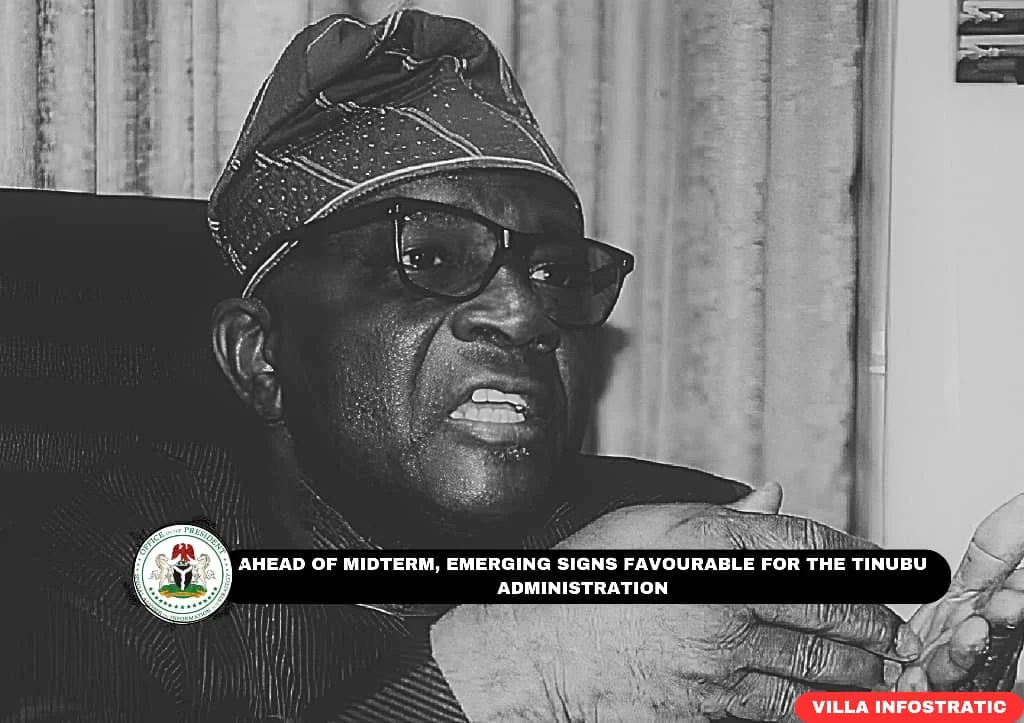
  • Ahead of Midterm: Emerging Signs Favourable for the Tinubu Presidency

    Ahead of Midterm: Emerging Signs Favourable for the Tinubu Presidency

    By Bayo Onanuga

    Although the Administration’s midterm is five months away, President Bola Ahmed Tinubu can proudly reflect on his administration’s journey over the last 19 months. After initial turbulence, the government concluded 2024 stronger than the previous year, as many policies began yielding significant results that even the most ardent detractors could not ignore.

    Under President Tinubu’s leadership, NNPC Limited has fixed two of the four state-owned oil refineries, achieving what many had cynically regarded as improbable. The administration’s efforts have led to a rise in crude oil production, with an expected inflow of more dollars into the Federation Account and remarkable accretion into the foreign reserves. The government remains focused on gas development, attracting investors’ interest. Dollars have flowed into the country through fresh investments in several sectors. The administration created an innovative Ministry of Livestock Development to unlock the previously untapped potential in animal husbandry, steering the country from tragedy to opportunity.

    The lucrative stock market ended the year on a high note, breaking its initial record under the Tinubu presidency. The All Share Index hit over 103,000 from 55,738 on May 30 2023. Market capitalisation is over N63 Trillion. In the last 19 months, local and foreign investors have invested unprecedented amounts in the market.

    The government is also expanding the national road infrastructure stock by building legacy superhighways from Lagos to Calabar and Sokoto to Badagry.

    The administration’s successful euro bond issuance of $2.2 billion notably attracted over $9 billion in interest, while a domestic dollar bond of $500 million was oversubscribed. These developments indicate confidence in the Nigerian economy.

    Revenue generation has increased, and all tiers of government received more funds to spend on the welfare of Nigerians, including the 774 local councils that recently won financial autonomy.

    November and December 2024 proved especially remarkable. Shell and Partners announced an estimated $5 billion investment in the Bonga North oil field. Brazil’s JSB, one of the world’s leading integrated livestock companies, announced a $2.5 billion investment in livestock development in Nigeria, with some officials flying into the country to actualise the pledge. Fuel prices began to decrease amid competition from local refineries, supporting President Tinubu’s belief that market forces would lower the prices of consumer goods to benefit Nigerians. For the first time in our history, the proposed 2025 budget included no provision for a fuel subsidy. There was no scarcity, too. Instead, the government has proposed more funds for capital expenditure, health, education, and national security in the record-breaking N49.7 trillion budget. Critics remain silent as positive indicators continue to emerge.

    Not an accidental president, Tinubu took office on May 29, 2023, with a clear vision for Nigeria: to renew hope through a programme of action to foster economic diversification, stability, and prosperity and build a trillion-dollar economy.

    He has implemented many of his campaign promises and those in his Renewed Hope Agenda.

    Although unintended consequences have emerged, temporarily affecting the well-being of all Nigerians, the administration is working hard to ameliorate the burden on the masses.

    President Tinubu consistently implements reforms, daring to confront headlong the country’s many hydra-headed socio-economic problems and committing to the transformative change the country urgently requires. Posterity will be kind to him and remember his era as a reform-minded leader.

    Positive signs continue to emerge: apart from declining fuel prices, the country recorded foreign trade surpluses for three consecutive quarters, foreign reserves are rising, and the Naira is gaining strength against the US dollar.

    One notable achievement of President Tinubu’s tenure is fulfilling his promise to implement a student loan programme. This initiative financially supports students, ensuring that higher education is accessible to all, regardless of economic background. Investing in the education sector, the administration aims to empower the youth and equip them with the skills needed for Nigeria’s future growth.

    In addition to the student loan scheme, President Tinubu has advanced the consumer credit initiative, another campaign promise, and plans to deepen it in the first quarter of 2025. Promoting access to credit is part of the administration’s broader strategy to stimulate consumption, drive entrepreneurship, and boost the domestic economy.

    On his first day in office, President Tinubu decisively eliminated the fuel subsidy, which had long burdened Nigeria’s economy. While the initial removal triggered higher fuel prices, the market is now experiencing a downward trend. This development illustrates the administration’s commitment to market-driven pricing and economic efficiency, which should benefit public investment in critical sectors in the long term.

    The administration introduced electric vehicles and Compressed Natural Gas (CNG) as alternatives to reduce Nigerian dependency on petrol. In the past 12 months, more Nigerians have converted their vehicles to CNG, spurred by government and private sector investment. A new industry is gradually unfolding, creating new jobs along the value chain whilst promoting a cleaner environment.

    Another bold economic reform was unifying Nigeria’s multiple exchange rates, which previously caused economic distortion, criminal arbitrage, and speculation. Following an initial depreciation, the Naira has stabilised against the US dollar, reflecting increased investor confidence and a more transparent foreign exchange policy.

    Investment inflows further testify to the positive impact of President Tinubu’s policies. The oil, gas, and solid minerals industries are experiencing renewed interest and investment. These sectors are crucial for enhancing Nigeria’s export capacity and creating jobs, thus driving economic diversification and growth. Moreover, Nigeria’s foreign reserves have shown a promising increase, bolstered by improved trade balances and strategic monetary and fiscal management.

    Looking ahead to 2025, President Tinubu plans to introduce what could be his most transformative reform yet—tax restructuring. With four bills before the National Assembly, the proposed reform seeks to streamline tax systems and administration in Nigeria to promote better investment and a friendly business climate.

    Under the proposed tax reform, low-income earners under the minimum wage bracket and small businesses within a certain threshold will be exempt from paying taxes. The administration’s mantra is that taxes should focus on prosperity, not people’s or businesses’ hardships. The government focuses on expanding the tax net, making taxes less burdensome to taxpayers, and getting wealthy people to pay their fair share. This progressive approach reflects the administration’s commitment to equity and fiscal sustainability.

    However, the road to reform does not come without challenges. President Tinubu faces resistance, particularly from politicians and tax evaders who have expressed concerns about the implications of the changes that will come with reforming our tax systems. President Tinubu, who is not oblivious to the pushback, has said he is willing to make necessary adjustments, as democracy is about negotiations, give and take.

    President Tinubu’s administration has demonstrated firm determination over the last 19 months to succeed against all odds and reposition the economy for better performance.

    While challenges remain, especially with food inflation, President Tinubu’s leadership has shown a proactive and committed approach to addressing these issues. The administration’s trajectory suggests a path toward Nigeria’s economic stability and social development. Though it is not midterm for the administration, realising a prosperous and equitable country looks promising and achievable. The Tinubu administration is undoubtedly steadfast in its resolve to improve Nigeria, and it’s on course to achieve all the campaign promises to the people.

    •Onanuga is the Special Adviser on Information and Strategy to President Tinubu

  • Tinubunomics: Have we Crossed the Rubicon?

    Tinubunomics: Have we Crossed the Rubicon?

    The year 2024 was gruesome for many, globally, what with the wars, violent crimes, civil strife; just name it. Many parts of the world became like William Butler Yeats’ widening gyre. It was no wonder that many looked so forward to 2025 that the new year was ushered in with some kind of gusto that belied all the whining about bad economy. May be the excitement stems from the resolve by many that even though 2024 left footprints tears and blood, the emotional turmoil most not be allowed to endure as we brace up for a new year that should be different.

    In Nigeria, President Bola Tinubu did a fairly job of giving a not too sombre new year broadcast. Unlike previous communications that drip with arrogance, insensitivity and propaganda, this new year message was temperate and contained realistic promises that one can relate. The only major flaw is that there is still a big gap between what the citizens expected to hear and what their president was telling them. For instance, not a few Nigerians are yet to be convinced that the economic policies of the administration is headed in the wrong direction and are waiting for the president to announce a review.

    As one of the anchors on Arise TV Morning Show brilliantly captured it yesterday, January 1, 2025, the Federal Government of Nigeria has unabashedly adopted a Neo-liberal economic development model that is anchored on dictates by the Bretton Woods Institutions. Put simply, Nigeria has adopted a fully fledged capitalist agenda in its economic planning principle. So, at least for now, there is no room for any form of subsidy or subvention and those who are still waiting and hoping that Mr. President would backtrack on his reform agenda are not only wasting their time waiting for a bus that would not come, they are at the wrong bus stop altogether! Now that the President and the Federal Executive Council have crossed the Rubicon, the question is whether Nigeria ready for a capitalist economic model? Or, our we merely putting the cart before the horse? May be the President, those working with him and his cheerleaders need to be reminded that economies are PLANNED, and not DICTATED. As it is often said, there are many ways of killing a chicken, but the challenge lies in deciding which is the best way, which, however, is not like reinventing the wheel.

    Creating chaos or causing massive destruction in the socioeconomic fabric of the society just because you want to proffer or find the solution to a recurring problem does not look like a smart approach to development or economic planning. After all, others have traversed the route, and we should be able to learn from their experience. One of the most important difference between any two individuals or countries in today’s world is most likely to be their capacity to create wealth. In this instance, Nigeria has the unique advantage of being a resource-rich and high-earning economy where the major challenge is the management of the wealth of the nation. It is true that time is of essence, but the regime has four years in the first instance, to commence the reform process, and it is entitled to another term of four years, if the electorate is convinced about the efficacy of the approach. The point being made here is that there is rarely an alternative to an organised planning that is thorough and methodical, if the outcome is expected to endure. In this instance, the more sustainable approach is a bottom-up strategy that enlists the buy-in of the enlightened segment of the populace.

    At the moment, the content and manner in which the President Tinubu Economic Reform Programme is being deployed may deny it needed integrity for it to endure. A substantial segment of the Nigerian populace feel unduly burdened by a set of reforms they are unable to connect with. Only yesterday, the former governor of Kano state, Senator Ibrahim Shekarau emphasised the point that part of the reasons many are resisting the Tax Reform Bills is because they feel excluded from the administration of President Bola Tinubu. Second, apart from the bias in the choice of officials to drive the policies of the government, it does not enjoy the buy-in of a lot of the people for which they are intended. Even the civil service is ill-conditioned to drive the policies. This leads some to wonder whether it would have not been more appropriate to commence with the reform of the service, cut the cost of governance, right-size the workforce and upwardly review the system of emolument before introducing some of the reforms?

    So, the advisable strategy is for the government to introduce measures to build back the purchasing power of the average citizen. And this can not be achieved through palliatives or cash transfers but through adoption and implementation of a robust and sustainable strategy that entails the following:

    1. Tackle Insecurity, Poverty: Insecurity is the negative elixir that fuels most of the headwinds against socioeconomic progress in contemporary Nigeria. Insecurity and poverty are intertwined and mutually re-enforcing. Affordable food supply is the silver bullet that has the potential to tackle both evils. So, the federal government may do well to bring the governors onboard and sensitise them to realise the imperative of a partnership across party lines to address the two problems through an agrarian revolution.
    2. Reform civil and public services to nip corruption in the bud and cut the cost of governance. For the civil service, it may be necessary to incentivise the dead woods to retire; then right-size, retrain the workforce and review the pay package to enhance discipline and productivity. The President must display the same courage he has exhibited in the withdrawal of subsidies by introducing similar cuts in the cost of governance. The current Animal Farm approach of not acting based on your preaching does not cohere. If not addressed, the president can be assured that his successor in office may throw away most of his policies.
    3. Upgrade existing infrastructural facilities to support industry and commerce. This will be the right point to withdraw subsidies, review tariffs and introduce tax reforms.
    Stampede at a food gifting centre, Okija, Anambra State at Christmas

  • A Plea to Prioritize Peace, Unity & Development of Ijeshaland as Monarch Receives Staff of Office

    A Plea to Prioritize Peace, Unity & Development of Ijeshaland as Monarch Receives Staff of Office

    The new Owa Adimula Obokun of Ijesaland, Kabiyesi Clement Adesuyi Haastrup Ajimoko III, has officially ascended the throne of his ancestors. It is absolutely the fact that the process of his choice and the rapidity with which he was presented the staff of office, to put it mildly, is unique and unusual. However, given the caliber of great and eminent Ijesa leaders including our Asiwaju Yinka Fasuyi, our Baba Sawe, virtually all the Kabiyesis in Ijeshaland, led by the Elegboro, the President of the IDC Elder Supo Shadiya, Alhaji Lateef A Bakare, Yeyerise of Ijesaland, eminent jurists like Dr. Adedotun Onibokun and other key stakeholders, de creme de la creme of the Ijesa high society, commissioners, the Ijesa grassroots, paramount rulers from across the state and, of course the Governor, all in attendance within a space of less than 24 hours.
    That should send the unequivocal message to all to sheath their swords, to prioritize Ijesaland’s hard earned subsisting environment of unity, peace and development that eluded us for decades until now, over and above the pain of our preferred candidate not making the cut.

    Yes, we wished the selection process had been 100% and by the book, but we can not allow the perfect be the enemy of the greater good.

    Kings and rulers are ordained by God. There can only be one king in palace at one time. The Bible enjoins us in Romans 13:1-7: that People should submit to governing authorities because they are established by God. The Bible did not tell us to submit to only the authority whose emergence was done via our preferred modality.

    Does Kabiyesi Adesuyi possess the gravitas, the intellectual, physical, and material acumen to occupy the throne? Was he eligible as a descendant of the ruling house? Would he probably have emerged had the process dragged on for weeks? Is he the most qualified, based on personal qualities, experience, accomplishments, national and global connections that will come in handy in attracting development to the community? Is he the worthy Ambassador Oba for Ijesaland who is already equipped with the charisma and wherewithal before ascending the throne to become relevant from day one among the first tier of Obas in Nigeria? Is he an Oba who will not be going cap in hand begging or grabbing and selling community land for sustenance and become an errand boy for the Ooni Ife?
    Yes, many of us are aggrieved that proper protocol might not have been followed to the letter, but if you can answer affirmatively to the questions, we must do the honorable thing by following the lead of our Ijesa leaders and submit to the authority of our new Kabiyesi.

    We must prioritize the peace, unity, non-violence, growth, and development of Ijesaland as more paramount than who the paramount king is. We should not write off the Kabiyesi based on how he ascended the throne but give him the space to prove his mettle.

    Given the circumstances of his ascension to the throne, it would be expected of our new Owa who has just been installed to prioritize and devote all of his energy to healing the fissure the process adopted in his selection has created in Ijesaland, to unite the divided Ruling House, regularize and legitimize the process, the procedures, the paperwork for the chieftaincy institution in Ijesaland, whose underbelly has been exposed for the world to see. We shouldn’t have high chiefs in Ijesaland whose paperwork at the state level has not been regularized if one is to believe the story about why prominent kingmakers were excluded from the selection process. Sadly, our traditional monarchical institution, whose reputation has already taken a bad beating over these past decades, has just gotten another huge punch in the gut. The implication is that the new Owa has a lot of work to do to rebuild the institutional reputation of our monarchy, restore the citizens confidence, and respect for this hallowed institution, as well as reposition it to its past glory. It is only then that His Royal Majesty can meet up the huge expectation of Ijesa at home and abroad to accelerate and build on the solid foundation of unity, peace, and community-led development that has already been laid. His first official duty of announcing the appointment of Alhaji Lateef A. Bakare as the Ajiroba of Ijesaland was a stroke of genius.

    Sir LAB is a grassroots man with his ears to the ground who knows the pulse of the Ijesa society. He would serve him in the reconciliation and healing process.

    The better news is that some of the heavy lifting has already been done under the able leadership of Asiwaju Fasuyi and the exceptionally talented team of seasoned community leaders and stakeholders who have worked diligently to create an ecosystem of development.
    The flip side of that great news is the challenge it poses to the new King , and there is no doubt he will meet and exceed. The standard of expectation for performance of Ijesa for their monarch is now through the stratosphere. Ijesa have no stomach and patience for incompetence or the go-slow approach. The new monarch would need a huge bust of energy, creativity, wisdom, a listening ear, and innovative 21st century approach to community governance to manage a high energy, highly motivated, development-oriented citizenry. It is our obligation and commitment as his patriotic subjects to support him as he embarks on this Herculean task. May the reign of Owa Obokun Adimula of Ijeshaland, His Royal Majesty Clement Adesuyi Haastruup Ajimoko III bring renewed unity, peace, harmony, and unprecedented development to Ijesaland.

    Adewale Alonge, PhD, is Founder & President, Africa Diaspora Partnership for Empowerment and Development. www.adped.org

  • MY PREDICTIONS FOR 2025

    MY PREDICTIONS FOR 2025

    DO not ask me whether I am now also among the prophets as was curiously inquired of someone else in the Good Book. This shock of a development was recorded in 1 Samuel chapter 10 verse 11. I will take the version or translation or adumbration of the Message Bible. It said: “When Saul and his party got to Gibeah, there were the prophets, right in front of them! When those who had previously known Saul saw him prophesying with the prophets, they were totally surprised. What’s going on here? What’s come over the son of Kish? One man spoke up and said, ‘Who started this? Where did this people come from? That’s how the saying got started, Saul among the prophets! (Is Saul also among the prophets?). Who could have guessed?”. I may not have really been called to the ministry of prophecy but I am also a prophet of sorts. But the more important thing is that in Nigeria you do not need to be a schooled prophet to predict what will happen tomorrow, the next day or the day after. I know that prediction and prophecy are not one and the same thing, but I will leave those who like to split hairs to worry about the distinctions and differences.

    For our purpose today, the last day of this troubled year, I will be peeping into my crystal ball and I will treat whatever I see that will happen in Nigeria in 2025 as a prophecy. So I will advise that you do not deprive yourself of the prophet’s portion through unbelief. Here we go. In 2025, I see the country implementing two distinct and separate national budgets simultaneously. Unless Nigerians pray very hard, I see the number of budgets climbing to three towards the end of the year. Whether two or three budgets end up being implemented by the All Progressives Congress political party led federal government, it will still be an improvement on 2023/2024 fiscal year when, at a time, three and half budgets were being implemented. As it is the case right now, I predict that by this time next year, the henchmen of the government will not bother to give a coherent account of the performance, or better still, lack of performance of the expiring fiscal document or documents.

    From my crystal ball it has been shown clearly to me that the 2025 budget will be passed by the national assembly and signed into law by the president of Nigeria, Alhaji Bola Ahmed Tinubu, before April. The delay in passing the budget will not be down to the scrutiny of the document by senators and representatives. The delay will be down to two factors: one, for them to have sufficient time to pad the budget to line their pockets, and two,to create the impression that they are conducting due diligence. I predict and prophesy that the 2025 fiscal document will be riddled with hanging monetary provisions: allocations for building farm settlements which will be under the aviation and aerospace ministry; budgetary provisions for the repair of highways which contracts will be awarded to crude oil prospecting companies; funds for space exploration which will be domiciled in the newly created ministry of livestock development; and, money inserted in the ministry of agriculture which is expected to be used to build and install solar lights on Lagos -Ibadan expressway. Budgetary allocations for the construction of new classroom blocks in our Unity Schools will be in the name of one obscure restaurateur whose eatery is not registered with the Corporate Affairs Commission; money will be allocated to a community development association in Mgbidi in Oru West local government area of Imo state for the kitting of the national youth service corp members nationwide. It’s our prediction that this will be the complexion of the 2025 national budget. Those who may not like the look and the taste and the texture of the fiscal document should be free to ‘go to court’. The pockmarks and  abracadabra budgeting will continue next year and Budgit, SERAP and other anti-graft kindred spirits go scream and shout taya. These watchdogs have yet to realise that they are talking to rulers who have ingrained witchcraft spirit, the type that whispered to them to remove petrol subsidy and devalue the Naira at the same time last year without considerations for the deleterious fallouts.

    I prophesy that nothing significant will happen with the claim by the regime that it is working to diversify the economy. The Naira value of non-oil exports will increase in a phenomenal manner. But the significant increases will be due to the illusion of money. In dollar terms, the value of non-oil exports will be lower, or it will at best be at the same level with that of Muhammadu Buhari. And there’s nothing complementary with any regime’s performance being compared with Buhari’s, who until now was Nigeria’s worst president. Bad as it is, the Naira will continue to be unstable and unsettled, and will continue to bleed. The posturing of the central bank of Nigeria is just that – posturing. The claims of accretion to the foreign reserves is a ruse. That’s why the CBN is loathe to speak to the structure and tenor of the foreign reserves. The devil is in the details. So there will be no sustainable reprieve for the Naira. Indeed as we wrote this last weekend, Afrinvest took the thunder out of our prophecy. It projected in its latest study that the Naira will depreciate to N1,804/$1 at the official Forex window in 2025. Afrinvest said that it anticipates “that exchange rate volatility would persist in 2025, albeit at a modest pace. Our prognosis is hinged on the belief that the CBN would be constrained from adequately meeting market demand on a sustained basis, as the recent FX reserves accretion was largely driven by inflows from inorganic sources, including those with stringent conditions on usability”. The title of the report, Beyond The Rhetorics: Transforming Reforms to Tangibles, should not be lost on Nigerians.

    Under Buhari over 133 million Nigerians were reported by the government’s national bureau of statistics (NBS) to be in the grips of dimensional poverty. The agency has studiously refrained from issuing further reports on this under Tinubu. In light of the punishing economic policies of the extant regime any further such reports will unsettle this administration and set the alarm bells ringing. However, the NBS recently said that about 53% of Nigerian children are dimensionally poor. A peek into the ramifications of dimensional poverty will help us to appreciate how dire the circumstances of Nigerians are. Dimensional poverty is a concept that describes a state of deprivation or scarcity that extends beyond traditional measures of poverty such as income or material possessions. It encompasses the totality of well-being, including limited access to financial resources, income and employment opportunities. It also involves social connections, relationships and community support. It includes environmental dimensions such as limited access to clean air, water, sanitation, and other environmental resources. There’s also a psychological aspect of dimensional poverty which includes mental health issues, stress, anxiety, and lack of emotional well-being. Spiritual dimension extends to disconnection from one’s spiritual or religious beliefs, values, and practices, while educational dimension involves limited access to quality education, skills training, and personal development opportunities.

    Furthermore, poor physical health, limited access to healthcare services, and inadequate nutrition as well as disconnection from one’s cultural heritage, traditions, and values form critical pillars of dimensional poverty. How many Nigerians are not affected or afflicted by one or more of these issues? Dimensional poverty recognises that poverty is not just about economic scarcity but also about the lack of opportunities, resources, and capabilities that can affect an individual’s or community’s overall well-being. The core of the concept is that dimensional poverty acknowledges that poverty is a multifaceted issue that cannot be addressed by a single solution. It requires a holistic approach by policy makers to overcome. Above everything else, it is important to recognise that poverty is not just an economic issue but a human rights concern. Many previous rulers of our country have been unable to recognise this, and the present rulers will not act differently in 2025. So, next year dimensional poverty will not be properly recognised and steps taken to address it to ensure that a more equitable and just society where everyone has access to the resources and opportunities they need to thrive would be created.

    The only way that the ruling APC knows how to grow the Nigerian economy is by accumulating debts. Therefore, I prophesy that both the domestic and external debt stocks of the country will continue to tick upwards in 2025. Buhari kept borrowing in the name of Nigeria, and then he resorted to mortgaging the country’s crude oil for cash for immediate squandering. Tinubu as he promised during the 2023 campaigns continued the borrowing spree without let. The profile of his borrowings from the World Bank alone reads like this: June 9, 2023, $750m for the power sector (the country is still in darkness suffering from acute energy deficit in spite of the prohibitive cost); June 27, 2023, $500m for women empowerment; July 2023, $800m to cushion the effects of petrol subsidy removal; September 2023, $700m for girls education; December 14, 2023, $750m for renewable energy; $500m to enhance rural access and agricultural marketing; June 13, 2024, $1.5bn for economic stabilisation reforms: June 13, 2024, $750m for resource mobilization reforms; September 2024, $1.57bn for health, education, and sustainable power sectors; October 2024, $500m for sustainable power and irrigation for Nigeria (SPIN) initiative; and, this December, $500m to boost rural access and agricultural marketing in Nigeria. This does not include borrowings from other sources, and this regime is less than two years in office.

    I prophesy that the national assembly will pass the tax reform bills in 2025 after Tinubu had made concessions to pacify sections of the seemingly implacable north. The measured climb down will be political, not economic, because the president has been in the campaign mode for 2027. However, he will look for ways to circumscribe the concessions. From tomorrow which is the first day of 2025, President Tinubu will continue the Yorubanization of appointments into sensitive and critical offices of the federation, the Lagos non-indigene Yoruba, of course. In this regard, I predict that the next chief executive officer of the Nigerian National Petroleum Company Limited (NNPCL) will be a Yoruba. That will be the culmination for full occupation of the country’s financial and revenue generating agencies of the federal government. The security angle is almost sealed with Yoruba Police and Army chiefs.

    In 2025, I prophesy that state governors will devise the means to continue stealing the federal accounts allocations of the local governments in spite of the weird financial autonomy awarded the councils by the Supreme Court at the instance of Tinubu. I predict that the national assembly will work hard to impose on the ‘Independent’ National Electoral Commission (INEC) the conduct of local government elections. Subsequently, the councils will be infested with the gargantuan corruption of INEC. During the year, Tinubu’s refrain about his wonder-working economic reforms will become louder in spite of the evidence before Nigerians. He, and his co-travellers, will insist by 2025 that those who would not see the light at the end of the tunnel are either blind or mischievous or both. But we know those who are suffering from optical illusion – they are our thoroughly wicked rulers. They are seeing nothing, and they know it. In 2025 judges will continue to harvest bribes to pervert justice; the police, army, customs and others’ road blocks (extortion plazas) from Sagamu-Aba will not decrease; governments at all levels will do nothing about internally displaced persons (IDPs) across the country; and, deaths occasioned by food stampedes will not abate. In all, Nigeria’s ranking on the global misery index will deteriorate further in 2025. There will be no change in Nigeria’s standing as the global capital of poverty. It has occupied that status since 2019. Let us, Nigerians, intensify to do what we know how best to do: PRAY, instead of holding our rulers to account. Happy New Year.

    UGO ONUOHA, a veteran Journalist, was the Managing Director/Editor-in-Chief of Champion Newspapers Limited

  • THE MIRAGE OF A FRENCH MILITARY BASE IN NIGERIA

    THE MIRAGE OF A FRENCH MILITARY BASE IN NIGERIA

    “So, it will seem like it is President Tinubu’s visit to France that is rattling Tchiani and he is scared of the possibility of discussions about Niger by the two Presidents. Since President Tinubu’s visit to France, the media space has been filled with rumors of French troops on our soil. Aside the AP video of 2013 in Mali, there is no evidence whatsoever to this outrageous claim.”

    By Tahir Ibrahim Tahir Talban Bauchi

    2027 has come so early with a groundswell of gimmicks and political manoeuvres that are being used to overheat the polity, and shape political opinion in favor of those angling to contest the 2027 elections. From the Samoa agreement fiasco, through to the tax reforms debates, we are now in the middle of a conversation about french invasion. A certain journalist who is notorious for spreading fake news and ending up presenting as a sick person in court when arraigned, was at his propaganda best, spreading the fake news of a french military presence in Nigeria. He was called out online by a security expert who pointed out to him that the soldiers in the said video were English, and that it was not the first time that the Nigerian military is collaborating with foreign personnel for training and similar programmes. He deleted his post after that. Now the Niger Head of state Abdourahamane Tchiani, President of the National Council for the Safeguard of the Homeland, CNSP, has come forward with allegations that the French government has a military base in Nigeria, and is harbouring and supporting the operations of terrorist cells with the active participation of the Nigerian government. Our ‘sick in court’ journalist and his cohorts have latched onto this once more and are milking it on behalf of the 2027 hopefuls.

    Who is Abdourahamane Tchiani? He is the presidential guard commander that betrayed President Bazoum and forcefully removed him from power on the 26th of July, 2023. Since his ascension to power, Niger has not witnessed meaningful developments that have justified his military coup. His supposed romance with Russia has not yielded any dividends as Russia is embroiled in a war with Ukraine, and practically the whole of Europe (or those that matter) and the US as foes. Tchiani has come to the crossroads where he has to come clean with his people. He has zilch on his scorecard, topped with a battle with rebels that want to ease him out. He is lost for words and ‘lost for action’ and does not have anything promising for his people. He is obviously not the hero he posed to be. He also does not have the support of his neighbouring countries. The economic support that is most crucial to his supposed transition to civilian rule. A drowning man they say will clasp onto a straw. Tchiani is drowning and he is looking for straws to latch onto. He is in search of protagonists to his lost cause. 

    The ECOWAS Commission, and the Nigerian Government have debunked his claims. The Information Minister and the National Security Adviser have also done so eloquently. The National Security Adviser has challenged him or anyone to provide proof of the claims of a french military base in Nigeria. Tchiani’s claims are quite porous anyway. His claims that the former Director of the National Intelligence Agency, Rufa’i Ahmed, is part of the operations linked to a terrorist group is a big lie to the high heavens. He probably thinks Rufa’i is still in charge. Meanwhile Rufa’i left the service in August of 2024. Tchiani is making his claims in December of 2024. Rufa’i is not in charge of the system anymore.

    Also, DailyTrust did us all a favor of fact-checking the video in circulation, which is being referred to as the evidence of French troops in Nigeria, and found out that the video was recorded in 2013 in Mali. The Nigerian troops seen were on a training mission under the auspices of the AU. This video was uploaded on Youtube in 2015. That is almost 10 years after. Nigerians are witnesses to the war on terrorism in Nigeria, including the war waged on the Lukarawa group, who have faced aerial bombardments from the Air Force. This is the group Tchiani is claiming that the Federal Government is using to fight him. Again, Tchiani’s claims do not hold up according to the border communities in Sokoto state who have also debunked Tchiani’s claims. He alleged that there is a forest called ‘Gaba’ where the french have their base in Sokoto. Those communities have denied the existence of any forest called Gaba in their areas. In fact the district head of Ilelah said that the Nigerien military officials come in from Niger to work with their vigilantes in maintaining peace and order in their communities. This was disclosed during a fact check by DailyTrust. There are no french troops in the border communities between Nigeria and Niger.

    The US had asked Nigeria for permission to build a military base long ago and it was refused. The UK who are our colonial masters have not built a military base in Nigeria. Nigeria has a better diplomatic relationship with the UK and the US. How will Nigeria entertain a French military base in the country? To incubate and propagate terrorism? The UK would sit and watch such incursion? Mr. President was hosted officially in France recently and his visit was to woo French investors into the country. There were no defence or security pacts. President Tinubu and President Macron have a personal relationship that spans over 25 years, back to when President Macron was a junior officer in the French embassy in Lagos.

    So, it will seem like it is President Tinubu’s visit to France that is rattling Tchiani and he is scared of the possibility of discussions about Niger by the two Presidents. Since President Tinubu’s visit to France, the media space has been filled with rumors of French troops on our soil. Aside the AP video of 2013 in Mali, there is no evidence whatsoever to this outrageous claim. Tchaini feels Nigeria is working with France to oust him. He doesn’t understand that Nigeria’s priority is to quench the fire of terrorism in its homeland, and not Niger’s. Nigeria’s concern is to woo investors, and not partake in military misadventure. As soon as the people of Niger realise that Tchiani has actually nothing to offer them, they will rise against him. If the people don’t, his military constituency will.

  • Deaths and blood rituals for bulaba balablu Christmas

    Deaths and blood rituals for bulaba balablu Christmas

    Deaths and blood rituals for bulaba balablu Christmas

    ‘It will get worse before it gets worse’. That was the title of my article published here and in other newspapers on November 21, 2023, six months after Nigeria’s president, Alhaji Bola Ahmed Tinubu, assumed office, and started his incoherent economic policies and programmes. The chicken is coming home to roost but it’s doing so at the cost of limbs, livelihoods and lives of the majority of Nigerians who are at the receiving end. Everyday we wake up to news of tragedies, especially of avoidable accidents, miseries and needless deaths. Tragedies now straddle the land – at home, school, market, highway, sea/river, farm, stream, bush path. Everywhere, really. There are no safe places in our country anymore. Nigerian lives no longer matter. Generator fumes wipe out families in their sleep. Kidnappers are no longer content with snatching travelers on the highways; they now pluck them from their homes, and kids from their schools, playgrounds, and classrooms. Terrorists, bandits, and sectarian insurgents who for political correctness were christened herdsmen invade farmlands and rape women and girls, slaughter  men and occupy  farms. Markets routinely go up in flames, many of them suspected to be acts of sabotage designed to cause economic dis-empowerment of a section of the country. Panels of inquiry follow such incidents but the results usually come to naught. There’s no life for a vast majority of Nigerians, and where there is, it is cheap.

    When we wrote on November 21, last year that things will only get worse in this country we had no inkling it will be this bad. We had wished that we will not be vindicated because the consequences will be dire. The reality today is that Nigeria is in a dire straits. But the truth is that in spite of the acute poverty gripping Nigerians right now, the prognosis is that the future, at least the near future, is not looking good. If truth be told the future for many Nigerians is foreboding. What we wrote 13 months ago could have been written today and they will not be widely off the mark. The first three paragraphs of that entry unedited read: “Nigeria is in the intensive care unit and its caregivers appear not to be perturbed. No. They are actually engaged but not in attending to a gravely ill patient. They make platitudes on the delivery of their promises but commit to attending to their hedonistic desires and pleasures.

    “It is 146 days (as at November 21, 2023) since another set of rulers took the reins of power in Abuja. But not for one day have Nigerians heaved a sigh of relief. It has been like the reign of the Biblical rebellious Absalom in one part of the divided Kingdom of Israel. Absalom had told his subjects that whilst his father King David chastised them with the whip, he would do the same with the scorpion. Under former President, Maj.-Gen. Mohammadu Buhari, Nigeria suffered afflictions of unimaginable proportions. Indeed as that clueless regime that was bereft of imagination and humaneness was winding down, the common refrain from Nigerians was: Never Again. Many citizens believed that no future administration in Nigeria will be worse than Buhari’s in terms of abuse of power, impunity, desecration of democratic ethos, insensitivity to the country’s diversity, disregard for the suffering of citizens and intolerance of critical and opposing views. Obviously, we were mistaken”.

    Stampede at Okija, Anambra State

    The extant regime which we wrote about when it was six months old in November last year will be 20 months in office by next month, January 2025. Loyalists and choristers of ‘on your mandate we shall stand…” will still fly off-the-handle to insist that it is still too early to assess the capacity of the regime with a four-year mandate. We will grudgingly concede that they may be right. However, the challenge is that there are virtually no indications that the needles for economic recovery and good governance are moving in the right direction, even if slowly. The experience is that of deterioration in the living standards of many, crisis in the cost of living, runaway inflation with food inflation about 40%, imported inflation caused by the country’s overwhelming dependence on imports and the poor exchange rate. The prediction is that many of these indicators will continue to head south for the foreseeable future. The consequences of forlorn hope which has trumped Tinubu’s ill-fitting  mantra of Renewed Hope are beginning to increase in their effects. You don’t need to listen to hear the groans of the people. You don’t need to be sensitive to feel the despondency of citizens. The sound of hopelessness is loud and clear. Nigerians are buffeted and the country could just be sitting on a keg of gunpowder. But do our rulers know about this clear and present danger? I doubt it otherwise they won’t still be behaving like Nero who serenaded himself with the wafting sounds and melodies from his flute while Rome burnt.

    If they know that the folks are hurting they probably will not continue their hedonistic indulgences by parcelling significant portions of the 2025 national budget to themselves. As in the budget of this year, hefty sums in billions have been carved out in next year’s appropriation bill to buy sport utility vehicles (SUVs) for themselves, their consorts, cronies, and their acolytes; renovate mansions, residences and offices; procure cooking utensils and cutleries; provide fittings, fixtures and furnishings; pay for offshore frivolous junkets and carousing; gorge themselves on foods and drinks at banquets; organize trainings at home and abroad where nothing useful are learned; set up additional ministries, departments and agencies that fail even before they take – off; and, sundry things that suit their fancies. Almost N50 trillion is said to be the size of the proposed 2025 budget. But by this time next year Nigeria will at best still be stagnant, and at worst deteriorated further in the global misery index. By the way, the current budget is said to have its implementation extended up till June 2025. So by the time next year’s budget is rubber-stamped by the national assembly, say in February or March, the two budgets will be running side-by-side. Multiple budgets make accountability by the government difficult but it has remained the preferred option for this regime since its inception. It ran multiple budgets in 2023. It is doing the same in 2024. It will do so in 2025. When you want to evade accountability, muddle the budget, and distort the conventional January -December budget cycle. Play ‘smart’ and pretend that nobody will understand the game. But Nigerians are no fools.

    We are in the season of Christmas and New Year celebrations. But the aroma of the season is not in the air. In its place we have the smell of death. Nigerians are not amused. Ordinarily, Christmas should be a season of celebrations and reflections symbolising light, hope, and redemption. It’s a period when people, especially Christians demonstrate love, kindness, and generosity towards others. It’s a time for family reunion, boost in retail sales and businesses as well as travels and tourism, and vacations. It’s also a period when many people engage in charitable giving, donating to causes and organisations that support the vulnerable and those in need. Christmas is a time for renewal and new beginnings. It offers the opportunity to reflect on past experiences and to look forward to the future. But under Tinubu Christmas has added a new, depressing and morbid dimension – death in dozens. Gloom has overtaken excitement. Mourning has replaced celebration. Hopelessness has displaced hope. It’s renewed anguish for renewed hope. Death has taken the place of life. For Christians December is a celebration of life, the birth of Jesus Christ. But Christmas of 2024 looks more like Easter when Christ was crucified. This Christmas is a season of mourning – mourning in scores.

    Ibadan Stampede, Oyo State

    Tomorrow is Christmas Day but many homes will be mourning, wearing sac clothes. The week before this Christmas may go down in history as the period the most tragedies were recorded in Nigeria with scores of avoidable deaths through stampede caused essentially by grinding poverty. In a space of one week about 35 persons, mostly children, were killed in Ibadan, Oyo state in a supposed fun fair. In reality, it was not a fun fair. It was a hunting ground for food and sundry gifts for starving kids and their parents or guardians. A stampede ensued and the children trampled under the foot. There was no assurance that the children who turned up in their numbers, far more than the capacity the organisers could handle, had any food in their stomachs, and the energy to survive the push and the shove. So they died because this country eats its children. Arrests have been made. Probe has been ordered. Commiserations have been offered. Those are standard fairs. As we wrote this last Sunday, the Ibadan deaths have receded from the news headlines. The authorities are still probing the devastating blast that wrecked the same Ibadan about the middle of this year. As we say here, that probe has ‘entered voicemail’. There’s no reason to believe that the same will not happen to the deaths of the kids.

    Soon after Ibadan tragedies struck in Abuja in the federal capital territory at a Roman Catholic church. Eleven persons were reportedly killed in yet another stampede. The church has a tradition of giving alms to its neighbours and other less privileged people in the community and beyond. The charity is not limited to its members nor to Christians. The church has done this in the past without any incidents. Until this year. The venue was besieged, and in the process of distributing the alms, a stampede ensued and almost a dozen people were killed. About 350 km from the Abuja church, another harvest of deaths took place. This time in Okija in Anambra state. Obijackson Foundation founded by billionaire Ernest Obiejesi, was conducting its annual gifting of bags of rice and other food items to the needy when tragedy through yet another stampede struck. The death toll was officially put at 21. They were mostly women and expectant mothers. A mother of Nigerian extraction who is abroad wept uncontrollably when her son showed her the video of the incident. She lamented that it had to be mothers because they were searching for where the next meal for their children would come from. She reportedly would not eat for the rest of that day. So in the week before Christmas about 70 Nigerians died because of poverty inflicted on them by their own rulers.

    Already the search for scapegoats for these avalanche of deaths has started. Some persons, especially regime choristers, are pointing accusing fingers at the organisers of these events for failure to put in place mechanisms for crowd control. They may have a point. But they conveniently forget that some of these charities have been going on for years with no incident. Could it then be possible that the misery and poverty and hopelessness inflicted on Nigerians are the reasons for the desperation that led to the stampedes in Abuja (north), Ibadan (west), and Okija (east)? Governments at all levels are culpable for the harvest of deaths. But the federal government whose misguided macro economic policies have pauperised the majority of Nigerians takes the lion’s share. The policies of this regime have turned once proud and otherwise hard working Nigerians into beggars and hunters of palliatives. The federal government has ordered that the tragedies be probed. What’s there to probe? The reason for what happened is in plain sight – hunger and starvation occasioned by government policies have driven people to the edge. In Okija, for instance, people were not deterred by the deaths. A video showed that people still stayed on for the bags of rice even after the confirmation that 21 persons from amongst them had died. That was the level of desperation. Nobody was scared that the next stampede could claim their own lives.

    Meanwhile, the Nigerian Police are at it. They said that they are minded to prosecute the charities and persons in whose events the tragedies happened for being negligent in crowd control. They can go ahead as long as they bear in mind that the first to be indicted should be the federal government which has breached a crucial provision in the Constitution which says that the primary duty of the government is to ensure the welfare and security of Nigerians. Has it lived up to it? The police should also know that after indicting the organisers, getting the courts to proscribe the charities, and jailing their operatives, others may begin to shun the act of giving. The emergent hungry and angry people will be recruiting grounds for criminals. It will be a vicious cycle. Is that where we want to be at this time in our country?

    President Lays 2025 Budget Proposal Before the Joint Session of NASS