Tag: President Bola Tinubu

  • Tinubu’s Broadcast: ECOWAS Breaks Silence on Hunger Protests

    The Economic Community of West African States (ECOWAS) has broken its silence on the ongoing protests in Nigeria.
    In a statement released on Tuesday, the ECOWAS Commission urged protesters to heed the call for dialogue and peaceful resolution of their grievances.
    The body expressed deep concern over the violence, fatalities, and property destruction that have marred the demonstrations
    The commission extended condolences to the families of those who have lost their lives in the protests and expressed sympathy with the Nigerian government and its people over the losses incurred.
    The statement said, “The ECOWAS Commission has been closely monitoring the ongoing protests by citizens of the Federal Republic of Nigeria and deeply regrets reports of violence in the course of the protests and the unfortunate death of some protesters as well as alleged looting and destruction of public and private properties.
    “The commission extends heartfelt condolences to the bereaved families and sympathizes with the Government and people of the Federal Republic of Nigeria over the losses.
    “The ECOWAS Commission recognises the right of citizens to peaceful protests, as guaranteed by the 2001 ECOWAS Supplementary Protocol on Democracy and Good Governance and enshrined in the 1999 Constitution of the Federal Republic of Nigeria, as amended.”
    ECOWAS also welcomed President Bola Tinubu’s recent State of the Nation address on Sunday, in which he called for inclusive dialogue to address the grievances of protesters.
    “The Commission welcomes the State of the Nation address of August 4, 2024 by President Bola Tinubu and urges the protesters and all stakeholders to heed the President’s call for inclusive dialogue for the resolution of all grievances and the preservation of peace and security in Nigeria and the ECOWAS region at large,” it added.
    The hunger protests in Nigeria, which began as a peaceful demonstration against the rising cost of living and food insecurity, took a violent turn last week, resulting in numerous deaths and the burning of properties.
  • The imperatives of creating Anioma state

    The agitation for the creation of Anioma state or autonomy for the people is not a fly-by-night struggle nor a new idea prompted by such other demands in the South East geo-political zone or in other zones. The Anioma issue has been raised at any given opportunity and at every appropriate forum in this country in the last 50 years, possibly more.

    By UGO ONUOHA

    FOR the life of Nigeria as an independent country, 1960, the history is fairly recent. Though the journey through time had been chequered, nothing these past 64 years, next October 1, had been so traumatic, including the chilling bloodletting of the Biafra -Nigeria war (1967-1970), and the challenge of reconciliation more than 50 years after the war, to erase our individual and collective memories.


    And because of this, it is likely that many adults amongst today’s Nigeria’s population of mainly young people will recall some fundamental events in the first republic between 1960-1967. One of such events was the creation in August 1963 of the defunct Mid-West region from the defunct Western region. Before the Mid-West region, there were the Northern region, Eastern region and the Western region which were in many respects the arbitrary creations of the British colonizers in the 1940s.


    So, historically, again if our memories do not play pranks on us, the Mid-West region was the first and sadly only self-governing territory within Nigeria that was created by popular demand and through a democratic process. The Mid-West region came to be essentially because of the political power play between the Eastern and Northern regions on the one hand, and the Western region on the other hand. But it was also founded to satisfy the political and developmental aspirations of the peoples of the Benin and Delta provinces of the Western region.

    In his private and public life, Nwoko has not been associated with tardiness. So it was no surprise that the contents of his bill for the creation of Anioma state appeared to be attended by forethought, political deftness, requisite consultations, rigour and vigour.

    It then means that since 1963 all the governing enclaves we have come to know now as states had been created arbitrarily by a succession of military regimes. And the last time states, six in number were created, was in 1996 by the former head of state, the late Gen. Sani Abacha. It’s instructive that more than 60 years after the creation of the Mid-West region through a plebiscite , the strongest candidate for state creation in our new democratic setting is the demand for Anioma state. The Anioma area was part of the Benin/Delta province which became the former Mid-West region. Ahead of the civil war it was reverted to a province, and later Edo and Delta states. The Anioma people are in present day Delta state.


    Early last month, Senator Ned Nwoko who represents Delta north in the Senate promoted and caused a bill for the creation of Anioma state to be tabled on the floor of the senate. In his private and public life, Nwoko has not been associated with tardiness. So it was no surprise that the contents of his bill for the creation of Anioma state appeared to be attended by forethought, political deftness, requisite consultations, rigour and vigour. The timing of his move was deft, and could in future provide a lesson for the masterclass for political gladiators. Senator Nwoko is on the cusp of using one pebble or stone to kill two birds at once. In my neck of the woods, and indeed his, Nwoko ‘choro iji ofu okwute/aku gbagbue nnunnu abuo’. That will be a feat in any clime and the possibility in this instance is rapidly unfolding before our eyes.


    The agitation for the creation of Anioma state or autonomy for the people is not a fly-by-night struggle nor a new idea prompted by such other demands in the South East geo-political zone or in other zones. The Anioma issue has been raised at any given opportunity and at every appropriate forum in this country in the last 50 years, possibly more. That may explain why during the 2014 National Political Conference (CONFAB), the need for the creation of Anioma state was raised, and it resonated with the majority of participants.


    The Conference was organised by the People’s Democratic Party (PDP) government of President Goodluck Jonathan. He lost power to the opposition All Progressives Congress (APC’s) Muhammadu Buhari the following year. The APC and Buhari ignored the recommendations of the Conference which included creating at least one more state in the South East to bring it at par with other regions except the North West which has seven states.

    …there are presently nine LGAs in Delta state whose indigenes are Igbo and whose language is Igbo. Additionally, these council areas are by geographical proximity within the orbit of the so-called mainland Igbo states of the South East. In terms of culture, tradition and names the people of Anioma cannot be said to be less Igbo.

    As we stated above, Senator Nwoko has brought a new and refreshing angle to the demand for the creation of Anioma state. His argument is virtually unassailable to the fair -minded, and his deft linkage of Anioma to the predominantly Igbo states of the South East is a masterstroke. His argument that when created Anioma state will fill a yawning gap in the South East was thoughtful. Presently, state creation is skewed against the South East. It has five states. The South West, South South, North Central, North East and South West have six states each. The North West has seven.


    Nwoko argues in his bill for the creation of Anioma state that there are presently nine local government areas in Delta state whose indigenes are Igbo and whose language is Igbo. Additionally, these council areas are by geographical proximity within the orbit of the so-called mainland Igbo states of the South East. In terms of culture, tradition and names the people of Anioma cannot be said to be less Igbo.


    The creation of Anioma state and the inclusion of the same as part of the Igbo nation will cure a number of ills that have been afflicting this country for many years. First, it will be a homecoming for the Igbo in the present Delta state back to their kith and kin under a big tent. It will curb the lingering fear of marginalisation of the people in their current location. The Anioma people, with a state of their own, will feel safer in the midst of their brethren than elsewhere in spite of the scare-mongering by those who are committed to throwing a wedge between, and among, Igbo people.


    Furthermore, fairness and equity will be served when Anioma becomes the sixth state of the South East. It brings the zone at par with other regions bar the North West. Going by Nigeria’s extant geo-political structure, the South East with Anioma, will enjoy greater representation in terms of number in the federal House of Representatives, the House of Senate, the federal cabinet and sundry appointments that required the application of the principle of federal character.

                                   “Anioma state is a compelling proposition, an idea which                                 time is now. It need not be put inside the basket of other                               demands for state creation from other parts of the country.”

    Also, the issue of revenue allocation from the federation account will be positively impacted. If revenue drives development, then the expectation will be that the improvements in the provision of public infrastructure and human capital formation will begin to manifest at a faster pace in the emerging new South East. The sense of marginalisation and victimhood in the region will abate when the people of the area notice that all sections of the Nigerian society are being treated fairly and equally.


    Every argument that can be used against the creation of Anioma state is moot. When aggregated, the population of the Igbo people in the about nine local government areas that will be involved compares with the population of some states in our country. Furthermore, the population and landmass of the proposed Anioma state will be bigger than some standalone countries in Africa and in some other parts of the world. And, Anioma state cannot be denied on account of local government areas. It has more than enough. In terms of economic viability, Anioma state could rank among the top 10 in the country when created. Certainly, Anioma state will hit the ground running because there are already in existence, requisite infrastructural facilities and human capital for a smooth take-off.


    Anioma state is a compelling proposition, an idea which time is now. It need not be put inside the basket of other demands for state creation from other parts of the country. Senator Nwoko made a smart and commonsense proposal which should be supported by all people of good conscience. Multiple demands for new states can be considered when the country decides to move all Geo-political zones to be at par with the North West.


    Meanwhile, it’s 25 years and counting since the return to rule by civilians in our country. Yet, we are still grappling with the political and governing structures which were arbitrarily created by past military regimes. The states of the federation have remained as created by the military since 1996. Efforts by state governments to create local governments within their domains since 1999 have been shot down and declared illegal by the Supreme Court. Ekiti state was the latest victim.


    For how long will we hide under the 1999 Constitution to do wrong? Our federal system of government is distorted and looks more like a man with a hunchback. Every level of government is now being accorded the status of a federating unit including council areas. Relying on governing structures created by  military regimes which were driven by command and control should by now be concerning for Nigerians and their ruling elite. When people are concerned they take action.

  • Organisers Continue Protest against Hunger and Bad Governance

    “In our view, the president cannot be approbating and reprobating at the same time. The President cannot offer an olive branch while at the same time holding a dagger to our throat,”
    The Lagos State organisers of the protest against hardship and bad governance in the country have announced plans to resume their demonstration at Gani Fawehinmi Freedom Park, Ojota, on Monday, August 5, 2024, despite recent comments from President Bola Tinubu.
    This is contained in a statement issued on Sunday, by Hassan Taiwo, Ayoyinka Oni, and Adegboyega Adeniji on behalf of the #EndBadGovernanceInNigeria Organising Committee, saying that the group expressed disappointment that it took President Tinubu three days of protests to address the nation.
    The statement is coming after the President’s broadcast earlier on Sunday, where Tinubu acknowledged the protesters’ concerns and urged them to suspend their demonstrations in favour of dialogue.
    “We consider the President’s decision to address the nation an important victory for our movement,” the organizers said.
    “Without our courage and resolve to dare the odds, even this acknowledgement would not have happened. So far, we have demonstrated that a President is not greater than the rest of the country,” the statement read.
    The group faulted the President for what they described as a dual approach: offering dialogue while also demanding an end to the protests.
    They also condemned recent violence against protesters, including attacks by thugs during a Sunday morning worship session and an incident where a protester was struck on live television.
    “In our view, the president cannot be approbating and reprobating at the same time. The President cannot offer an olive branch while at the same time holding a dagger to our throat,” the trio said.
    The organizers then called on Nigerian youth and the general public to join them at 7 a.m. on Monday at Gani Fawehinmi Park for the fifth day of protests.
  • Controversy Brews as VC  Appoints Self Director of University Institute

    Controversy Brews as VC Appoints Self Director of University Institute

    … move  sparks controversy, with many questioning the ethical implications of a sitting Vice-Chancellor appointing himself to a directorial position within the same institution.

    In an unprecedented move, the Vice-Chancellor of the Federal University of Health Sciences, Otukpo (FUHSO), Professor Innocent A.O. Ujah, has appointed himself as the Director of the Institute of Maternal & Reproductive Health of the same institution he currently heads.

    Prof Ujah has barely three months to the end of his five year appoint as pioneer Vice Chancellor of the University. This appointment is therefore viewed by many as a desperate act that is fueled by greed.

    Moreover, this decision has raised eyebrows and sparked discussions within the university community about the apparent desperation behind such an appointment.

    The official communication from the Registrar, Mal. Aminu Abba, as sighted by Nigerian Anchor, confirms the approval of Professor Ujah’s appointment for a period of one year, effective from May 19, 2024.

    As Director, Professor Ujah is expected to oversee the daily administration of the Institute, reporting directly to the Vice-Chancellor—an office he currently occupies.

    The letter, issued from the Office of the Registrar, states:

    “I write to convey the approval of your appointment as the Director, Institute of Maternal & Reproductive Health in the University. The appointment is for a period of one (1) year in the first instance with effect from 19th May, 2024.

    As Director, you are responsible to the Vice-Chancellor for the day-to-day administration of the Institute in accordance with the provisions of the extant regulations of the University.”


    Read also: https://punchng.com/benue-community-youths-protest-alleged-neglect-by-varsity-management/

    This move has sparked controversy, with many questioning the ethical implications of a sitting Vice-Chancellor appointing himself to a directorial position within the same institution.

    Critics argue that this could be seen as a conflict of interest and a potential misuse of power, especially given the proximity to his retirement.

    The university community and stakeholders await further developments as the situation unfolds.

  • #EndBadGovernance: Please Protect Our Lives And Properties – APC Begs Security Operatives

    APC Begs Security Operatives As Protesters Target Matawalle’s Residence

    The Zamfara State chapter of the All Progressives Congress (APC) has condemned the attempt by some protesters to attack the residence of the Minister of State for Defence, Bello Matawalle, in Gusau, Zamfara State.
    The party shared its concerns on Thursday via a statement by its Zamfara Publicity Secretary, Yusuf Idris.
    Idris said the party was disturbed by the nationwide supposed peaceful protests in the state.
    He claimed that many thugs were deployed to attack the personalities and properties of the APC members.
    Idris subsequently urged the security operatives to protect their lives and properties.
    “We observed that many thugs were strategically deployed to attack and destroy personalities and properties of the APC members.
    “It is very unfortunate that on the first day of the protests, the protesters attempted to attack the former Governor BelloMatawalle’s personal residence,” he claimed.
    Idris recalled that Matawalle’s residence was burgled in 2023 by some thugs, adding that security operatives should not allow such an ugly act to recur.
    “Luckily, the quick intervention of the security personnel who blocked the protesters from destroying the minister’s house saved the situation
    “We commend the security agencies in the state for being proactive.
    “Those political thugs, most likely implementing the directives of their leaders, would have razed down the minister’s house and property,” he explained.
    Idris claimed that the thugs also attacked the residence of Senator Sahabi Yau at his hometown of Kaura Namoda, where they destroyed many valuables and damaged his Toyota Hilux van in the name of peaceful protests.
    “We have earlier forecast the possible hijacking of the protests by the hoodlums and other miscreants in the state, which they actualised.
    “We wish to implore security agencies in the state to give our members and all well-meaning citizens the desired protection of lives and property.
    “We are calling on youths not to allow themselves to be used by bad politicians, especially as the nationwide protest is supposed to be peaceful and address concerns in the country.
    “The protest, which is a constitutional right of Nigerians, should be peaceful and without any threat to life and property,” the APC scribe added.
  • Hunger Protest: Don’t bother to continue

    Hunger Protest: Don’t bother to continue

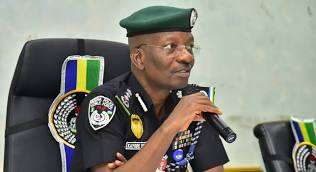
    The Inspector General of the Nigeria Police Force (NPF), Mr. Kayode Egbetokun has warned protesters to discontinue the ongoing national protest against hunger and bad governance or have the police and other armed forces to contend with.


    Briefing the press in Abuja this evening, Mr. Egbetokun said the NPF shall not hesitate to call in other members of the Nigerian armed forces to help quell the uprising should they be overwhelmed.


    Giving his view about the way the protest panned out on the first day, he insisted that what happened today was, “Mass uprising and looting, not protest”. He regretted that even “those who claimed to be the protest leaders were nowhere to be found when things got out of hand”.


    Advising the protesters to be law abiding he said, “groups who claim to exercise right to protest must also know they are duty bound to obey laws of the land.


    Know your rights but do not neglect your responsibilities or duties,” he cautioned the protesting youth.


    He warned that the police was on the red alert and determined to ensure that law and order was maintained in the country.


    Concluding, the Police chief said, “I advise that they should not bother to continue with this.”

  • Protesters shout down minister at Eagles Square

    Protesters shout down minister at Eagles Square

    Protesters shouted down the Minister of State for Youths Development, Ayodele Olawande, who arrived at the Eagles Square in Abuja to address the protesters.
    As the minister tried to address the crowd, the protesters continued to chant “hunger dey”, preventing the minister from speaking.
    However, after quelling the crowd, the minister said he wasn’t attempting to shut down the protest, describing himself as a comrade who has attended between a hundred and five hundred protests.
    “I’m not here to fight you, I’m not here to ask you not to protest, it is your right. Like I said, I’ve been to over 100-500 protests,” he said.
    The minister also assured that he would address the police regarding the shooting of canisters against the protesters.
    Meanwhile, protesters have insisted they would not join the others at the Moshood Abiola National Stadium, noting that a few days ago, a parallel protest had been held without interference by the police.
  • Banks, others shut as hunger protest holds

    Banks, others shut as hunger protest holds

    Banks and other financial institutions in the country will be closed on Thursday, August 1, 2024, as the planned hunger strike begins across the country.


    While none of the banks outrightly announced a closure, chats with different employees of the banks indicated that they have been advised not to report for work on Thursday as the banks monitor the protest.


    A banker who spoke with The PUNCH said, “You saw what happened during previous protests, banks were targets. We don’t want a repeat of a similar experience, hence we have been advised to monitor the situation first and then we know where to go from there.”


    Another banker based in Lagos simply said, “I’m not going to work tomorrow,” when asked.


    However, another banker said they were not advised either way, just told to exercise caution during their commute.


    A Pension Fund Administrator, Leadway Pensure, in a mail to their customers on Wednesday titled ‘Business Continuity Amid Planned Protest’ said, “Due to the planned nationwide protest starting August 1, 2024, please be informed that all our office will be closed on Thursday, August 1, 2024, and Friday, August 2, 2024, at the first instance as we monitor the situation.”


    The PFA went on to urge its customers to adopt its digital channels for their transactions.


    Asset Management firm, Meristem Securities Limited, also issued a notice of closure to its customers on Wednesday.


    “Dear esteemed client. Due to the upcoming nationwide protest tomorrow, this is to inform you that all our offices in Lagos, Port Harcourt and Abuja will be closed on Thursday, 1st June 2024. We will closely monitor the situation and provide further communication, depending on the developments of the protest.”


    Their customers were advised to reach them via their online channels.


    Speaking with The PUNCH in an exclusive interview, the President of the National Union of Banks, Insurance, and Financial Institutions Employees, Anthony Abakpa, said, “Banks will monitor the National planned protest closely and see how it plays out. The regulatory body has not given express approval to close any of the bank operations amid the protest.


    “Banks cannot close shop without the express approval of the Central Bank of Nigeria. We will monitor closely while we have advised our members to exercise extra caution and be alert to stay safe during and after.”


  • Government by Cash gifts and palliatives: Ineffectual Tokenism to Citizens’ Miserys

    Media report has it that senate President Akpabio recently announced President Tinubu’s approval of 50,000 Naira monthly stipends for 10,000 youths in the Niger Delta area. I hope that news is not true, otherwise it would tone-deafness on steroid. It is a demeaning policy that reduces Nigerian youth to Pavlovian dogs in his classical conditioning experiments who can be taught compliance with food.


    Nigerian youths do not need cashgifts, nor bribes, nor tokenisms or palliatives, call it what you like. It is an insult to them. They need an educational infrastructure fit for human learning, not the filthy chicken pens in which they are packed like animals called schools. They need a functioning economy with modern infrastructure that stimulates economic productivity and job creation.


    As much as I am a supporter of President Tinubu, his alms-seekers’ pan-handling, hand-out tokenism palliative policy is like putting bandage on a cancerous bedsore. Sharing envelopes of bags of rice might work for vote harvesting during political campaign. It is not a sustainable model for governance. It is demeaning, belittling, insensitive, and an insult to us all.


    If today’s protest falls apart like some hope it does because of the suspicion that it may be a misguided ethnic and political conceptualization and branding as “day of rage” as an alleged attempt at upturning the result of a failed presidential bid. It is hoped that President Tinubu and his team see that as a temporary reprieve to give him a chance for course correction and a massive restructuring and pruning down the huge bureaucracy that has become part and parcel of the culture of government by political patronage with layers upon layers of special assistants to special assistants, with no portfolio nor value addition to governance in Abuja and all over the states and local government capitals. It must stop now.


    That is low hanging policy shift that does not need any legislative action, just executive order to send the signal to the populace of shared sacrifice and a listening presidency.


    The bubbling explosive tension in the country is palpable. You cannot pack megaton of explosive TNT in a hot combustible room and hope and pray that one day it would not detonate and bring down the house.


    The time for presidential action is now, not tomorrow. Like the explosion of the pile of ammonia fertilizer which eviscerated blocks upon blocks of Beirut taking with it the homes of the poor, the powerless the rich and powerful, will be a child’s play unless decisive action is taken is to avert the looming catastrophe.


    Our country is siting on a huge pile of TNT that is on the verge of explosion. Only quick and decisive action by all layers of government, federal, state and local government can save the country.


    May God bless Nigeria our country. May God bless our president Tinubu, our governors and all those who have willingly sought leadership positions of our country and have been honored with such huge responsibility. May He give them the wisdom, and prick their conscience and sensibilities if they still have any left, to do the right thing for the long suffering, long abused, long deprived Nigerian masses. If they fail to do so, they must be prepared for the spontaneous ire and rage of the people that is likely to sweep them off their exalted position of power.


    A word they say is enough for the wise. The clock is ticking and the day of reckoning is literarily at hand.

  • Hunger Protest: D-DAY in Nigeria?

    Hunger Protest: D-DAY in Nigeria?

    A blogger called it the “Ides of March in August.” Some called it the “Day of Rage.” Others have aptly described it as the “day to take back Nigeria.” Call it what you may but today is August 1, 2024 and what shall not be in doubt is that President Bola Ahmad Tinubu shall today play host to some not-too-August visitors, as Nigerians from all works of life pour onto the streets, if all go as planned, to demand better treatment from the leadership of their country.

    Operated under the hashtag: #END BAD GOVERNANCE, a group of Nigerians issued a notice to the Federal Government some weeks back with the intention to embark on ten days of mass protest, starting August 1-10, 2024, to demand reversal of economic polices that the current government had introduced. Some of these policies include the withdrawal of subsidy on petrol, hike in energy (electric power) tariff, further liberalization of the foreign exchange market.

    It is worth repeating here that these policies were dictated by the International Monetary Fund (IMF) and the World Bank, so called Bretton Woods Institutions, created in December 1945 to mastermind the implementation of the Bretton Woods Agreement of July 1944. Over the years, the two institutions have served “as important pillars for international capital financing and trade activities.” Unfortunately, their advises and the prescriptions contained in the Structural Adjustment Policies (SAPs) that they recommend, have always failed to serve the interest of needy Third World Countries.

    From countries of the Latin Americas to poor countries in Africa and the Asia, the one-size-fits-all policies that these two lending institutions propose to third world countries often lead to mass revolts, often because of the hardship that they cause. As for Nigeria, it is a deja vu as the current episode is Nigeria’s second attempt at implementing SAP. The first also ended in a fiasco as the country was thrown into a turmoil of mass revolt that is today remembered as the anti-SAP Riots.

    Same as now, the Anti-SAP Riots were a result of the government decision to implement the Structural Adjustment Program (SAP) in 1986 under the International Monetary Fund (IMF) in an effort to counteract the impact of declining oil revenue and devaluing the Naira, cutting back on social spending, implementing widespread layoffs, being measures taken to guarantee Nigeria’s eligibility for loans from the IMF.

    Public resentment to IMF Structural Adjustment Programmes are fueled by several factors. Apart from the very bitter pills that they prescribe, the failure of the ruling elite to subordinate themselves to the same lifestyle modification that they recommend to the mass of the people, spike most of the anger that drive the protests. In Nigeria, just as the ongoing episode in Kenya, while the people grapple with cost of living crisis, politicians and their families, supposed servants of the people, revel in obscene affluence.

    In Nigeria, the numbers tell all the story. Down by 370.55 percent, the local currency was so massively devalued that a US dollar today exchanges for 1,660 naira, instead of N448.0 by end of 2022. With this fall in the value of the naira, and Nigeria being import dependent, the price of all goods skyrocketed. Just to give an example, rice, Nigeria’s most staple food has become a luxury item in many family menus as a 50kg bag, hitherto sold at N7,500 in 2023 now sells between N85,000 and N100,000. Food inflation estimated at 40 percent. While interest rate hovers around 28-30 percent.

    President Tinubu, either wittingly or otherwise, it was, who set the tone and pace for the current harsh economic reality buffeting Nigerians when he announced that subsidy on petrol was gone while reading his inaugural speech. Even the most strident advocates of subsidy removal sharply disagreed with the method of withdrawing the very critical subsidy on petrol by the president. This was due to how he announced it without proper review and implementation plan.

    The rest, as they say, is now history. The country now tithers precariously by the edge of the cliff. Whether the people will troupe out to carry out the threat of a mass protest shall become manifest momentarily. What is of critical essence going forward is how the law enforcement agents contain the protest that the Federal Government and the sub-nationals can not be excused as having done enough to stave off.