
Category: Business

  • Scandal rocks FCTA Park & Pay investment project

    *Original owners seek justice from Tinubu, Wike

    Trouble appears to be brewing in the Federal Capital Territory as an ongoing scandal involving the Park & Pay investment has sent shockwaves through Abuja, raising concerns about transparency and justice.

    Otumba Olusegun Olarewanju, CEO of Platinum Parking Management, and Iliyasu Abdu, MD/CEO of Integrated Parking Managers, who claim to be the pioneers behind the recently reintroduced Abuja Park and Pay project, are demanding fair treatment from President Bola Ahmed Tinubu and the newly appointed FCT Minister, Nyesom Wike.

    To attract investments from Nigerians in the Diaspora, especially in the Capital Territory, Olarewanju and Abdu assert that President Tinubu and Minister Wike should investigate the activities of top officials within the Federal Capital Territory.

    The duo allege that they were unjustly sidelined by the Adesola Olusade-led leadership of the FCT, despite having initiated the Abuja Park and Pay project.

    It’s reported that the former Minister of the FCT, Bello Mohammed, had upon leaving office, advised the Permanent Secretary to prioritize the pioneer companies’ right of refusal to ensure fairness and prevent the perpetuation of impunity.

    However, the Permanent Secretary and his colleagues allegedly disregarded this advice, moving swiftly to bring in their proxies and seized the concept developed by the original initiators.

    The situation is complicated further by an existing court judgment requiring the FCTA to pay damages for the abrupt disengagement of the two companies, causing significant financial losses.

    Olarewanju and Abdu detailed their journey, explaining that they returned to Nigeria as a response to then-President Olusegun Obasanjo’s call for Diaspora investments. They designed an “On-Street Parking Management” solution for Abuja, aiming to generate revenue and provide employment opportunities.

    “At the onset of democracy in 1999, the then President Olusegun Obasanjo invited people in Diaspora when we tried to romance with his government. He said we should come back home, bring all our ideas, and come and invest in the country.

    “This gingered us to come back home, and looking at the esthetics, the design, and the road network of Abuja, we came on board that we could do ‘On street Parking management’ on the streets of Abuja in other to generate revenue for the FCT and also to create massive employment for the teaming youths of Nigeria.

    “And we also had it in mind that one day the influx of vehicular movement in Abuja city will be uncontrollable. So, in other to have a plan in place was what necessitated us coming up with ‘On street parking’ project in the street of Abuja.

    “And we came with everything, we came with all our technical partners, we set it up, we did everything, and we tendered for the project. The FCT Minister later set up a technical committee to look into the proposal and here we are, we signed an agreement with them in 2010.

    “When we started, we put the entire infrastructure in place, synergies or what have you. We did all the line markings in all the roads of Abuja. I and my PPMS went back abroad and brought technical partners to set up all the infrastructure. We engaged thousands of Nigerians.

    “My company engaged over four hundred and fifty direct and indirect labour to start the project, same with my friend. We brought the state-of-the-art applications to manage the projects and start setting everything up, until one day we saw two companies that took over the street of Abuja saying the Minister said they should drive us away from the streets.

    “And then these people took over the streets, and then mayhem started; chaos, and pandemonium on the streets of Abuja. This was what led to Justice Peter Afe to place a suspension on the project because people sued us, they sued one of the illegal operators in court.  And when they suspended us they told FCT to go and get a proper traffic law to support the project,” Otumba Olarewanju explained.

    However, their vision was derailed by the actions of FCT officials, who allegedly favored their own interests over the original initiators’ rights.

    The two entrepreneurs stressed their demands: a return of their original zones for operation, compensation for incurred losses due to disengagement, and adherence to the arbitration judiciary award.

    “This is because as pioneers, and in the agreement we had with FCDA we have the right of first refusal. It’s in the agreement, and that agreement has been certified by a court of competent jurisdiction, so our agreement is valid and subsisting and anything contrary to that is against the law. And number two, the arbitrary award is a legal thing that nobody can wish away except the court of competent jurisdiction. Since they have gone to the High Court, the high court could not set it aside; the Court of Appeal court did not set it aside, and even the Supreme Court will not set it aside because arbitration has a time limit. If you cannot do anything within those ninety days that means it’s only God that can intervene,” he stated.

    Their plea hinges on their agreement’s legal validity, their certified rights of first refusal, and the binding nature of the arbitration award.

  • First Bank, ELOY Foundation empower over 1000 women MSMEs

    First Bank, ELOY Foundation empower over 1000 women MSMEs

    First Bank Nigeria Limited in partnership with the ELOY Awards Foundation has launched the 2023 Edition of the “Eloy Business Shower” designed and dedicated to encouraging, promoting and empowering businesses owned by women across Nigeria.

    The focus and aim of the awards are to expose women in business to important business skills, networking, and the Eloy Foundation Business Toolkit, which is a collection of business survival information. 

    This   will   further   be   executed   through   the First Bank’s FirstGem 9 percent Loan Scheme created for female owned MSMEs and the SME Connect Initiative. 

    The   Business   Shower   by   the   ELOY   Awards   Foundation   was   held   in   five states: Lagos, Delta, Anambra, Kano and Osun States from the 1st of July 2023 to the15th of   July   2023.     

    According   to   the Founder, ELOY   Awards Foundation, Tewa Onasanya “the ELOY Business Shower was held to support business owners to build sustainable businesses.

    This year at the second edition of the program, the company hosted 1087 women across the 5 states visited in Nigeria.   It   was   an   avenue   for   these   women   to   gain   access   to   entrepreneurial trainings from experienced businessmen and women, who armed them with tools and information to help them grow their businesses successfully”.

    The over 2300 women who registered for the program will also be invited to join the ELOY Foundation Network, a network that will continue to give them access to resources to help their businesses grow. 

    Expressing   her   delight   on   the   recently   concluded   ELOY Foundation Business Shower, Folake   Ani-Mumuney, First Bank’s Group Head, Marketing   &   Corporate Communications, said, “we commend Eloy  Foundation Awards for convening the second edition of its Eloy Business Shower which has impacted over 1000 female business entrepreneurs across the country.”

    “Female business owners that participated at the event in   the 5 cities –Lagos, Delta, Anambra, Kano and Osun States – are encouraged to take advantage of the teachings from the facilitators as these are essential to boosting their contribution to the economic activities in their host state, geopolitical zones and nation at large, whilst sustaining their businesses,” she concluded.

    Following the huge success of the event, Phase two of the event will begin soon, where  ELOY   Awards   Foundation   will   enrol   50   women   who   are   small   business owners onto the three month ELOY Foundation Sustainable Empowerment Program(SEP), these small business owners will be mentored for a period of three months and they  will  have access to  entrepreneurial trainings  every  month, mentorship, access   to   information   on   affordable   finance   and   10   of   these women considered for a grant to assist them on businesses.

  • BRICS Bank to lend in Brazilian, South African currencies

    The BRICS Development Bank has announced plans to begin lending in South African and Brazilian currencies in order to reduce reliance on the US dollar.

    The NDB was created in 2014, by the BRICS bloc of Brazil, Russia, India, China, and South Africa, as a Global South-oriented alternative to the US-dominated World Bank, which is infamous for imposing neoliberal economic reforms on impoverished countries, which hinder their development.

    Vice President Kashim Shettima is currently representing President Bola Tinubu at the 15th BRICS summit in South Africa.

    The conference, which commenced in Johannesburg on August 22, will focus on issues of trade and investment facilitation, sustainable development, innovation, and global governance reform.

    Rousseff explained, “It is necessary to find ways to avoid foreign exchange risk and other issues, such as being dependent on a single currency, such as the US dollar”

    “The good news is that we are seeing many countries choosing to trade using their own currencies. China and Brazil, for instance, are agreeing to exchange with RMB (renminbi) and the Brazilian real”, she said.

    “At the NDB, we have committed to it in our strategy. For the period from 2022 to 2026, the NDB has to lend 30 per cent in local currencies, so 30 percent of our loan book will be financed in the currencies of our member countries”, Rousseff added.

    “That will be extremely important to help our countries avoid exchange rate risks and shortages in finance that hinder long-term investments”, the new NDB president stressed.

    She said the NDB would issue debt in rand for lending in South Africa and do “the same thing in Brazil with the real. We’re going to try to either do a currency swap or issue debt. And also in rupees.”

    Rousseff said lending in local currency would allow borrowers in member countries to avoid exchange rate risk and variations in US interest rates.

    She said the bank has also tried to distinguish itself from the World Bank and the International Monetary Fund (IMF) by not setting lists of political conditions on loans.

    She also said the Shanghai-based lender was considering applications for membership from about 15 countries and was likely to approve the admission of four or five.

    Members of the NDB not only include the founders of the BRICS but also Bangladesh, the UAE, and Egypt. Uruguay is likewise in the process of joining, and many other countries have expressed interest.

    Argentina, Iran, and Algeria have formally applied to join the extended BRICS bloc, and according to the foreign minister of Russia, Sergei Lavrov, other nations that are interested “include Egypt, Turkey, Saudi Arabia, the United Arab Emirates, Indonesia, Argentina, Mexico, and a number of African nations”.

  • Equity market sustains bullish run, gains N158bn

    Trading activities on the floor of Nigerian Exchange (NGX) Tuesday sustained an upward trajectory as the market appreciated by N158 billion.

    The market capitalisation of listed equities increased by 0.44 per cent to N35.842 trillion from N35.684 trillion reported the previous day.

    The NGX All Share Index also appreciated 286.26 basis points to 65488.67 points from 65202.41 points traded on Monday.

    Investors’ attention during the day were directed towards shares of Transnational Corporation of Nigeria (Transcorp), AccessCorp, and Fidelity Bank, ETI and others.

    An analysis of the investment showed that Cornerstones Insurance led gainers table with 9.84 per cent to N1.34 per unit, CWG followed with a gain of 9.74 per cent to close at N4.28 per unit, SCOA added 9.38 per cent to close at N1.40 per unit, ABC Transport increased by 8.33 per cent to close at N0.52 per unit. BUAFoods added 7.91 per cent to close at N165 per share.

    On the contrary, Nigerian Breweries, SUNU Assurance and Chellaram Plc recorded the highest loss during the day in percentage terms, declining by 10 per cent to close at N38.25, N0.72 and N3.96 per share respectively. John Holt trailed with a drop of 8.81 per cent to close at N1.45 per unit while Mutual Benefits dipped 6.82 per cent to close at N0.41 per share.

    The volume of trades increased by 61.864 million representing  26.71 per cent as investors traded 293.463 million shares valued at N4.122 billion in 5895 deals against 231.599 million shares worth N3.992 billion exchanged hands the previous day in 5494 deals.

    Transactions on the shares of Transnational Corporation of Nigeria (Transcorp) led market activities during the day with 41.441 million shares valued at N185.042 million, AccessCorp followed with account of 36.158 million shares worth N616.420 million, Fidelity Bank traded 32.105 million shares valued at N229.733 million, Omatek exchanged 15.006 million shares cost N4.293 million while Ecobank Transnational Corporate sold a total of 13.200 million shares valued at N208.479 million.

  • Africa Social Impact Summit: Entrepreneurs seek $49.6m intervention

    Africa Social Impact Summit: Entrepreneurs seek $49.6m intervention

    Africa Social Impact Summit: Entrepreneurs seek $49.6m intervention

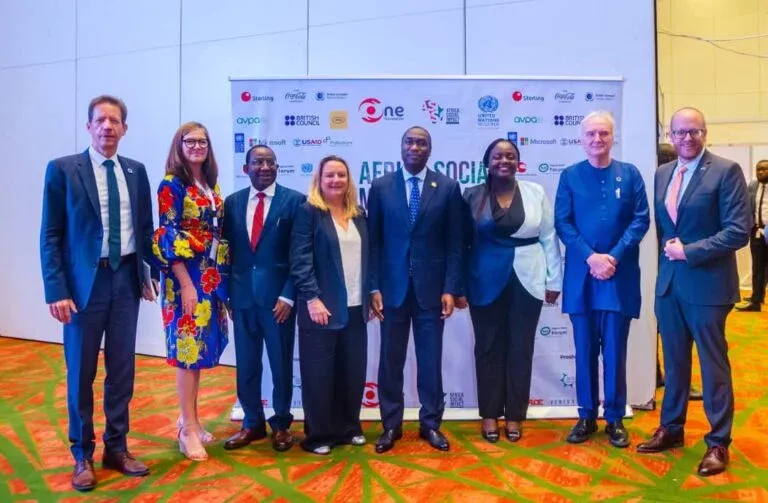
    African inventors and entrepreneurs are seeking $49 million from investors at the just concluded Africa Social Impact Summit (ASSIS) to scale up their businesses.

    This is contained in a statement signed by Mrs Olapeju Ibekwe, Chief Executive Officer (CEO), Sterling One Foundation, made available to newsmen on Tuesday in Lagos.

    The two-event was co-convened by Sterling One Foundation and the United Nations in Nigeria.

    The summit had as its theme, “Global Vision, Local Action: Repositioning the African Development Ecosystem for Sustainable Outcomes.”

    Ibekwe said that the Summit featured a deal room with pitches from 18 businesses shortlisted from over 500 applications from across Africa.

    She said that the finalists, drawn from South Africa, Kenya, and Nigeria with businesses cutting across health, waste recycling, agriculture and education, had a combined investment bid of about $49.6 million for expansion and production capacity increase.

    According to her,   the investors are observing due diligence to determine what the successful candidates will access to upscale their businesses.

    The CEO noted that the gathering of key players from the government, the diplomatic community, civil society and the public and private sectors for the summit, was not a talk shop but a meaningful engagement that would spark the desired impact in Africa.

    She said that ASIS 2023, being the second edition, was designed to help build partnerships and galvanise investments that would ensure that Africa made rapid progress towards achieving the SDGs.

    Ibekwe said that with the world halfway through the 15-year timeline set for the actualisation of the SDGs, there had been a call across the globe to review the work done to see what had worked and what had not.

    He said this was to identify critical areas where additional measures were needed for success to be achieved.

    She said that the call formed the basis of conversations at ASIS 2023.

    She said that the call also resonated as former President of Malawi, Joyce Banda; Consuls-General of the British High Commission, USA, Germany and Denmark, including experts in various fields, shared insights into different sustainability strategies.

    She expressed the hope that several partnerships and innovations would emerge from the summit.

    The CEO said that she was looking forward to existing social impact initiatives in various rural communities, accessing multilevel resources, to be able to do more and spread their impact from community to community across the continent.

    She added that she was humbled by the intentionality of the private sector to own the SDGs and expressed gratitude to the partnership of the United Nations as the co-convener of the summit

    “Across the continent, the people are waiting for action. For far too long, Africa has been tagged the emerging continent, with its potentials a recurring theme of conversation, yet poverty, hunger, climate crisis, and inequality, remain visible; thus, Africa is yearning for action.

    “I remain confident and incurably optimistic that there is the capacity for the type of action we seek in this room. There is the capacity to build strong partnerships for sustainable solutions to move from plans to action quickly.

    “I urge everyone to interact and collaborate because the stakes are very high,” Ibekwe said.

    She said that Mr Abubakar Suleiman, Managing Director and CEO of Sterling Bank Limited, explained that the true essence of the Summit was to ensure that at every level, the issues and challenges resulting in widespread poverty across Africa got tackled rightly.

    “Six months from now, when we reach out for you, we want to hear that because you came here, you met someone, and you established a relationship, you rethought your approach, therefore, are getting more value from your resources, and are better at solving problems together.

    “The only thing that matters is the relationships you form today and how these relationships transmit to a much better outcome than you had before you came here,” Suleiman, who is also board member of the Sterling One Foundation, said.

    Ibekwe said that the UN Resident and Humanitarian Coordinator, Nigeria, Mr Matthias Schmale, said the 2030 Agenda was a clear framework for addressing the challenges facing Africa, which required all to break free from business-as-usual approaches and move together faster.

    “Governments, NGOs, and civil society cannot tackle our current challenges alone.

    “If we are to secure a just, sustainable world, we need a whole-of-society approach in which the private sector plays a pivotal role,” Schmale said.

    While further stating that the promise of the 2030 Agenda was now in peril, he urged more CEOs and investors to adopt the 10 principles of the UN Global Compact.

    He asked them to hire more qualified women, and ensure that their investments focused on more than just profit, to reflect social impact considerations.

    He pledged support to the Nigerian Government, citing the Cooperation Framework for Sustainable Development, which both parties had agreed to.

    He also called on more organisations to embrace Public-Private Partnerships to leverage the strengths and capabilities of both sectors to fast-track and scale up major development initiatives.

  • Regularise your tax positions or face sanctions, FIRS warns shippers

    The Federal Inland Revenue Service (FIRS) has mandated all shipping companies operating in Nigeria’s territorial waters to regularize their outstanding tax return before 31st December 2023.

    The service disclosed this in a public statement made available to the public and signed by its Executive Chairman, Muhammad Nami.

    FIRS noted the order is the sequel to two previous seculars of June and December 2021 wherein it provided the basis of taxation of international shipping lines and also called on them to regularize their tax affairs with the service within three months.

    The circular also stated that the FIRS had observed that many international shipping lines operating in the country had not been complying with the nation’s extant tax laws.

    “The circular provides the basis of taxation for all international shipping lines in Nigeria and the public notice requested all international shipping lines to regularise their tax affairs with the Federal Inland Revenue Service (FIRS) within three months of the date of that publication”

    “Consequently, the Service hereby requests all international shipping companies operating in Nigerian territorial waters in whatever capacity (containerized, bulk cargo, fishing trawlers, crude oil and natural gas lifting vessels, dredging, survey, floating, production, storage, and offloading, etc.) to immediately regularise their tax positions.”

    The service noted that it is collaborating with relevant security agencies to prosecute defaulting shipping agencies after December 2023.

    The statement reads, “The Service is collaborating with relevant government regulatory and security agencies in the maritime sector to commence enforcement action on defaulting shipping companies after the expiration of the grace period of December 31, 2023”

  • Nigeria’s local equities gain N262bn 

    The local equity market on Monday opened the week on a positive note, gaining N262 billion following profits recorded by BUAFoods, Dangote Sugar, Livestock Feeds, Transnational Corporation of Nigeria among others.

    The market capitalisation of listed equities appreciated by 0.74 per cent to N35.684 trillion from N35.422 trillion reported the previous day.

    The NGX All Share Index (ASI) also appreciated by 481.32 basis points to 65202.41 points from 64721.09 points traded on Friday.

    An analysis of the investment showed that JohnHolt led gainers table with 9.66 per cent to close at N1.59 per unit, SCOA Plc followed with a gain of 9.40 per cent to close at N1.28 per unit BUAFoods added 9.29 per cent to close at N152.90 per share, Mansard added 6.85 per cent to close at N3.90 per unit, Livestock gained 6.82 per cent to close at N1.88 per share.

    On the contrary, Tantalizer recorded the highest loss in per cent age terms, shedding 10 per cent to close at N0.36 per share, Omatek trailed with a loss of 9.09 per cent to close at N0.30 per unit, Jaiz Bank fell by 7.78 per cent to close at N1.54 per unit, Chi Plc failed by 7.61 per cent to close at N0.85 per share, Cornerstone Insurance dipped by 6.15 per cent to close at N1.22 per unit.

    The volume of trades declined by 305.985 million, representing 56.91 per cent as investors traded 231.599 million shares valued at N3.992 billion in 5494 deals against 537.584 million shares worth N9.394 billion exchanged hands the previous day in 5893 deals.

    Transactions in the shares of Transnational Corporation of Nigeria (Transcorps) led market activities during the day with 36.837 million shares valued at N159.312 million, Universal insurance followed with account of 16.989 million shares cost N3.611 million, GTCO Plc traded 15.442 million shares worth N563.447 million, Jaiz Bank traded 14.464 million shares cost N22.895 million, Chi Plc exchanged 12.754 million shares valued at N10.690 million.

  • High operating costs weighing down manufacturing coys’ revenue

    The harsh operating environment experienced in the country which worsened with scarcity of foreign exchange, removal of fuel subsidy have impacted negatively on the performance of the manufacturing industry as companies listed under the sector recorded 351 per cent losses in the first half of 2023.

    Investors in the nation’s Stock market said that shortages in forex supply coupled with inflationary pressure, currency redesigned of the Central Bank of Nigeria and other challenges witnessed from importing raw materials have affected the profit margin of manufacturing companies directly.

    They said that all these joined together resulted in a decline in purchasing power and sales volume and revenue of the companies in the first six months of their operations.

    This development according to them is currently impacting negatively on the share price of these listed firms under the manufacturing sector as most of the stocks are currently undervalued following negative sentiments that have enveloped demand for the stocks.

    Specifically, a financial analyst, Mr Iheanyi Egbue said that the huge import levies, exchange rate volatility, haulage cost of imported materials and heavy dependence on alternative source of power has increased cost of production in the sector by almost 30 per cent.

    Egbue said that the federal government failure to adopt a strategy that would encourage investment and development in the manufacturing sector mayerode shareholders 2023 full year dividend as the operating environment is currently very harsh and full of uncertainty.

    Another investor, Mrs Florence Okeke said that with removal of fuel subsidy, introduction of floating of exchange rate, manufacturing firms have experienced an unexpected high operating cost with the attendant reduction in profitability as operating costs are expenses associated with the maintenance and administration of a business on a day to day basis.

    She said with the high cost of living, the demand for goods and services have reduced drastically and as result most consumer goods companies in Nigeria have continued to find it difficult to weather the storm.

    For instance, a look at the performance of Cadbury Nigeria Plc listed under manufacturing segment of NGX showed that it declared loss before tax of N14.52 billion in the first half of the financial year ended June 30, 2023 against profit before tax of N3.35 billion reported in the same period of 2022. The company reported a loss after tax of N14.54 billion compared to profit after tax of N2.34 billion in the corresponding period of 2022.

    Also, Nestlé Nigeria Plc posted a loss after tax of N49.9 billion, a 280 per cent decline over N27.7 billion reported in the same period of 2022.

    The company recorded revenue of N261.8 billion in the first half of 2023, representing a 17.7 per cent increase compared to its performance in the same period of 2022.

    Nigerian Breweries Plc in the same vein reported N85.26 billion Net loss on foreign exchange transactions within the period under review from N7.28 billion in preceding year.

    The company also declared a loss of N47.6 billion in the first half of 2023 representing 348 per cent compared to N18.74 billion achieved in H1 2022.

  • NLNG sustaining gas exports, local supplies amid Force Majeure challenges -Odeh

    Amidst reports of Force Majeure, the Nigeria Liquified Natural Gas (NLNG) has emphatically confirmed the uninterrupted flow of sustainable gas exports and local supplies from its Rivers State facility.

    This confirmation directly refutes recent news articles that suggested otherwise.

    Andy Odeh, the General Manager of External Relations and Sustainable Development at NLNG, labeled the aforementioned reports as both false and misleading.

    Odeh clarified that the NLNG’s operational activities on Bonny Island remain active, despite the prevailing Force Majeure.

    He added that the NLNG’s cargo loading operation also continues without interruption.

    “The latest cargo from the Bonny plant sailed on 17th August 2023 to the St. Croix, U.S. Virgin Islands, carrying 140,000 M3 of LNG,” Odeh said.

    He said the NLNG remains committed to collaborating with key stakeholders to minimise the impact of the consequent gas supply shortage.

    The declaration of Force Majeure came as a result of the disruption in the availability of major liquids evacuation pipelines caused by acts of sabotage and vandalism by unidentified parties.

    In spite of this setback, the NLNG facility steadfastly continues the production of both Liquified Natural Gas (LNG) and Liquified Petroleum Gas (LPG).

    These outputs are proportionate to the volume of feed gas received from their upstream gas suppliers. This concerted effort caters to the demands of the domestic market.

    In the face of the ongoing gas supply shortage brought about by the disruptions in upstream gas supply chains, Odeh reiterated the NLNG’s unwavering commitment to collaborating closely with key stakeholders. This collaborative approach aims to mitigate the adverse impacts stemming from the gas supply shortage.

    Ultimately, NLNG’s confirmation of the continuous gas export and local supply operations serves as a reassurance to stakeholders and the general public alike. Despite challenges, the NLNG remains steadfast in its commitment to maintaining a stable supply of gas and fostering effective collaboration to navigate these complex circumstances.

  • Revised CMMP tops discussion as SEC, stakeholders hold Q2 CMC meeting

    The Securities and Exchange Commission (SEC) is set to hold the Second Capital Market Committee (CMC) meeting in 2023.

    The meeting is scheduled to be held virtually through Zoom with key stakeholders in the capital market on August 24, while the usual interface with the press, on the outcome of the CMC meeting, will take place on Friday, August 25.

    The SEC and the capital market community would discuss the implementation of the Revised Capital Market Master Plan, Fintech and commodities trading ecosystem roadmap as well as other matters relating to the capital market and the economy at its Second Capital Market Committee (CMC) meeting in 2023.

    The CMC is an industry-wide committee comprising members of the SEC, representatives of capital market operators and trade groups and other stakeholders. It was primarily established to serve as a medium for the exchange of ideas among market stakeholders as well as an avenue for providing feedback to the SEC on how to continuously address challenges, improve market operations and enhance the regulatory framework.

    According to the SEC, “Attendance to both events is strictly by invitation. Invited participants will be sent unique links with which to join the meeting.

    “During the meeting, issues bordering on implementation of the Revised Capital Market Master Plan, implementation of the Fintech Roadmap, the commodities trading ecosystem roadmap as well as other salient matters relating to the capital market and the economy would be discussed.”

    The Commission unveiled the Revised Capital Market Master Plan (CMMP) in November 2022 which serves as a blueprint to harness opportunities to better position the capital market as the engine of economic growth and development. The SEC had previously implemented the initiatives of the 10 Year Capital Market Master Plan, which were designed to reposition the Nigerian Capital Market as an attractive investment destination and a critical facilitator of capital formation for the accelerated growth and development of the Nigerian economy. 

    Some of the CMMP initiatives that have been implemented include; Direct Cash Settlement, regularisation of multiple subscriptions, dematerialisation of share certificates, and the introduction of the e-Dividend Management System.

    The CMMP initiatives have helped in promoting transparency, protecting investors and enhancing market confidence, while also ensuring that only fit and proper persons are allowed to operate in the capital market.

    The objectives of the CMMP are also in consonance with the Federal Government’s economic strategy, focused on deepening the capital market and encouraging a private sector-led economy to drive inclusive growth.

    Expected participants at the CMC meeting include Chief Executive Officers (CEOs) of all registered capital market firms (i.e. Broker/Dealers, Investment Advisers, Custodians, Fund/Portfolio Managers, Receiving Banks, Issuing Houses, Rating Agencies, Registrars, Reporting Accountants, Trustees, and Capital Market Consultants, etc.); Chief Executive Officers of Nigerian Exchange Group (NGX), National Association of Securities Dealers (NASD); FMDQ Group Plc; Africa Exchange Holdings (AFEX); Nigeria Commodity Exchange (NCX); Central Securities Clearing System (CSCS); as well as representatives of relevant financial sector regulatory agencies, among others.