Governor Hyacinth Alia of Benue State has assured that outstanding pensions and gratuities for retired civil servants accrued between 2023 and 2025 will be fully cleared by the end of January 2026.
The announcement was made in a press statement by his Chief Press Secretary, Mr. Tersoo Kula, in Makurdi.
Alia emphasized that his administration has consistently prioritized the welfare of civil servants, ensuring regular payment of salaries, pensions, and gratuities since he assumed office.
He stated that while priority was initially given to approved arrears, steps are now being taken to ensure all retirees within his tenure receive their entitlements promptly.
“For those within the last two and a half years who have not received their gratuities, they will receive them in a matter of days,” he said, adding that other pension and salary arrears will continue to be settled based on available funds.
The governor also addressed the ongoing national strike by resident doctors, urging dialogue and negotiation.
He acknowledged that some grievances may stem from unfulfilled commitments by previous administrations but stressed the humanitarian risks posed by disruptions in medical services.
Alia commended health workers for their dedication and expressed confidence that the strike would soon be resolved, noting the Federal Government’s ongoing efforts to address the issues.
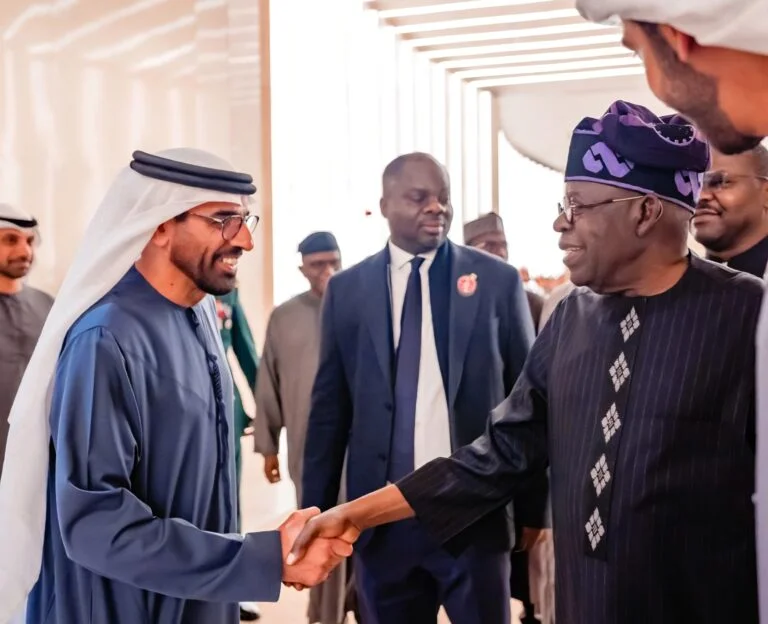
President Bola Tinubu arrived in Abu Dhabi, UAE, on Sunday night for the 2026 Abu Dhabi Sustainability Week (ADSW), which begins Monday.
His aircraft landed at the Presidential Wing of Zayed International Airport at 11:30 p.m. local time, according to Presidential Spokesperson Bayo Onanuga.
Tinubu was welcomed at the airport by Sheikh Shakhboot Nahyan Al Nahyan, UAE Minister of State for Foreign Affairs, and UAE Ambassador to Nigeria Salem Saeed Al-Shamsi, alongside Nigeria’s Minister of Foreign Affairs, Ambassador Yusuf Maitama Tuggar, and other members of the Nigerian diplomatic mission.
At his hotel, several Nigerian officials received the president, including Minister of Budget and Planning Atiku Bagudu, Minister of Industry, Trade and Investment Dr Jumoke Oduwole, and Director-General of the National Intelligence Agency Amb. Mohammed Mohammed.
President Tinubu arrived from Europe, where he held consultations with Rwandan President Paul Kagame and French President Emmanuel Macron.
The 2026 ADSW, themed “The Nexus of Next, All Systems Go,” focuses on sustainable development, climate action, energy transition, and inclusive growth.
Tinubu’s visit highlights Nigeria’s commitment to global sustainability discussions and aims to strengthen diplomatic and economic relations with the UAE.
No fewer than 12 people lost their lives on Sunday following a fatal multiple-vehicle accident along the Yangoji–Abaji corridor of the Federal Capital Territory (FCT), Abuja.
The incident was confirmed by the Federal Road Safety Corps (FRSC), FCT Sector Command, through its Public Education Officer, Mrs Helen Nnaji, quoting the Sector Commander, Mr Felix Theman.
According to the FRSC, the crash occurred at about 11:45 a.m. at Gada Biyu, with the first distress call received two minutes later. A patrol team from Zebra 6 Unit, Yangoji, arrived at the scene within seven minutes.
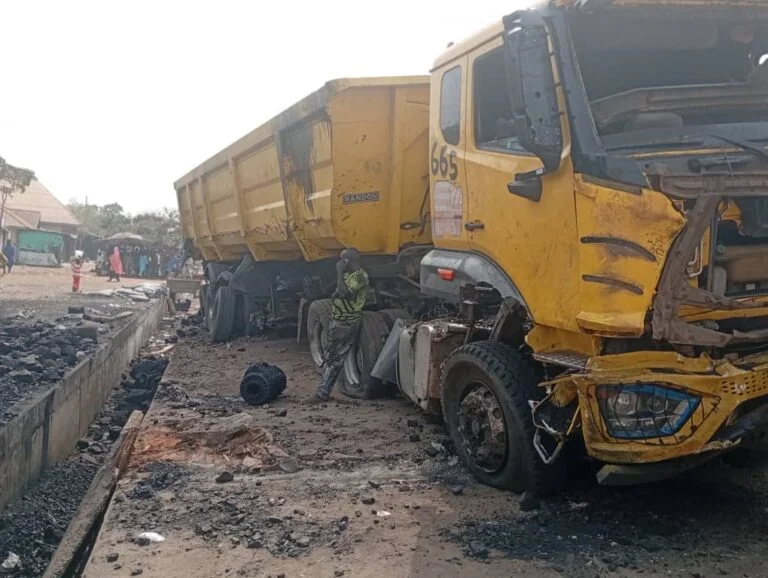
Four vehicles were involved in the crash: two Volkswagen Golf cars (registration numbers GWA 162 KZ and ABJ 111 NW), a Ford Sharon bus (AFN 325 YL), and a Volvo Randon trailer (ANC 665 XA).
Preliminary investigations indicated that speed limit violation and loss of control caused a chain collision.
Eyewitnesses reported that the trailer, owned by African Natural Resources and Mines Ltd and conveying coal from Gujeni in Kagarko Local Government Area of Kaduna State, lost control and rammed into an illegal roadside motor park.
A total of 18 people were involved in the crash, including eight adult males, four adult females, two male children and four female children.
Twelve persons, comprising four adult males, two adult females, two male children and four female children lost their lives. Three others sustained injuries, while three escaped unhurt.
FRSC personnel administered first aid at the scene and evacuated the injured victims to Abaji General Hospital for medical treatment.
The deceased were released to their families for burial in accordance with religious and cultural practices. Recovered items were secured by the FRSC.
Wreckage from one of the vehicles involved in the multiple-vehicle accident at Gada Biyu on the Yangoji–Abaji road in Abuja, where at least 12 people were killed.
The Motor Traffic Division (MTD) of the Nigerian Police, Kwali Division, has taken over the investigation to determine additional factors responsible for the crash.
The FRSC commander expressed condolences to the families of the victims and warned motorists, especially commercial drivers, against the use of illegal roadside loading and off-loading points.
He urged road users to avoid speeding, reckless driving and dangerous overtaking, particularly in populated areas, and called for strict compliance with traffic safety regulations to prevent further loss of lives.
Abia State Governor, Dr Alex Otti, has commended the Inspector-General of Police, Kayode Egbetokun, for directing that newly commissioned police officers be posted to their states of origin.
The Governor describes the policy as a significant step towards strengthening community-based policing and internal security.
Otti gave the commendation on Thursday in Nvosi, Isiala Ngwa South Local Government Area, when 31 Abia-born officers of the 7th Regular Course of the Nigeria Police Academy paid him a courtesy visit.
The governor noted that officers deployed to unfamiliar environments often encounter challenges such as language barriers, cultural differences and limited understanding of local terrain, which could affect effective policing.
According to him, posting officers to their home states enhances familiarity with local languages, customs and security dynamics, thereby improving intelligence gathering, crime prevention and trust between the police and host communities.
Otti observed that the policy mirrors a long-standing practice in the Nigerian Army, where personnel are routinely posted to formations within or near their states of origin, especially at early stages of their careers, to leverage local knowledge and strengthen civil-military relations.
He said the army’s experience had shown that home-state deployment promotes discipline, accountability and cooperation with local populations, while reducing friction arising from cultural misunderstandings.
The governor commended the Inspector-General and his management team for extending a similar principle to the Nigeria Police Force, noting that the initiative was capable of deepening community policing nationwide.
He expressed satisfaction with the presence of the officers in Abia and acknowledged their requests for support, assuring them that the state government would explore ways to assist, as it had consistently done in the past.
Otti congratulated the officers on their commissioning and prayed for their safety and success in the discharge of their duties.
Also speaking, Senior Advocate of Nigeria, Mr Monday Ubani, urged the officers to remain focused and uphold the highest standards of integrity, honour and professionalism.
Ubani warned them against involvement in criminal or fraudulent activities and cautioned against turning policing into a transactional exercise where citizens are required to pay money before their complaints are addressed.
According to him, policing should be anchored on justice, service and security, not financial inducement.
Speaking on behalf of the officers, Assistant Superintendent of Police Somtochukwu Irozuru said Governor Otti’s leadership had restored public confidence and inspired young people to embrace service, integrity and sacrifice.
Irozuru said the posting of the officers to their state of origin was aimed at strengthening community policing, describing it as the first time such a policy had been applied to newly commissioned police officers.
He described the deployment as a privilege that would deepen their bond with the people and appealed to the Abia State Government for support in welfare needs, including accommodation, mobility and laptops, to enhance effective policing and career development.
He thanked the governor for granting them audience despite his busy schedule and pledged the officers’ commitment to the peace, security and development of Abia State.
LAGOS, Jan. 9, 2026 – Many Nigerian youths lack basic knowledge of their political representatives, a recent study has revealed, raising concerns about the state of democracy and political consciousness among the country’s younger population.
James Ojo, a Nigerian journalist and researcher, made the revelation while presenting findings from his study titled “Comparative Analysis of Online Advocacy for Good Governance and Actual Political Involvement among Nigerian Youths”, published by the International Journal of Sub-Saharan African Research (IJSSAR) on December 31, 2025.
According to Ojo, the study, which surveyed 385 youths across Nigeria via social media, found that most respondents were unaware of their representatives at ward, state assembly, federal house, and senate levels, both in their states of residence and origin.
Awareness was higher for governors and local government chairmen in states of residence, but knowledge of representatives in states of origin was generally low.
Despite this gap in political awareness, the study found that Nigerian youths are highly active in online advocacy.
More than half (51.2%) reported engaging in daily political discussions, primarily on WhatsApp, followed by Facebook and X. Common activities included commenting on political issues and sharing governance-related content.
However, offline political participation was markedly low. Over 50% of respondents had never voted, protested, or attended political rallies.
Among those who did participate offline, engagement was irregular, and most had not joined political parties or attended political training sessions.
Fear of violence, lack of interest, and distrust in the electoral body were cited as major barriers to offline involvement.
Yet, the study also highlighted positive signs: offline participation was mainly motivated by a desire to promote good governance (69.7%), personal civic beliefs, and dissatisfaction with government policies.
Most youths who participated offline also possessed Permanent Voter Cards (PVCs) and had voted in previous elections.
Ojo stressed that online advocacy alone is insufficient for achieving good governance. “Beyond online engagement, youths must actively participate in offline political activities, such as voting, attending rallies, and engaging in genuine protests, to drive real reforms in Nigeria,” he said.
The researcher called for urgent reforms to improve security before, during, and after elections, increase civic education, and restore youth confidence in the electoral process.
According to him, 84.2% of respondents said they would be more active in offline political activities if concerns over security, transparency, and electoral credibility were addressed.
“This study should worry us,” Ojo said. “When young people do not even know who represents them, it becomes difficult to demand accountability. Good governance is anchored on transparency and civic participation, and these gaps highlight the need for urgent interventions.”
The All Progressives Congress (APC) in Nasarawa State has dismissed as false and misleading reports circulating on social media alleging that a former National Chairman of the party, Senator Abdullahi Adamu, has defected to the African Democratic Congress (ADC).
The denial was contained in a statement issued on Thursday in Lafia by Hassan Abubakar, the party’s State Organising Secretary and Coordinator of the APC e-membership registration exercise.
Abubakar described the reports as baseless propaganda deliberately designed to mislead the public and create confusion within the party.
According to the statement, Senator Adamu, a former governor of Nasarawa State, remains a committed and card-carrying member of the APC.
“For the avoidance of doubt, Senator Abdullahi Adamu has at no time defected, contemplated defection, or associated himself with any other political party,” the statement said.
Abubakar explained that the photograph being circulated online as evidence of the alleged defection was taken during the ongoing APC e-membership registration and revalidation exercise — a nationwide initiative aimed at strengthening the party’s database and internal democracy.
He noted that the image clearly showed Senator Adamu revalidating his APC membership in line with the party’s constitutional processes and reform agenda.
The APC described the attempt by unnamed individuals to misrepresent a legitimate party activity as a defection as irresponsible and politically desperate, adding that it amounted to deliberate misinformation.
The statement further stressed that Senator Adamu’s loyalty to the APC, as well as his contributions to the party’s growth and stability, remained well documented and unquestionable.
The party urged its members, the media, and the general public to disregard the claims and rely only on verified information from credible sources.
It reaffirmed that the APC in Nasarawa State and across the country remains united and focused on advancing progressive governance.
Former Imo State Governors, Chief Achike Udenwa and Chief Emeka Ihedioha, have spearheaded a N219.7 million fundraising drive for the African Democratic Congress (ADC), signaling the party’s growing influence in the state and its ambitions ahead of the 2027 general elections.
The fundraising took place during an ADC stakeholders’ meeting in Owerri on Tuesday, attended by party leaders and supporters.
According to Udenwa, the funds will be used to support party activities and strengthen grassroots mobilization across Imo State.
He described ADC as the leading opposition party in the state and expressed confidence that the party would challenge the ruling All Progressives Congress (APC).
“We may be the underdogs, but we’ll put the ruling party in their place after the elections. We will uproot the APC,” Udenwa said.
Ihedioha praised Prof. James Okoroma, the state chairman, and his team for their leadership, calling on party faithful to continue supporting ADC.
Okoroma, while speaking, emphasized that the meeting aimed to strategize for future challenges and unify party leaders behind the party’s goals.
“We will remove them from power. It is a generational duty. It will not be easy, but we will do it; it is a constitutional responsibility,” he stated.
The meeting also saw the induction of new members from other parties, including Chief Paul Mbadiwe, son of the late former Minister of Aviation, Kingsley Mbadiwe, as well as several chieftains from the Labour Party.
Their inclusion is expected to broaden ADC’s reach and strengthen its electoral machinery in the state.
Political observers note that the fundraising and high-profile endorsements reflect ADC’s serious intent to challenge APC in the 2027 elections.
The participation of former governors and defectors signals a strategy of coalition-building and grassroots expansion. Analysts caution, however, that while financial resources and new members are important, the party must also maintain unity and present a clear policy agenda to convert support into electoral success.
With the groundwork laid and party ranks strengthened, ADC appears poised to emerge as a formidable contender in Imo State politics over the next election cycle.
Defending champions Côte d’Ivoire secured a commanding 3–0 victory over Burkina Faso in Marrakesh on Tuesday to book their quarter-final spot at AFCON 2025.
The win completed the last-eight line-up, following Algeria’s 1–0 extra-time triumph over DR Congo.
Amad Diallo starred for the Elephants, opening the scoring in the 20th minute with a deft chip over the goalkeeper and later setting up Yan Diomandé to double the lead.
Burkina Faso threatened before halftime, but Dango Ouattara’s low strike cannoned off the post.
The Stallions pressed after the break, but a disciplined Ivorian defence held firm.
Any comeback hopes ended in the 87th minute when Ousmane Diomandé finished a swift counter-attack.
Côte d’Ivoire now heads to Agadir to face record champions Egypt in a mouth-watering quarter-final on Saturday, underlining their ambition to defend their AFCON crown.
UN Human Rights Chief Volker Türk raised alarm on Tuesday over the United States’ military operation in Venezuela, expressing deep concerns that it undermines fundamental protections for sovereign nations.
Türk’s remarks followed the U.S. seizure of Venezuelan President Nicolás Maduro, which has drawn international scrutiny.
Ravina Shamdasani, spokesperson for the UN High Commissioner for Human Rights, reinforced Türk’s position, stating that the U.S. action could make “all States less safe around the world.”
Shamdasani disputed the U.S. justification for its intervention, citing the Venezuelan government’s “longstanding and appalling” human rights record.
She stated, “Accountability for human rights violations cannot be achieved by unilateral military intervention in violation of international law.”
Shamdasani highlighted that this intervention contravenes Venezuelan sovereignty and the principles laid out in the UN Charter, which prohibits the use of force against the territorial integrity of states.
She reiterated that such actions damage international security frameworks, a sentiment echoed by the UN Secretary-General.
The UN Human Rights Office (OHCHR) was expelled from Venezuela in February 2024 after documenting the deteriorating human rights situation in the country.
Independent investigations by the Human Rights Council have previously revealed grave human rights abuses against opponents of the ruling party.
Shamdasani stressed that the Venezuelan people deserve accountability through a fair, victim-centered process, emphasizing that their rights have been violated for far too long.
Following the U.S. intervention, a state of emergency was declared in Venezuela, restricting free movement, seizing property for national defense, and suspending the right to assembly and protest.
Shamdasani noted concerns about the Venezuelan government’s historical suppression of free speech and assembly under the guise of national security.
The UN Human Rights Chief called on the U.S., Venezuelan authorities, and the international community to respect international law and ensure the protection of human rights.
She urged that the future of Venezuela should be determined solely by its people, with respect for their self-determination and sovereignty over their resources.
Despite the political turmoil, the humanitarian crisis continues to escalate, with approximately eight million Venezuelans in need of assistance due to years of economic decline, repression, and instability.
The UN Office for the Coordination of Humanitarian Affairs (OCHA) reported that a response plan is in place requiring about $600 million to support relief efforts.
OCHA spokesperson Jens Laerke noted that while the political situation has changed dramatically, the humanitarian needs of the population have persisted. “For the broad mass of people, their humanitarian day-to-day situation hasn’t changed that radically,” he stated.
Among those in need, around 900,000 individuals face “very high” multisectoral needs, including access to food, nutrition, education, and health services.
OCHA has managed to provide aid to approximately two million people within Venezuela despite funding challenges.
Concerning Venezuelan refugees, the UN refugee agency UNHCR reported that nearly 7.9 million people have fled the country, with the majority finding refuge in Latin America and the Caribbean.
UNHCR is closely monitoring the situation and collaborating with humanitarian partners to support emergency relief efforts and protect displaced individuals in need.
As the world watches the unfolding situation in Venezuela, the UN continues to advocate for human rights and support initiatives aimed at stabilizing the region.
LATE last year, precisely on December 28, a presidential spokesman, Bayo Onanuga, wrote across his social media platforms that Nigeria’s president, Alhaji Bola Ahmed Tinubu, had departed to Europe as part of his end-of-year pleasure and winding down activities. The statement was not explicit that he would be on vacation. He hates the word ‘vacation’ because it might require him to transfer power to vice president Kashim Shettima, who is an orphan in the administration. The statement was as vague as they come, including the announcement that Tinubu would travel from ‘Europe’ to Abu Dhabi in the United Arab Emirates [UAE] in January to attend the annual Abu Dhabi Sustainability Week [ADSW 2026] Summit.
Onanuga’s statement was careful to emphasize that Tinubu’s planned attendance of ADSW 2026 was to honour an invitation that was apparently graciously extended to him by the president of UAE, His Highness Sheikh Mohamed bin Zayed Al Nahyan.
But there are issues surrounding the processes leading to the nebulous year-end activities and the detour from ‘Europe’ to UAE for a one-week stay. But the issues are not new, and they are not out of tune with the proclivities of Tinubu from his years as governor of Lagos State between 1999-2007.
The statement announcing Tinubu’s itinerary, which will be a blatant abuse of the use of that word ‘itinerary’, was deliberately vague, dismissive, and designed to demonstrate how much the presidency, the president himself, and his enablers hold Nigerians in utter contempt.
As president, Alhaji Bola Ahmed Tinubu, is this country’s number one public figure. The statement said that he was departing for ‘Europe’ on December 28. The last time we checked, Europe was not a country, even if anyone is minded to stretch the concept of the European Union [EU].
If Tinubu planned in the course of his usual junckets abroad to visit more than one country on the continent of Europe, decency and accountability required that Nigerians whom he is supposed to be serving should be apprised of his movements. But no, not for Tinubu, and certainly not for his collaborators. He treats a majority of Nigerians as though they do not exist and do not matter.
Alone in the silence of an empty street, power fades and only the weight of the journey remains.
To this presidency, Nigerians are veritable ‘mumus’ who do not know the difference between a continent and the countries therein. And even if they know the difference, they have been so pauperised and castrated by the rulers’ policies and programmes to ask questions and to demand answers.
Tinubu’s indifference to, and contempt for, Nigerians has been evident for close to one generation. He was not different while he was the governor of Lagos State. He could pretend for all he cares, but he’s not a democrat. Contrary opinion counts for nothing in his politics. The receipts are in the public domain.
His braggadacio, not withstanding, Tinubu exhibits the traits of an insecure person. Here’s a man who craves adulation and public office but despises accountability to the people. Not many Nigerians imagined that after the years of the locusts that marked the presidency of the former head of state, the late Muhammadu Buhari, that Nigerians would yet be saddled with another man who regards the presidency as a trophy, and not a call to service that imposes a duty of care on the occupant. One of the Obamas [either Barack or Mitchell] once said that the presidency of the United States does not change its occupant. It reveals the person. That profound assertion was prior to the emergence of Donald Trump as America’s president. Trump 2.0 is unravelling.
The presidency of Nigeria revealed the person of Buhari – as incompetent, low on energy, clueless, sectarian, myopic, divisive, and a man with little or no redeeming feature. Buhari came, he saw, and he was overwhelmed and conquered. Some of us were surprised only by the magnitude of his spectacular failure.
Tinubu was an open book ever before he ascended to the presidency. There was not much waiting to be revealed about him. He said that becoming Nigeria’s president was his lifelong ambition. Ahead of the 2023 presidential election, he commanded his henchmen and supporters to “grab, snatch, and run” with ballot boxes and ostensibly the result sheets. His supporters dutifully went beyond the brief. They disrupted balloting in places suspected to be the stronghold of opposition political parties. On election day, they attacked and bloodied voters whom they feared would vote for candidates other than Tinubu. State security agencies played their own part in an alleged industrial scale electoral heist.
Earlier, during the stomping, Tinubu had declared that it was his turn to be coronated as president in his fraud- tainted and entitlement-laddened claim of “emi lo kan”.
Like Buhari, but from a different prism, the Nigerian presidency is also unmasking Tinubu – that he’s at best a pseudo-democrat if not a dictator, he’s unprepared for the job in spite of claims to the contrary, he may not really be in the best of health, he prefers to operate as a sole administrator or an emperor, he’s epicurean, he listens only to himself, he detests accountability, he delights in adulation and praise-singing, faces of citizens contorted by pains do not move him to sympathy and empathy, that he can only work with people from a section of his Yoruba nation, among other parochial considerations.
The other concerning aspects of his current end of year trip to ‘Europe’ has to do the Abu Dhabi leg this January. For the Abu Dhabi Sustainability Week Summit, the presidency would rather treat it like the mystery of Tinubu’s travel to ‘Europe’ where nothing definite was disclosed. Not the country or countries he was travelling to; not the specific purposes of the visit beyond the claim of end-of-year activities; not how long he would be in ‘Europe’, or any other things for that matter.
Except for the cruise and the opportunity to ‘flex’ as we are wont to say on Nigerian streets, no serious president of any serious country, especially a country like ours which is in the lower rungs of the global development index should ever elect to waste one whole week in a foreign land for this kind of summit. In any case, we are not persuaded that the president is currently equipped with the necessary alertness, mental capacity, and requisite attention span to absorb the technical details and jargon of such a summit. We have seen the president at events at home and abroad, and his struggles to remain alert and follow conversations have been, to put it mildly, very embarrassing.
Furthermore, it was difficult to imagine that Nigeria’s president departed for ‘Europe’ hours after the US president, Donald Trump, ordered the American military to bomb alleged terrorists enclave in parts of Sokoto state in the north west region of our country. Tinubu behaves in a troubling manner. His behaviour can be likened to the case of “onye ulo ya na-agba oku ona achu oke,” or a home owner who is busy chasing rats while his home was being consumed by an inferno.
In a little over two years of this regime, one issue has dogged its leadership – persistent allegations of forgery. Somehow, a sentence on forgery and sundry shenanigans is deemed incomplete until the name of the president of Africa’s most populous country or the ruling APC is featured in it.
If any name is controversial, some people would be minded to use the name of the president to illustrate the unsavoury subject. If a certificate is suspected to be from the ‘Oluwole’ area of Lagos, instinctively, some Nigerians would allow their minds to wander to the same suspect. Why not, given that Tinubu and his team created their own bishops ahead of the 2023 election. By the way, ‘Oluwole’ is a byword for anything and everything fraudulent in our country.
When unknown persons suspected to be from the bureaucracy, the presidency and the national assembly [NASS] forged the 2024 budget with the insertion of strange items worth billions of Naira, it was difficult to exculpate the lead figure and the usual suspect. The same thing is currently playing out with the alleged forgery of the new and controversial tax laws, which came into effect on January 1.
The abduction of Maduro
It was bound to happen – the abduction of the president of Venezuela, Nicholas Maduro, by the president of the United States, Donald Trump. It did happen last weekend. The pretext was drug trafficking by Maduro, but the quest was to seize the over 300 billion barrels of crude oil in the belly of Venezuela.
Trump framed the exercise as a ‘capture’, but it was not. It was a case of the abduction or kidnapping of another country’s head of state. Trump violated the US constitution and ignored international laws. He has said that he would run Venezuela for some time. This is curious coming from a man who bankrupted casinos as a private businessman. What Trump has succeeded in doing is turning the world’s order upside down. And made it less safe. The sovereignty of nations is now a myth and the United Nations a caricature. Might is now right. It will be a matter of time before China seized Taiwan, and Putin escalated his hunger for an imperial Russia to straddle Europe.
UGO ONUOHA, A Veteran Journalist, was the Managing Director/Editor-in-Chief, Champion Newspapers Limited