Author: admin

  • Super Eagles Cruise Past Mozambique 4–0, Book AFCON 2025 Semi-Final Spot

    Super Eagles Cruise Past Mozambique 4–0, Book AFCON 2025 Semi-Final Spot

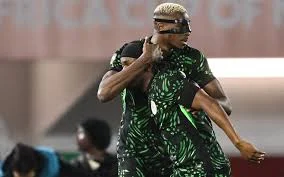
    The Super Eagles of Nigeria delivered a masterclass performance on Saturday, dismantling the Mozambique Mambas 4–0 in their AFCON 2025 quarter-final clash to secure a convincing place in the semi-finals of the tournament.

    Nigeria asserted their dominance early in the encounter, pressing high and controlling possession, with the midfield trio dictating the tempo and starving Mozambique of space.

    The breakthrough came in the 18th minute when Victor Osimhen rose highest to head home a pinpoint cross from Ademola Lookman, sending Nigerian supporters into celebration.

    Buoyed by the opener, the Super Eagles intensified their pressure.

    Ademola Lookman doubled Nigeria’s advantage in the 33rd minute with a well-placed finish following a swift attacking move, capping a dominant first-half display that left the Mambas chasing shadows.

    Mozambique attempted to respond after the break, but Nigeria’s defence, marshalled by Kevin Bassey and Taiwo Ajayi, stood firm, while goalkeeper Stanley Nwabali remained largely untroubled.

    Nigeria effectively put the game beyond reach in the 56th minute when Alex Iwobi delivered a perfectly weighted pass that was calmly finished by Lookman, following sustained pressure in Mozambique’s half.

    The Super Eagles continued to dictate proceedings, with Osimhen and Lookman stretching the opposition with pace and movement.

    The rout was completed in the 74th minute as Lookman turned provider once again, setting up Adams Akor, who slotted home confidently to underline Nigeria’s attacking depth and dominance.

    Osimhen’s tireless runs, Lookman’s creativity, and Iwobi’s control in midfield proved decisive, while the defensive unit ensured Mozambique failed to register any meaningful attempt on target throughout the contest.

    Speaking after the match, the Super Eagles’ coach praised his team’s discipline and collective effort, describing the emphatic victory as a clear statement of intent as Nigeria continues its quest for a fourth AFCON title.

    With the convincing win, the Super Eagles march into the AFCON 2025 semi-finals full of confidence and momentum, awaiting their next opponent as hopes of continental glory grow stronger.

  • Nigerian Army Foils Bandits in Kogi: 3 Neutralised, Supplier Arrested

    Nigerian Army Foils Bandits in Kogi: 3 Neutralised, Supplier Arrested

    Troops of the Nigerian Army’s 12 Brigade, Lokoja, have successfully disrupted bandit activities in Kogi State, neutralising three suspected bandits and arresting one suspected logistics supplier, in a series of coordinated operations over the weekend.

    The operations, disclosed by the Brigade’s spokesperson, Lt. Hassan Abdullahi, occurred on Saturday, January 3, as part of ongoing efforts to curb banditry and kidnapping across the state.

    According to Lt. Abdullahi, the military conducted targeted patrols and ambushes in Kabba Bunu and Yagba West Local Government Areas, acting on credible intelligence about suspected bandits moving from the Adankolo general area.

    In one engagement, troops ambushed a group of bandits heading toward Agbadu Bunu. The encounter resulted in two bandits being neutralised, while troops recovered an AK-47 rifle, a magazine, ammunition, and a locally fabricated firearm.

    Lt. Abdullahi noted that the ambush forced the bandits to withdraw, leaving behind blood stains at the scene, indicating casualties.

    In a separate operation in Yagba West, troops, in collaboration with local vigilantes, confronted another bandit group around Saminaka village.

    One bandit was neutralised during the engagement, and another AK-47 rifle with ammunition was recovered.

    The operation also led to the arrest of a suspected bandit logistics supplier, identified as Sunday Adedotun.

    Items recovered from his settlement included energy drinks, soft drinks, bottled water, and harvested farm produce, believed to be intended to supply bandits in the area.

    The suspect is currently in custody and undergoing investigation.

    Lt. Abdullahi emphasised that these operations reflect the Nigerian Army’s sustained pressure on criminal elements and their support networks, aiming to deny them freedom of movement and operational space within the state.

    He added that the troops’ actions underscore professionalism, discipline, and rapid response to actionable intelligence.

    Brigade Commander Brig.-Gen. Kasim Sidi commended the troops for their courage and diligence, reiterating the Brigade’s commitment to aggressive patrols and operations aimed at securing communities and protecting lives and property in Kogi State.

  • Army Intercepts Criminal Kingpin’s Wife, Seizes Weapons in Taraba

    Army Intercepts Criminal Kingpin’s Wife, Seizes Weapons in Taraba

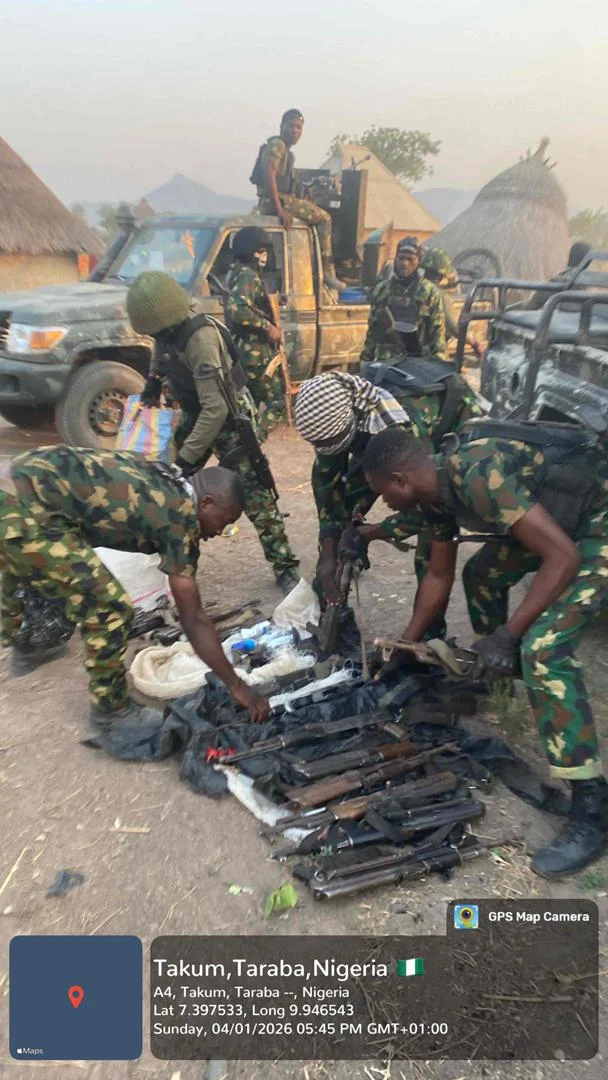
    Troops of Operation Whirl Stroke (OPWS) have intercepted the wife of notorious criminal kingpin John Gata and uncovered a major arms cache in Amadu Village, Takum Local Government Area, Taraba State.

    According to a source at Army Headquarters, actionable intelligence indicated that the suspect’s wife was moving from Amadu Village through Wukari, Kyado, and Zaki-Biam toward Gboko.

    “Troops of Sub Sector 1A quickly set up a snap roadblock at Zaki-Biam and intercepted the woman without any incident,” the source said.

    The suspect later led the troops to a hidden armoury, where they recovered:

    • 13 AK-47 rifles
    • 38 magazines
    • 690 rounds of 7.62mm ammunition
    • 4 hand grenades

    The facility was subsequently destroyed to prevent further use by the criminal network.

    Troops reportedly returned safely to base, with the security situation in the area described as calm but unpredictable, while civil-military relations remain cordial.

    “Troops’ morale and operational readiness continue to remain high as fighting and confidence-building patrols persist in the region,” the source added.

    This operation highlights the ongoing efforts by the military to disrupt criminal networks in the region and strengthen security in Taraba.

  • Tinubunomics Not About Instant Wealth, Says Budget Office DG

    Tinubunomics Not About Instant Wealth, Says Budget Office DG

    Abuja – Nigeria’s economic reforms under President Bola Tinubu, popularly called Tinubunomics, were never designed to create sudden riches, the Director-General of the Budget Office of the Federation, Tanimu Yakubu, explains.

    In a statement titled “Tinubunomics and the Arithmetic of Illusion”, Yakubu warned that much of the criticism surrounding the reforms is based on misleading numbers, not proper economic analysis.

    “This is not economic analysis. It is an arithmetic illusion,” he said.

    Yakubu explained that viral critiques often confuse revenue with actual cash, and borrowings with income.

    Many also treat federation-wide collections as fully available to the federal government, a mistake that creates unrealistic expectations.

    “Revenue is not the same as cash available to the Federal Government. Borrowing is not income; it is financing and creates future obligations,” Yakubu said.

    He criticized analysts who add up tax collections, oil revenues, customs receipts, borrowing, and subsidy savings to arrive at huge figures like ₦150 trillion, ₦170 trillion, or ₦180 trillion  only to ask, “Where did the money go?”

    “Much of it never existed in the form being implied,” Yakubu said.

    On fuel subsidies, Yakubu clarified that removing them doesn’t generate instant cash. Instead, it closes long-standing leaks in the budget, gradually freeing resources to improve fiscal discipline and support vulnerable Nigerians.

    “Subsidy reform does not conjure idle cash. It closes a hole,” he explained.

    Yakubu also addressed concerns about rising debt, explaining that much of the increase in naira-denominated debt comes from exchange-rate adjustments of existing foreign loans, not new borrowing.

    “Treating this accounting effect as new borrowing is a category error,” he said.

    The Budget Office chief said Tinubunomics is a macro-fiscal reset, not a promise of instant abundance. It aims to:

    • Restore proper price signals
    • Strengthen revenue administration
    • Rebuild credibility
    • Protect vulnerable citizens

    “Accountability does not begin with social media arithmetic. It starts with audit logic; anything else is theatre,” Yakubu said.

    Yakubu urged Nigerians to look beyond headline numbers and focus on how the government spends what it actually controls.

    He said this approach, rather than viral figures and social media commentary, is the true measure of accountability.

  • Cameroon Edge South Africa 2–1 to Reach AFCON Q/Finals

    Cameroon Edge South Africa 2–1 to Reach AFCON Q/Finals

    RABAT, Morocco — In a gripping AFCON2025 Round of 16 clash on Sunday, 4 January 2026, Cameroon’s Indomitable Lions booked their place in the quarter-finals with a 2–1 victory over South Africa’s Bafana Bafana at the Al Medina Stadium.

    The result sends Cameroon into the last eight to face hosts Morocco later this week, while South Africa’s promising tournament run comes to an end.

    South Africa started with intensity, dominating early possession and fashioning several good chances. Relebohile Mofokeng threatened in the opening stages and Lyle Foster appeared to score, only for the effort to be ruled out for offside.

    But it was Cameroon who struck first. In the 34th minute, Junior Tchamadeu reacted quickly inside the box to tap in after a rebound fell his way, giving the Indomitable Lions the lead against the run of play.

    Just minutes after the restart, Cameroon doubled their lead. Christian Kofane, the 19-year-old forward, climbed highest to head in a pinpoint cross from Mahamadou Nagida in the 47th minute, making it 2–0 and swinging momentum firmly in Cameroon’s favour.

    That goal underscored Cameroon’s efficiency, taking their opportunities with composure when presented, despite South Africa’s better start.

    South Africa refused to wilt. In the 88th minute, substitute Evidence Makgopa met a precise delivery from Aubrey Modiba to score a powerful close-range finish, pulling one back and igniting hopes of a late turnaround.

    But Cameroon’s defence and goalkeeper Devis Epassy stood firm in the closing moments, withstanding Bafana Bafana’s pressure to secure the 2–1 victory and progression.

    Cameroon’s victory keeps alive their hopes of continental glory and sets up a quarter-final showdown with Morocco, a match that promises to be one of the standout ties of the AFCON 2025 knockout rounds.

    For South Africa, it’s a bitter exit but one that provides valuable lessons as they look ahead to future tournaments and competitions.

  • Tinubu’s Tax Reset and the Rising Cost of Living: Who Really Pays in 2026?

    Tinubu’s Tax Reset and the Rising Cost of Living: Who Really Pays in 2026?

    By the start of 2026, the Nigerian economy had crossed a critical psychological threshold. For millions of households, survival, not prosperity, had become the central economic concern. Food prices climbed relentlessly, transportation costs ballooned, electricity tariffs rose, and the naira’s weakness continued to hollow out purchasing power. Wages, meanwhile, remained stubbornly stagnant. In one word: Nigeria’s cost-of-living crisis swirl.

    This is the economic terrain into which President Bola Tinubu’s administration has launched Nigeria’s most aggressive fiscal overhaul in decades. Framed as reform, sold as necessity, and defended as inevitability, the new tax regime arrives not as a technocratic adjustment but as an additional burden on a population already stretched to its limits.

    The question confronting Nigerians in 2026 is no longer whether reform is needed, but who bears the cost, and who decides how much pain is acceptable.

    Reform in the Middle of Hardship

    The removal of fuel subsidies unleashed a cascade of price increases that reverberated through every sector of the economy. Transport fares surged, food inflation accelerated, and informal businesses, already operating on thin margins, struggled to survive. Electricity tariff hikes followed, further eroding household incomes and raising production costs. Currency policy adjustments compounded the crisis, making imports more expensive and local substitutes scarcer.

    Rather than pause to stabilize living conditions, the government pressed ahead with sweeping tax reforms. For many Nigerians, the timing alone felt punitive: a state demanding more at the precise moment its citizens had less to give.

    A New Tax Regime, Old Trust Deficit

    The overhaul rests on four major laws that replace Nigeria’s chaotic tax framework with a centralized, digitally monitored system. On paper, the logic is compelling: fewer taxes, better enforcement, broader compliance. In reality, centralization without trust risks becoming coercion by another name.

    Progressive tax bands and exemptions for low-income earners are cited as evidence of fairness. Yet the lived experience tells a different story. Middle-income Nigerians comprising, civil servants, professionals, and small traders, are watching their take-home pay shrink as inflation bites and long-standing reliefs disappear. What remains is a widening gap between what the state demands and what it delivers.

    “Widening the Net” or Tightening the Noose?

    Officials insist the reforms are about widening the tax net rather than increasing the burden. But a net cast over a struggling economy does not magically become lighter because it is broader. When energy costs soar, food prices spike, and wages lag inflation, taxation, no matter how elegantly designed, feels punitive.

    The promise that higher revenue will eventually translate into better schools, hospitals, and infrastructure rings hollow in a country where decades of oil wealth failed to produce durable public value. Nigerians have heard this argument before. Each time, they were asked to be patient. Each time, patience yielded diminishing returns.

    VAT and Regional Fault Lines: Old Battles, New Weapons

    No element of Tinubu’s tax reset better exposes Nigeria’s unresolved national question than the proposed restructuring of the Value Added Tax (VAT) sharing formula. Presented by the government as a neutral, efficiency-driven move toward derivation, the reform has instead resurrected the ghosts of Nigeria’s most bitter fiscal conflicts, conflicts never resolved, only postponed. By tilting VAT allocation more decisively toward where consumption and economic activity are recorded, the reform overwhelmingly favours Lagos and a handful of commercially dominant states in the South-West. Lagos’s outsized contribution to VAT revenue is frequently cited to justify this shift. The logic is straightforward: where revenue is generated, revenue should remain.

    But Nigeria’s history warns that straightforward logic often produces dangerous outcomes. In the First Republic, a strong derivation principle allowed regions to retain up to 50 percent of revenues from cocoa, groundnuts, and palm produce. That system collapsed not because derivation was inefficient, but because widening regional disparities turned it into a political weapon. The fiscal tensions it generated contributed to the instability that ended civilian rule.

    After the civil war, military governments centralized revenue sharing not out of ideological preference, but because national survival required redistribution. Oil revenues were pooled to hold a fractured country together, not to reward efficiency. The VAT debate now retraces that path, without the trauma that once forced compromise.

    Many Northern states, heavily dependent on VAT allocations to fund basic services, see the reform not as fiscal federalism but as fiscal punishment. Their argument is blunt: productivity cannot be rewarded fairly in a country where productivity itself has been shaped by decades of uneven federal investment, insecurity, and policy bias. When ports, rail lines, industrial clusters, and financial infrastructure are concentrated in one region, derivation ceases to be neutral, it becomes structural exclusion.

    The echoes of the Niger Delta struggle are unmistakable. For decades, oil-producing communities watched wealth flow to Abuja while bearing the environmental and social costs of extraction. Today, roles appear reversed: commercially dominant states demand to keep what they generate, while poorer regions warn that redistribution, the glue of the federation, is being quietly dismantled.

    The federal government’s response, that states should simply “grow their economies,” rings hollow in regions battling insurgency, banditry, collapsing education systems, and mass poverty. Growth is not summoned by rhetoric; it is enabled by security, infrastructure, and human capital, public goods that require funding in the first place. History is unambiguous: Nigeria’s most destabilizing crises often begin as revenue disputes disguised as technical reforms. When groups feel fiscally cornered, resistance follows, political, legal, and sometimes worse. Wether anyone agrees or not, a VAT regime that sharpens inequality without robust equalization mechanisms is not reform, it is deferred instability. The question therefore becomes, wether Nigeria is prepared for another combustive civil disorder?

    The Lagos Model Goes National

    The reforms unmistakably bear the imprint of the Lagos model that is notorious for its centralized authority, digital surveillance, and uncompromising enforcement. In Lagos, this model thrived on a dense commercial base and a large formal sector. Nationally, it risks flattening Nigeria’s economic diversity into a one-size-fits-all template.

    Equally corrosive is the perception, fair or not, that fiscal power is increasingly concentrated within a narrow regional and ideological circle. In a federation where legitimacy depends on balance as much as performance, perception alone can be politically fatal.

    A Dangerous Gamble

    The tax reforms underpin President Tinubu’s ₦58 trillion 2026 Budget of Consolidation, a document that demands sacrifice now in exchange for promises later. But for Nigerians already suffocating under inflation, those promises feel remote and uncertain. This is the administration’s gamble: that Nigerians will endure sustained hardship on faith. Yet faith is precisely what the Nigerian state has depleted over decades of broken promises, opaque governance, and squandered revenues. Moreover, who shall have faith in your promises when it amounts to telling an economically distressed populace to fast while you, your family members and a few rogue elite feast?

    Tax reform without visible accountability is extraction.

    Ultimately, the success of Tinubu’s tax reset will not be decided in policy papers or revenue charts. It will be decided in markets, transport hubs, and households where people calculate daily whether survival is still possible.

    Without transparency, fairness, and immediate, visible improvements in public services, this reform risks doing more than failing. It risks hardening public cynicism, weakening compliance, and pushing an already fragile social contract toward a breaking point. As it is often asserted, Nigeria does not lack reform ideas. What it lacks is a state that convinces its citizens that reform is being done with them, not to them.

  • EFCC to Arraign Ex-AGF Malami on Money Laundering Charges

    EFCC to Arraign Ex-AGF Malami on Money Laundering Charges

    Abuja, December 30, 2025 – The Economic and Financial Crimes Commission (EFCC) will arraign former Attorney-General of the Federation (AGF), Abubakar Malami, his son, and Bashir Asabe, an employee of Rahamaniyya Properties Ltd, before the Federal High Court in Abuja on 16 counts of fraud and corruption.

    The case is scheduled to be heard by Justice Emeka Nwite.

    Malami has been under investigation by the EFCC since December 8, 2025.

    The anti-graft agency alleges that between 2015 and 2025, the former AGF, alongside his son and Asabe, engaged in a series of suspicious transactions, attempting to conceal billions of naira through bank accounts and property acquisitions across Abuja, Kano, and Kebbi.

    According to the EFCC, the defendants conspired to disguise the origin of funds, acquire property indirectly, and retain sums they allegedly knew were proceeds of unlawful activity, in violation of the Money Laundering (Prohibition and Prevention) Acts of 2011 and 2022.

    Some of the key allegations include:

    Counts 1 and 2: Between July 2022 and February 2021, Malami and his son allegedly concealed over N1.6 billion through Metropolitan Auto Tech Limited accounts at Sterling Bank.

    Count 3: In March 2021, the duo allegedly retained N600 million as collateral for a N500 million loan to Rayhaan Hotels Ltd, knowing the funds were illicit.

    Counts 4–16: The EFCC claims the defendants acquired multiple properties, including luxury duplexes in Maitama and residences in Garki, Asokoro, and Jabi districts, with funds allegedly from unlawful sources. The amounts involved range from N120 million to over N1.3 billion.

    The commission said it plans to call several witnesses, including EFCC staff, bank representatives, Bureau de Change operators, and financial experts.

    Among the key witnesses are Folarin Dare, Chinedu Eneanya, and Sani Lukeman, who are expected to testify on intelligence and petitions received by the EFCC, and Abdulrahman Musa Basheer, who will provide evidence regarding Rahamaniyya Properties Ltd’s role in purchasing properties for Malami.

    Representatives from Zenith Bank Plc and Sterling Bank Plc are also expected to testify.

    The EFCC alleges that the offences span Malami’s tenure as AGF under former President Muhammadu Buhari, highlighting a decade-long pattern of concealing and misappropriating funds through complex financial and property transactions.

  • Traumatized travellers, broken highways, and coastal road

    Traumatized travellers, broken highways, and coastal road

    By

    UGO ONUOHA

    The 1999 Constitution of Nigeria is unequivocal: the security and welfare of all Nigerians must be the primary purpose of government. Yet, decades of neglect, poor planning, and elite indifference have turned the nation’s highways into deathtraps, exposing citizens to danger, delays, and economic loss. Federal roads, meant to connect communities and enable commerce, have crumbled under the weight of neglect and overuse, while successive administrations have prioritized grand projects over the basic maintenance that ensures safety and wellbeing. This failure on the part of those in power reflects a deeper disregard for the constitutional mandate and the everyday lives of Nigerians.

    For the avoidance of doubt, we will reproduce aspects of the relevant constitutional decree. Yes, decree, because the prescription was made to be obeyed. It did not make room for any administration to offer excuses in lieu of compliance. Under the headline The Government And The People, Chapter 2 of the Nigerian Constitution states in part: (1) The Federal Republic of Nigeria shall be a State based on the principles of democracy and social justice. (2) It is hereby, accordingly, DECLARED (emphasis mine) that: (a) sovereignty belongs to the people of Nigeria from whom government through this Constitution derives all its powers and authority; (b) the SECURITY and WELFARE of the people SHALL BE THE PRIMARY PURPOSE OF GOVERNMENT…(again emphasis mine).

    It is unlikely that the intention of the framers of the prescription of the “primary purpose” clause in the constitution was that the government would spoon feed the citizens. No. But even in its severely distorted form, this country can still lay a modicum of claim to operating a capitalist economy. In effect, the least expectation is that this regime as well as preceding administrations should provide an enabling environment at all times for Nigerians to thrive. This should not ordinarily be difficult for any service – driven government to deliver. Here are a few things that will qualify any administration to be said to have met the constitutional prescription. Ensuring security of life and property is at the core of the matter. Without security every other thing will be virtually impossible to accomplish. Then there’s the issue of providing access to affordable and quality education. This should be a matter of priority for any administration that understands that human capital is key to the development of a country, and not necessarily the abundance of natural resources buried under the ground. Of course, next but not necessarily in that order, is access to health care. Sickly people translate to a sickly society.

    Can we say of a truth that this has been the lot of our people since the return to democracy in 1999? Certainly not. Yes, there may have been flashes of sanity in how our rulers treat the commonwealth, but the image we have of our rulers has been that of marauding bandits. The majority of our rulers have been what my Igbo people call “ikiri”, the tenacious animal that never lets go of its prey, or “usu biara orji ntagbu”. Our rulers fit those that the Good Book (Holy Bible) refers to as devourers. And because of our shortsighted and extremely selfish rulers, Nigeria is virtually on its knees. It has been laid bare and belly up.

    The insensitivity, nay wickedness, of any regime can be gleaned from how it treats its citizens in prioritising the provision of basic infrastructure. And the regime of Alhaji Bola Ahmed Tinubu lived up to its reputation as an uncaring government in the days before, during, and after the celebrations of Christmas by Christians. I am not unmindful of the fact that Christmas has become a global cultural phenomenon which celebration transcends Christians, and incorporates people of other faith. In spite of its global stature, Christmas remains essentially a key and sacred event in Christendom.

    For the avoidance of doubt, Christmas has fixed date in the calendar irrespective of the variant of the sect. The Eastern Orthodox church marks Christmas around April while the majority of Christ followers where Nigerian adherents belong celebrate Christmas in December. So, it has not been unusual for successive governments to make special preparations for ease of celebrations ahead of time. Christmas does not depend on the sudden sighting of the moon or the occurrence of other elements in the cosmos. This is not to denigrate the practices of other faiths, but it is to emphasize that Christmas celebrations in the modern era do not depend on the whims of any person or authority.

    This may be the reason why late in November of 2024 works minister, Dave Umahi, (a self acclaimed professor of practice) assured the country that all federal roads would be made motorable before Christmas of that year. It appeared he worked furiously to deliver on the promise, but he failed. Miserably. If we are to be charitable, we have to admit that his failure was not for lack of trying. What, however, we can not say for certain is that his promise to do remedial work on federal highways was imbued by manifest sincerity. For a regime that’s essentially driven by propaganda and hollow promises, he might have been playing games with Nigerians. Those who thought that Umahi’s word was his bond believed him, took to the roads, especially the very busy Lagos – Sagamu – Benin – Onitsha expressway. To varying degrees, users of that highway passed through the valley of the shadow of death. But most of the travellers that year made it to their destinations unscathed in comparative  terms.

    So ahead of this December Umahi kept his cool. He refused to run his mouth. He made no such promise in spite of the fact that federal roads including the Lagos – Onitsha road had gotten worse. Last year, the contentious portion of the highway was mainly the Benin bypass. This year almost the whole stretch of the road had deteriorated badly. Travellers from Lagos to all parts of the east and parts of the south south zone started to contend with traffic jams from Sagamu (construction work), then Okada just before Benin where a vehicle-swallowing manhole in the middle of a bridge had remained unrepaired for going to one year. After surviving the Okada broken bridge complete logjam, travellers would then start the tortuous manoeuvring and meandering through the Benin bypass. If hell in the Holy Bible is a place of torture and gnashing of teeth, then Benin bypass was hell on earth for users of that road this season. Many did not make it through. Some spent hours and days for a travel time between Lagos and Onitsha of normally six hours. Any driver on that road this season will spend a minimum of 15 hours to make. I was among the fortunate people on Sunday, December 21.

    Unlike in the past years, the same travelling nightmare was visited on commuters plying the Abuja – Lokoja – Benin highway. That so-called expressway is already notorious for being a haven for kidnappers, bandits, and terrorists. The trauma of road users trapped and made sitting ducks on that highway this Christmas and New Year season is better imagined than experienced. A senior journalist who has had a stint working in the presidency recently related the experiences of a cousin who plied that route days before Christmas. Of course, the traumatized cousin barely it on time for Christmas in Lagos from Abuja. Lagos – Sagamu – Benin – Onitsha – Enugu – Owerri – Aba, and Abuja – Lokoja – Benin highways are not peculiar in terms of torturing road users. The truth is that virtually all federal roads are broken. They are deathtraps. They constitute clear and present dangers to lives, limbs, and livelihoods of Nigerian road users. And our rulers know about the state of these roads, though they do not use them.

    If you ply this country’s highways, at any period and more so in the rainy season, you will not need to be persuaded that our rulers are “thoroughly wicked”, to borrow the words that bishop emeritus of Ondo Anglican Diocese, the late Emmanuel Gbonigi, once used to describe former head of state, the late Gen. Sani Abacha.

    It may be uncharitable to heap the blame of the sufferings of road users on Umahi and Tinubu. But they should take the flak because they are the people who are now in office and in power. If Nigerian roads are broken, and they unmistakably are, it is the result of years of neglect and especially of lack of vision by successive rulers.

    Certainly, our highways are broken, they are seldom repaired and maintained, they are hardly reconstructed, and they hardly met the minimum global standards at the time of their construction. But our freeways fail essentially to lack of vision. The roads are exposed to all manner of traffic. Our roads are the major mode of transportation of humans and cargoes. Articulated and heavy duty vehicles constitute menace and hazards on our roads. They bear the burden of transporting everything from logs (wood) to petroleum products to cement to iron rods and everything in-between. Given this situation, the roads that are ab initio poorly constructed collapse under the weight of trucks. Of course, these vehicles which have seen the better days of their lifespan in Europe, North America and Asia before being dumped in Nigeria suffer frequent breakdowns on the highways and become accidents waiting to happen to cars and buses and hapless road users.

    For the life of this country since 1960, our rulers have neglected and failed to develop the rail and the rivers/seas as alternatives to travelling by road. Are travel has been made the exclusive of the elites. The ruling elites have also conspired to develop only the seaports in Lagos. Recently, the relevant authorities announced multi trillion Naira impending further investment on Lagos ports. Meanwhile, the seaports in Koko near Warri, Calabar, Port Harcourt, and Onne are underdeveloped and underutilized. The potential for a seaport in the south east is an anathema to the ruling elite who are the winners of the civil war (1967-1970). The net effect of this visionlessness or wickedness is that almost all container goods come into the country through the ports in Lagos. And they include containers meant for manufacturers and markets outside Lagos and the south west. Studies have since established that many of the containers that are shipped through Lagos ports are destined for the south east. This means that they have to be trucked by road to the east and to destinations elsewhere. Meanwhile, the Lagos ports are perennially congested and ineffective. They routinely lose business to the seaports in neighbouring countries.

    Indeed, bad roads were responsible for the traumatic experiences of travellers this season, but the situation was compounded by the fact that broken down trucks littered the Lagos – Onitsha highway. Some of the articulated vehicles tumble and rest on their backs because of the bad roads. And these trucks included petroleum products tankers which spill their inflammable liquids on the road. Such vehicles and their spilt products constitute obvious danger to other road users. They are incinerators waiting for victims. Many travellers have been so incinerated.

    It is in the midst of this state of the highways that the Tinubu regime embarked upon a N15 trillion Lagos – Calabar coastal road. All entreaties to the administration to prioritise the recovery of the broken roads nationwide before the coastal road project fell on deaf ears. To demonstrate how much the regime holds Nigerians in utter contempt, it proceeded to award the coastal highway contract to a long-standing business partner of President Tinubu, without public tendering, without competitive bidding, ahead of determining the route of the road, without budgetary provisions at the beginning, without firm assurance funding sources, and without environmental impact assessment report. The president and his Kept Man, Umahi,  rode roughshod over Nigerians in their desire to forge ahead with the project that had opacity and numbing corruption written all over it. It’s tempting to say that a people get the kind of leadership they deserve, but for the fact that the extant regime assumed office in 2023 under a cloud. And it has had to contend with legitimacy problems ever since.

    UGO ONUOHA, A Veteran Journalist and reknown columnist was the Managing Director/Editor-in-Chief, Champion Newspapers Ltd

  • From Secrecy to Openness: Why 2025 Actually Meant Something for NNPCL

    From Secrecy to Openness: Why 2025 Actually Meant Something for NNPCL

    For most Nigerians, the old NNPC was a black box.

    Money went in. Crude came out. Losses were explained away. Profits, when they appeared, were never quite clear. And no one outside the building really knew what was going on inside.

    That history matters, because it explains why 2025 felt different.

    Not because everything suddenly worked, Nigerian oil has never worked that way, but because, for the first time in a long while, the Nigeria National Petroleum Company Limited (NNPCL) behaved less like a government department hiding behind silence and more like a business willing to show its workings.

    Production Finally Stopped Being a Mystery

    For years, the headline around oil production was always the same: theft, sabotage, decline. This year, that script changed.

    By December, NNPCL’s exploration arm, NEPL, recorded peak daily production of about 355,000 barrels per day, a level not seen in decades. More importantly, national output settled into a steady 1.6–1.7 million barrels per day range.

    That stability mattered more than the record itself. Nigeria has spent years missing OPEC targets and explaining why. In 2025, the explanations gave way, at least partly, to results.

    Was everything independently verified down to the last barrel? No. But the consistency of the data, month after month, was a noticeable improvement over the erratic, often contradictory figures of the past.

    The Profit Headline: and What Sat Behind It

    NNPCL’s announcement of ₦5.4 trillion in profit naturally raised eyebrows. Critics were quick to point out that a weaker naira made the numbers look bigger than they might otherwise have been.

    That criticism isn’t wrong. But it’s also not the whole story.

    What made this different from previous years was not just the profit figure, but the detail that came with it: revenues north of ₦45 trillion, clearer cost breakdowns, and open acknowledgment of FX exposure and legacy subsidy distortions.

    For an institution long known for saying as little as possible, saying this much was progress. Transparency doesn’t mean everyone agrees with your numbers, it means people can finally argue about them.

    Gas: Less Noise, More Substance

    While attention stayed fixed on petrol prices, NNPCL quietly made some of its most important moves in gas.

    The AKK pipeline crossed the River Niger. The long-delayed OB3 pipeline finally linked eastern gas to western and northern markets. And in a subtle but significant shift, NNPCL opened up third-party access to NLNG feedstock, easing its grip on export routes.

    These weren’t flashy announcements. But they signaled something new: a willingness to loosen control and let infrastructure work for the wider market, not just the company.

    In a system built on discretion and gatekeeping, that kind of openness is reform.

    Refining: Saying the Quiet Part Out Loud

    If there was one moment that captured NNPCL’s changing posture, it was the refinery conversation.

    After years, and trillions of naira poured into Port Harcourt, Warri, and Kaduna Refineries with little to show for it, the company stopped pretending that sentiment could replace economics. Instead of promising yet another “near completion,” management admitted the obvious: some of these assets may simply not be worth reviving.

    The decision to review them honestly, even if that means converting some into storage or blending hubs, didn’t deliver fuel independence. What it delivered was something rarer: honesty.

    Did Any of This Matter to Regular Nigerians?

    Early in the year, it didn’t feel like it.

    Petrol prices surged, hitting ₦1,200 per litre and beyond in some areas after full deregulation. For months, it looked like the pain had no upside.

    Then, slowly, things eased.

    As crude production stabilized and the Dangote Refinery ramped up, supply pressures softened. By December, prices in major cities dropped into the ₦850–₦950 range, with differences driven more by transport costs than scarcity.

    Fuel wasn’t cheap, but it stopped being unpredictable. And in Nigeria’s fragile economy, predictability is relief.

    Why 2025 Actually Matters

    NNPCL didn’t transform Nigeria’s oil sector in one year. What it did was more basic and more important.

    It spoke more openly.
    It published more data.
    It made choices that could be questioned, and questioned publicly.

    For a company once defined by silence, that alone is a shift.

    The real test is still ahead. Transparency has to deepen. Audits must stay credible. And none of this can disappear when politics heats up or oil prices fall.

    But for the first time in a long time, NNPCL ended a year not asking Nigerians to trust it
    but giving them something to examine.

    And that’s how institutions stop being myths and start becoming accountable.

  • Nigeria Outgun Tunisia in Thrilling AFCON 2025 Group Clash

    Nigeria Outgun Tunisia in Thrilling AFCON 2025 Group Clash

    Nigeria booked their place via a Victor Osimhen-assisted 3-2 win over rivals, Carthage Eagles of Tunisia in the knockout stage of the 2025 Africa Cup of Nations in an entertaining Group C encounter played in Fez, Morocco.

    The Super Eagles produced a dominant attacking display to take control of the match early, putting the Carthage Eagles under sustained pressure with their pace and movement.

    Nigeria’s breakthrough came late in the first half when Victor Osimhen rose highest to power home a header, giving his side a deserved lead at the 44th minute.

    Nigeria continued on the front foot after the restart and were rewarded with two quick goals that appeared to put the contest beyond Tunisia’s reach.

    Wilfred Ndidi doubled the advantage with a well-taken strike from midfield before Ademola Lookman added a third, finishing off a swift counter-attack that showcased Nigeria’s attacking quality.

    Tunisia, however, refused to capitulate. The North Africans mounted a spirited comeback, pulling a goal back through Montassar Talbi and later converting a penalty to set up a tense finale.

    Despite late pressure, Nigeria’s defence held firm to secure all three points.

    The result confirmed Nigeria’s qualification for the round of 16 and strengthened their credentials as one of the tournament favourites.

    Tunisia, meanwhile, were left to reflect on missed opportunities as they turn their attention to their remaining group fixture in search of qualification.

    Speaking after the match, Nigeria’s coaching staff praised the team’s attacking intent while stressing the need for greater concentration in defence.

    Tunisian officials acknowledged their side’s resilience but admitted the slow start proved costly.

    The latest chapter in the long-standing Nigeria–Tunisia rivalry once again delivered drama, goals and intensity, underlining why both nations remain among Africa’s football heavyweights at AFCON 2025.