
The average retail price of a litre of petrol witnessed a drop from N264.29 in March to N254.06 in April 2023, the National Bureau of Statistics (NBS) has said.
This is according to the NBS Petrol Price Watch released in Abuja on Friday.
It stated that the April 2023 price of N254.06 represented a 3. 87 percent decrease over the price of N264.29 recorded in March 2023.
However, the average retail price of a litre of petrol increased on a year-on-year basis from N172.61 recorded in April 2022 to N254.06 in April 2023.
It stated that the April 2023 price of N254.06 represented a 47.18 percent increase over the price of N172.61 recorded in April 2022.
“On state profiles analysis, Taraba paid the highest average retail price of N320.00 per litre, followed by Imo at N310.55 and Jigawa at N305.00.
“Conversely, Sokoto paid the lowest average retail price of N195.00, followed by Benue at N198.13 and Kogi with N206.11,” it stated.
Analysis by zone, the NBS said, showed that the South-East recorded the highest average retail price in April 2023 at N291.15, while the North-Central recorded the lowest at N208.88.
The NBS also stated in its Diesel Price Watch Report for April 2023 that the average retail price paid by consumers increased by 28.69 per cent on a year-on-year basis.
It explained that the retail price moved from a lower cost of N654.46 per litre recorded in April 2022 to a higher cost of N842.25 per litre in April 2023.
“On a month-on-month basis, the price increased by 0.17 per cent from N840.81 per litre recorded in March 2023 to an average of N842.25 in April 2023,” it added.
On state profiles analysis, the report said the highest average price of diesel in April 2023 was recorded in Adamawa at N980.33 per litre, followed by Bauchi at N934.46, and Borno at N900.50.
On the other hand, the lowest price was recorded in Bayelsa at N708.04 per litre, followed by Kebbi at N773.33 and Anambra at N773.56.
In addition, the analysis by zone showed that the North-East had the highest price at N895.42 per litre, while the South-South Zone recorded the lowest price at N807.59 per litre.
The Federal Government has said that poor access to credit especially for small and medium enterprises was contributing to stifling Nigeria’s economic growth.
The Minister of Industry, Trade, and Investment, Otunba Adeniyi Adebayo, said this at the National Workshop on Bankruptcy and Debt Collection in Nigeria.
The event with the theme “Creating A 21st Century Credit-Oriented Economy’’, was organized by the Nigerian Office for Trade Negotiations (NOTN) in collaboration with AELEX.
Adebayo expressed concern that the credit system in Nigeria faced numerous challenges with many businesses unable to access credit due to finance scarcity, high interest rates, and stringent lending conditions often imposed by financial institutions.
“The lack of access to credit has stifled economic growth, leading to a decline in investment and job creation.
“This is a trend that we have to reverse for the greater interest of the national economy going forward,” he said.
Adebayo said that the outcomes of the workshop must ensure the institutionalization of a vibrant and sustainable credit system in the country.
According to him, it should sufficiently incentivize financial institutions to lend to especially Micro, Small and Medium Enterprises (MSMEs).
“This is critical towards enhancing the overall competitiveness of the national economy, leading to increased productivity, economic growth and employment generation, as well as the promotion of entrepreneurship and increased benefits from the country’s participation in international trade,” he said.
The minister recalled that in March 2022, the Federal Executive Council approved the proposal to establish the Nigerian Bankruptcy Commission with Debt Collection Offices in the 36 States of the federation and the Federal Capital Territory (FCT).
He said that the commission was established to provide an effective legal and institutional framework to regulate business behaviour and reduce the challenges associated with enforcement of trade-debt contracts in the regular courts.
According to him, this is as the debt collection office would be equipped with the expertise, resources and specific focus to ensure that customers pay their trade debts on time.
“If successfully implemented, the commission will not only be complementary to the ongoing reforms under the Presidential Enabling Business Environment Council (PEBEC).
“It will also significantly contribute to the creation of a modern 21st Century credit-oriented economy for the benefit of producers, retailers and consumers in Nigeria,” he said.
The minister expressed the federal government’s commitment to promote financial inclusion by ensuring that all Nigerians have access to financial services, regardless of their income level or location.
Adebayo said that it would contribute positively to financial stability as well as enhance trade and economic growth.
Earlier, Mr. Fred Agah, Director-General/Chief Trade Negotiator, Nigerian Office for Trade Negotiations (NOTN) emphasized the need for a review of the regulatory and institutional framework for bankruptcy and debt collection.
According to him, it will help producers get credit for their products and consumers to get goods and pay later.
He said that the framework would facilitate definitive procedures for loan recovery and risk management as well.
“Even when a growing concern runs into trouble, the priority as to how assets will be shared among creditors is clear.
“So, you either have a claim on a particular asset or at least you know that this can help you and you can even retrieve the goods while it is still being delivered to the creditor,” he said.
The event recorded lecture topics including “The inter-relationship between bankruptcy, debt collection and trade and overview of the bankruptcy and debt collection system in Nigeria.
Troops of Operation Delta Safe (OPDS) have destroyed 38 illegal refining sites and apprehended 29 suspected oil thieves in the last two weeks, the Defence Headquarters has said on Thursday.
The Director, Defence Media Operation, Maj.-Gen. Musa Danmadami, who said this in Abuja at the bi-weekly news conference on the operations of the armed forces, said the troops conducted patrols, raids, anti-illegal oil refining and swap buggies operations at different locations within Bayelsa, Delta and Rivers states.
He said this was aimed at denying oil theft and other criminal elements freedom of action.
Danmadami said the troops, in the conduct of Operation Octopus Grip and other operations, discovered and destroyed illegal refining sites with 24 wooden boats, 169 storage tanks, 152 ovens and 19 dugout pits.
According to him, the troops also recovered 551,500 litres of crude oil, 394,500 litres of Automotive Gas Oil (AGO), 16 vehicles, four motorcycles and one tricycle.
Other items recovered were two pumping machines, one outboard engine, one generator, one speed boat, four weapons and 132 assorted ammunition, while 29 economic saboteurs were also arrested.
“All recovered items and apprehended suspects have been handed over to the appropriate authority for further action.
“Additionally, it is worthy to mention that the sum of N448.3 million were denied to the oil thieves.
“Relatedly, the air component conducted a series of air operations within the joint area of operation.
“Notably, an air interdiction was conducted at Abacheke general area, observed to be active with illegal oil bunkering activities.
“Consequently, the target was struck, destroying all illegal refining equipment at the location,” he added.
In the South-East, Danmadami said the troops of Operation UDO KA had sustained an offensive against the outlawed Indigenous People of Biafra/Eastern Security Network and other criminal activities in the zone.
He said the operational activities resulted in killing of two terrorists, arrest of seven suspected terrorists and rescue of four kidnapped victims within the period under review.
President Muhammadu Buhari, on Thursday, inaugurated the Kashimbila Multipurpose Dam’s 40MW Hydropower Station and Associated 132KV Switchyard, Transmission Line and Distribution Substation (Phase I) Project that is located at the Kashimbila Dam site in Taraba State.
Speaking at a virtual ceremony held at the Council Chamber, State House, Abuja, Buhari underscored the importance of the project, and highlighted the project’s role in his administration’s commitment to achieving the target of 30GW of electricity in the country by 2030, under the Electricity Vision 30:30:30.
According to Buhari, the Electricity Vision initiative aims to have renewable energy contribute at least 30 per cent to the energy mix, thereby expediting the expansion of electricity access.
He said the implementation and completion of the Kashimbila projects align with his government’s policies to alleviate poverty, generate employment opportunities, enhance healthcare services, and improve the overall standard of living of Nigerians.
“The Kashimbila Multipurpose Dam in Taraba, with storage capacity of 500million cubic metres, was conceived principally to checkmate the threat of the imminent collapse of the structurally weak and poisonous Lake Nyos,” he said.
He said that the Dam, located at the line of volcanic activities in Cameroun Republic, and its collapse could result in flooding and affecting millions of lives and properties.
Buhari maintained that the Dam was meant to serve as a buffer to contain possible discharge of water of Lake Nyos.
He said its engineering design maximized the benefits of the Kashimbila ecosystem by incorporating a 40MW Hydropower Station, 60,000 cubic metre per day Water Supply Scheme, 2,000 hectares of Irrigation System, an airstrip, fishing activities and tourism potentials.
According to the President, the Phase I of the Power Evacuation Component of the Project includes the 132KV Switchyard, four substations at Takum, Wukari, Rafin Kada, Donga, and the rehabilitation of the existing 132KV Yandev substation.
The concessioning of the Nnamdi Azikiwe International Airport (NAIA), Abuja, and the Mallam Aminu Kano International Airport, Kano will fetch about $800 million for the Federal Government.
The Minister of Aviation, Hadi Sirika, who dropped the hint, said that the concessioning of the two international airports was approved by the Federal Executive Council (FEC).
Sirika said the Abuja and Kano airports would be concessioned for 20 years and 30 years, respectively, by the Corporación America Airports (CAA).
He also said the approval was part of the Ministry’s roadmap aimed at putting the nation’s assets under concession rather than privatisation.
The concession, he said, would generate $797.4 million (N368.8 billion) as fees and taxes from the concessionaire.
“Put together, it is about $800 million. And this is equal to the amount of money that we borrowed to build those four airports.
“The consortium that won the bid is Mssr Corporación America Airports consortium and in the consortium, they have Mssr Mota-Engil Africa and Mssr Mota-Engil Nigeria and this is through a PPP, and it’s for 20 years for Abuja, and 30 years for Kano,” he said.
Speaking further on revenue expected from the deal, Sirika gave a breakdown of the amounts payable to the government as fees and taxes.
“The concession fees or upfront fees for Abuja is $7 million while $1.5 million will be given for Kano. The fixed concession fee is $401.2 million for Abuja and fixed fees for Kano is $21 million.
“The variable costs concession fee is $154 million for Abuja, and $26.9 million for Kano. Tax $111.2 million for Abuja and $42.7 million for Kano. The Infrastructure Concession Regulatory Commission (ICRC) supervision fees for Abuja is $16.4 million and $5.3 million for Kano.
“So, the total amount of money that is accruing to the government is $700 million for Abuja and then $97.4 million for Kano,” he added.
Sirika also said the aforementioned fees are different from the direct fees the Federal Airports Authority of Nigeria (FAAN) would continue to earn from passenger service charges, which is projected to be $4 billion (N1.84 trillion).
The Senate, on Wednesday, passed a resolution calling on the Central Bank of Nigeria (CBN) to release the sum of $717,478,606 in airline funds that are currently trapped in the country.
The Upper Chamber also urged the CBN to allocate $25 million to airlines operating in Nigeria at its fortnightly dollar auction.
These resolutions were made after considering a motion titled ‘Current Issues on airlines blocked funds in Nigeria’ sponsored by Senator Biodun Olujimi (PDP-Ekiti) during plenary.
Olujimi who is the chairman of the Senate Committee on Aviation was represented by the Vice Chairman of the Committee, Senator Bala Na’Allah (APC-Kebbi) who presented the motion on his behalf.
The Red Chamber has urged the Federal Government to take immediate action to reverse the trend of increasing airlines blocked funds in Nigeria.
It also called on President Muhammadu Buhari to direct the CBN Governor, Mr. Godwin Emefiele, to release the blocked funds to the affected airlines.
Additionally, the Senate appealed to airlines operating in the country to refrain from withdrawing their services while efforts are underway to resolve the issue.
Senator Na’Allah, who moved the motion, stated that since January 2021, Nigeria has been the most challenged country in the world for airlines to repatriate their funds to support their operations.
In February, Nigeria alone accounted for 44 per cent of the total airlines blocked funds in the world.
As of March, the total amount of airlines blocked funds in Nigeria was $717,478,606, which includes matured bids that the CBN has not yet delivered, bids that are yet to mature, and cash balances in airlines’ accounts for repatriation.
He furthered that of the total amount of airlines blocked funds in Nigeria, matured bids that the CBN has not yet delivered accounted for $186.5 million, which is 26 per cent of the total blocked funds.
Three stakeholders, IATA, Qatar Airways, and Ethiopian Airlines, accounted for 57 per cent of the total blocked funds.
A review of the airlines’ blocked funds in Nigeria over the last six months indicates an average month-on-month increase of $49.3 million.
The consequences of these blocked funds are that cheap tickets are not available in Nigeria because taxes and inflation will have eroded the profit when the funds are kept for a long period of time.
As a result of the blocked funds, tickets in Nigeria have become very expensive and limited.
Neighbouring countries are able to get cheaper tickets because they make prompt payments due to the prompt repatriation of funds.
Senators supported the motion and voted to approve the prayers when they were put to a voice vote by Senate President, Ahmed Lawan.
The Renewable Energy Association of Nigeria (REAN) and Odyssey Energy Solutions, an end-to-end distributed energy technology platform, have signed a memorandum of understanding (MoU) to make solar equipment procurement easier, cheaper and efficient for solar companies operating in Nigeria.
The deal will enable REAN members to benefit from $100 million for equipment finance with very favourable terms.
The benefits derived from the deal include a small down payment and a 60-day window for the solar companies to pay up the balance once the equipment has arrived in Nigeria.
REAN, with support from the German-Nigerian Hydrogen Office and the Foundation for Partnership Initiatives in the Niger Delta (PIND), organised an Energy Access Roadshow programme with the theme, ‘Driving Energy Transition through Renewable Energy’.
As one of the fastest-growing economies in Africa, Nigeria has a significant demand for renewable energy solutions. However, many solar companies face significant challenges when it comes to sourcing equipment and materials, including long lead times, high costs, and lack of access to quality products.
The partnership between Odyssey Energy Solutions and REAN aims to address these challenges by streamlining the procurement process and providing better access to high-quality solar products for REAN members.
Under the agreement, Odyssey Energy Solutions and REAN will streamline equipment procurement for REAN members by helping them access financing, better payment terms and supply chain support.
The epoch event which also held virtually brought together key players in the renewable energy sector in Nigeria to discuss the latest trends, opportunities, and challenges facing the industry.
“We are delighted to be partnering with REAN to help improve the efficiency and cost effectiveness of solar equipment procurement in Nigeria.
“Our combined expertise and resources will enable us to provide better solutions to solar companies in Nigeria, helping them to grow their businesses and contribute to the development of a sustainable energy future for the country,” the VP of Procurement Solutions at Odyssey, Justin Tinsey, said.
REAN President, Ayo Ademilua, also expressed his enthusiasm for the agreement.
“REAN is committed to supporting the growth and development of the renewable energy sector in Nigeria, and this partnership with Odyssey Energy Solutions is an important step in that direction. We look forward to working together to provide better access to quality solar products and solutions for our members,” he said.
Nigerian Anchor reports that REAN is an independent, non-profit industry association founded by stakeholders within Nigeria’s Renewable Energy (RE) sector.
Nigeria’s headline inflation rate increased to 22.22 percent on a year-on-year basis in April 2023, The National Bureau of Statistics (NBS) has said.
This is according to the NBS Consumer Price Index (CPI) and Inflation Report for April 2023 released in Abuja on Tuesday.
According to the report, the figure is 0.18 percent points higher compared to the 22.04 percent recorded in March 2023.
It said on a year-on-year basis, the headline inflation rate in March 2023 was 5.40 percent higher than the rate recorded in April 2022 at 16.82 percent.
“This shows that the headline inflation rate (year-on-year basis) increased in April 2023 when compared to the same period in April 2022,’’ it said.
The report showed that contributions of items on the divisional level increase in the headline index are food and non-alcoholic beverages at 11.51 percent.
While housing, water, electricity, gas and other fuel at 3.72 percent.
Others are clothing and footwear at 1.70 percent; transport at 1.45 percent; furnishings, household equipment, and maintenance at 1.12 percent and education at 0.88 percent, and health at 0.67 percent.
“Miscellaneous goods and services at 0.37 percent; restaurant and hotels at 0.27 percent; alcoholic beverage, tobacco and kola at 0.24 percent; recreation and culture at 0.15 percent and communication at 0.15 percent.”
It said the percentage change in the All-Items Index in April 2023 was 1.91 percent on a month-on-month basis.
“This indicates a 0.05 per cent increase compared to the 1.86 per cent recorded in March 2023.
”This means that in April 2023, on average, the general price level was 0.05 percent higher relative to March 2023.”
The percentage change in the average CPI for the 12 months ending April 2023 over the average of the CPI for the previous 12 months period was 20.82 percent.
“This indicates a 4.37 percent increase compared to the 16.45 percent recorded in April 2022.’’
It said increases were recorded in all Classification of Individual Consumption by Purpose (COICOP) divisions that yielded the headline index.
The report said the food inflation rate in April 2023 was 24.61 percent on a year-on-year basis, which was 6.24 percent higher compared to the rate recorded in April 2022 at 18.37 percent.
“The rise in food inflation is caused by increases in prices of bread and cereals, potatoes, yams and other tubers, and oil and fat, fish, vegetable, fruits, meat, and spirits.”
It said on a month-on-month basis, the food inflation rate in April was 2.13 percent, which was a 0.06 percent rise compared to the rate recorded in March 2023 at 2.07 percent.
The report said the “All items less farm produce’’ or Core inflation, which excludes the prices of volatile agricultural produce stood at 20.14 percent in April 2023 on a year-on-year basis.
“This increased by 5.96 percent compared to 14.18 percent recorded in April 2022.’’
“On a month-on-month basis, the core inflation rate was 1.46 percent in April 2023, which was a 0.78 percent drop compared to what it stood at in March 2023 at 1.84 percent.”
According to the report, the highest increases were recorded in prices of gas, passenger transport by Air, liquid fuel, fuels, lubricants for Personal transport equipment, and vehicles spare parts.
“Others are maintenance and repair of personal transport equipment and solid fuel, medical services, and passenger transport by road, among others.
“The average 12-month annual inflation rate was 17.91 percent for the 12 months ending April 2023, this was 4.23 percent points higher than the 13.68 percent recorded in April 2022.”
The report said on a year-on-year basis in April 2023, that the urban inflation rate was 23.39 percent, which was 6.05 percent higher compared to the 17.35 percent recorded in April 2022.
“On a month-on-month basis, the urban inflation rate was 2.05 percent in April 2023, representing a 0.05 percent rise compared to March 2023 at 2.00 percent.’’
It said the corresponding 12-month average for the urban inflation rate was 21.50 percent in April 2023.
“This was 4.49 percent higher compared to the 17.01 percent reported in April 2022.’’
The report said on a year-on-year basis in April 2023, the rural inflation rate was 21.14 percent, which was 4.82 percent higher compared to the 16.32 percent recorded in April 2022.
“On a month-on-month basis, the rural inflation rate in April 2023 was 1.78 percent, which increased by 0.06 percent compared to March 2023 at 1.72 percent.’’
It said the corresponding 12-month average for the rural inflation rate in April 2023 was 20.18 percent, which was 4.27 percent higher compared to the 15.91 percent recorded in April 2022.
On states’ profile analysis, the report showed in April 2023, all items inflation rate on a year-on-year basis was highest in Bayelsa at 26.14 percent, followed by Kogi at 25.57 percent, and Rivers at 24.95 percent.
It, however, said the slowest rise in headline year-on-year inflation was recorded in Borno at 19.60 percent, followed by Taraba at 19.64 percent, and Sokoto at 19.90 percent.
The report, however, said in April 2023, all items’ inflation rate on a month-on-month basis was highest in Cross River at 3.05 percent, Bayelsa at 2.92 percent and Rivers at 2.62 percent.
“Katsina at 0.52 percent, followed by Jigawa at 0.74 percent and Osun at 0.96 percent recorded the slowest rise in month-on-month inflation.”
The report said food inflation in April 2023, on a year-on-year basis, was highest in Kogi at 29.50 percent, followed by Kwara at 29.48 percent, and Bayelsa at 29.38 percent.
“Sokoto at 19.55 percent, followed by Taraba at 20.20 percent and Jigawa at 20.68 percent recorded the slowest rise in food inflation on a year-on-year basis.’’
The report, however, said on a month-on-month basis, April 2023 food inflation was highest in Cross River at 4.65 percent, followed by Bayelsa at 3.61 percent, and Ekiti at 3.49 percent.
”With Jigawa at 0.14 percent, followed by Katsina at 0.44 percent and Osun at 0.62 per cent recorded the slowest rise on month-on-month inflation.’’
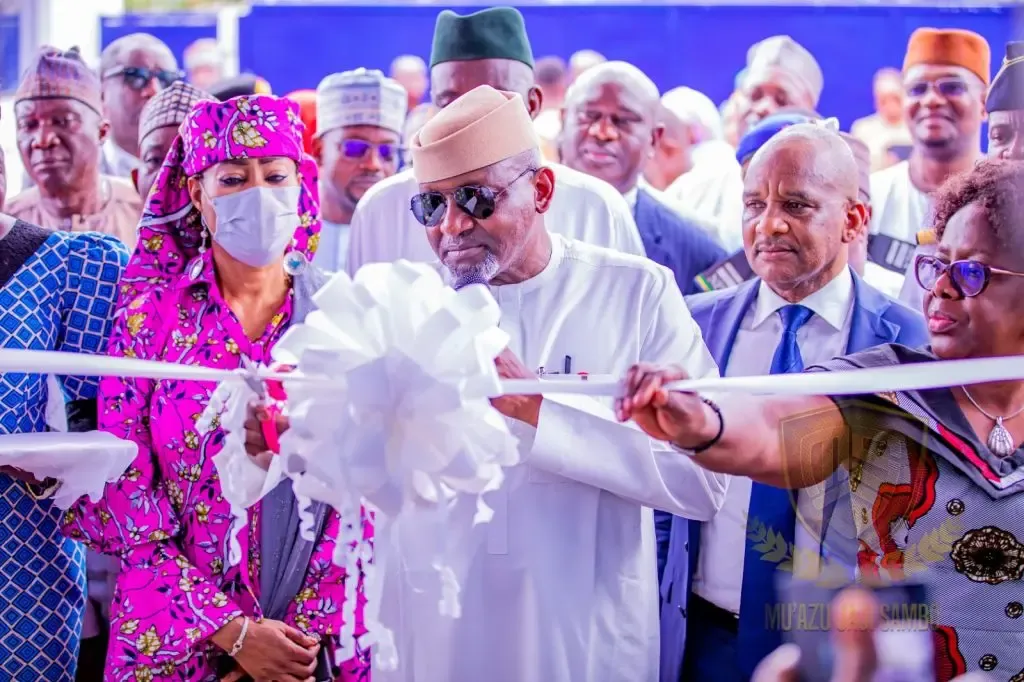
The Minister of Transportation, Alhaji Mu’azu Sambo, has urged members of staff of the Nigerian Maritime Administration and Safety Agency (NIMASA) to double their efforts to ensure improved service delivery and economic development.
Sambo gave the advice while inaugurating the new NIMASA Abuja Liaison office.
He said that establishing a permanent Zonal office for the agency was imperative because of its strategic role in the sector.
“Apart from the reduction of cost of governance, the New Abuja Zonal Office will serve as the centre piece of government relations on matters with bilateral and multilateral implications on international trade and cooperation.
“It will enable the agency to host foreign diplomats and other key maritime stakeholders in the Federal Capital Territory, thereby helping the agency to speedily achieve its mandate.
“All these led to the acquisition of the office and served as further proof of the growth in capacity of NIMASA due to its deepened role in Nigeria’s economic development,” the minister said.
While expressing the ministry’s commitment to NIMASA and all other departments under it, Sambo said this project was a pointer to its determination in that regard.
He commended President Muhammadu Buhari-led administration for approving the procurement of the office, the NIMASA Chief executive and all who made the project a reality.
Sambo thanked everyone who contributed to the realisation of the project, saying more of such projects would subsequently be inaugurated in the country
Earlier, the Director-General of NIMASA, Dr Bashir Jamoh, thanked the minister and the Federal Government for ensuring the acquisition of the state-of-the-art edifice.
Jamoh said the project signaled the agency’s commitment to providing conducive, favorable and supportive working conditions to boost staff productivity.
The Director-General said,” Today’s ceremony is just one more step in living up to what the world has come to expect from us.
“If we train our staff internationally, we must provide them with a working environment that matches with those international standards.
“This edifice reflects management’s commitment to providing a world-class working environment in addition to the recently reviewed and improved conditions of service for all employees.
“With this investment, we have taken things up and made them top-notch by providing support, infrastructure environment, regarding safety and security.’’
He, however, pledged NlMASA’s commitment to ensure a culture of maintenance to extend the lifespan of the building.