
Category: Governance

  • Northern Rulers Pledge Support for Security in South-South, South-East

    Northern Rulers Pledge Support for Security in South-South, South-East

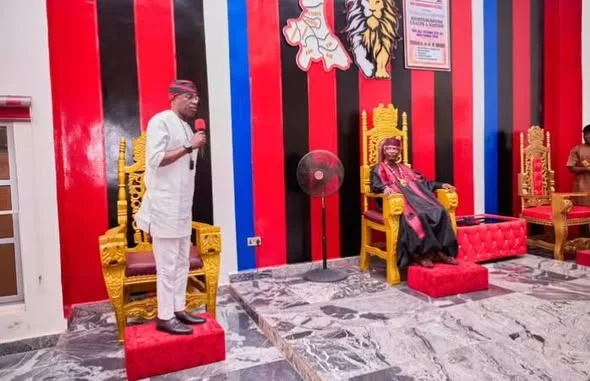
    The Northern Traditional Rulers Council for the South-South and South-East has pledged to support security agencies and state governments in addressing security challenges across the two regions.

    The council’s chairman, Alhaji Yaro Danladi, disclosed this on Sunday while briefing journalists on the outcome of a two-day emergency meeting held in Umuahia, Abia State.

    Danladi said the council resolved that northern communities resident in the regions would work closely with state governments, host communities and security agencies to promote peace, stability and harmonious coexistence.

    “We agreed to work hand-in-hand with our governors and live peacefully with the indigenous people of our host states,” he said.

    He explained that the meeting was convened in response to emerging security concerns, adding that the council resolved to support security agencies through timely intelligence gathering and information sharing.

    According to him, representatives would be appointed in northern communities across the regions, including at local government levels, to ensure the swift transmission of security-related information to relevant authorities.

    “Once any incident occurs, information will reach us promptly, and we will immediately alert the appropriate security agencies,” Danladi said.

    He reaffirmed the council’s commitment to supporting state governments in the fight against crime and criminality, stressing that no criminal element within northern communities would be protected.

    “We do not support criminals. Anyone found engaging in criminal activities will be handed over to law enforcement agencies for prosecution,” he said.

    Danladi also urged youths from northern communities to respect the laws of their host states and continue to live peacefully with their neighbours. He called on state governments to strengthen collaboration with northern leaders in identifying and integrating long-term residents, noting that many northerners had lived in the regions for decades.

    Similarly, the leader of the Hausa community in Enugu State, Alhaji Abubakar Sambo, reiterated the council’s resolve to strengthen peace, security, cooperation and welfare in the South-East and South-South.

    Sambo, who is also the National Vice Chairman of the Inter-Tribal Traditional Leaders Association of Nigeria, said the council discussed strategies to enhance intelligence gathering and coordination within northern communities in support of state security efforts.

    He said the council resolved to establish a coordinated structure for northern communities in each state, down to local government and community levels, to improve engagement, welfare delivery and rapid information sharing.

    Sambo also reaffirmed the traditional role of the Sarkin Hausawa as the recognised leaders and primary point of contact for northern communities across the states.

    He called for sustained collaboration between the council and state governments, describing such partnership as critical to addressing security challenges and maintaining peaceful coexistence.

    In his remarks, the Head of the Hausa Muslim Umma in Cross River State, Alhaji Garba Lawan, said northern communities in the region had continued to enjoy cordial relations with host communities and state governments.

    Lawan said the communities had benefited from government support and security protection over the years, reflecting long-standing peaceful coexistence.

    Commenting on concerns over scavenging activities, he said the trade was not exclusive to northerners and noted that members of the Hausa Muslim Umma had been sensitised on lawful conduct and compliance with regulations.

    He recalled that scavenging was previously banned in Cross River State due to security concerns but said the ban was recently lifted following consultations between the government and key stakeholders, with strict conditions attached.

  • ONICCIMA Calls for Dialogue as Anambra Shuts Onitsha Main Market

    ONICCIMA Calls for Dialogue as Anambra Shuts Onitsha Main Market

    The Onitsha Chamber of Commerce, Industry, Mines and Agriculture (ONICCIMA) has urged the Anambra State Government to embrace dialogue in resolving the closure of Onitsha Main Market, warning that prolonged shutdowns could deepen economic hardship for traders and residents.

    The appeal followed a one-week closure of the market ordered by Governor Chukwuma Soludo in response to the continued observance of the Monday sit-at-home across parts of the state.

    In a statement signed by its President, Chinedu Nwonu, and made available to journalists in Onitsha on Wednesday, the chamber acknowledged the constitutional duty of government to maintain law, order, and an enabling environment for businesses to thrive, noting that such stability is critical to the state’s Internally Generated Revenue (IGR).

    ONICCIMA said government records indicate that the South-East loses an estimated ₦19.6 billion weekly to sit-at-home activities, with Anambra State accounting for about ₦8 billion of that figure.

    It warned that the scale and frequency of the losses pose a serious risk of economic dislocation and instability.

    While expressing support for decisive actions to restore lawful economic activities, the chamber cautioned against the use of prolonged market closures as punitive measures, describing them as economically and socially damaging.

    According to the chamber, the closure of Onitsha Main Market disrupts supply chains, erodes investor confidence, heightens social tension, and threatens the livelihoods of thousands of households dependent on daily trading activities.

    It added that continued disruption of market operations could negatively affect manufacturers, importers, wholesalers, and retailers nationwide, leading to scarcity of goods, increased transportation costs, and inflationary pressures that would ultimately be borne by consumers.

    ONICCIMA therefore called on the state government to strike a balance between enforcement and engagement, security and economic sensitivity, and authority and partnership, in the overall interest of the people and the state’s economy.

    It urged the government to restore confidence, protect businesses, and ensure the full return of Onitsha Main Market to normal Monday-to-Saturday operations in a safe, secure, and sustainable manner.

  • Reps Minority Alleges Illegal Tampering with Nigeria’s Tax Laws

    Reps Minority Alleges Illegal Tampering with Nigeria’s Tax Laws

    Lawmakers say gazetted versions differ from Acts passed by parliament, accuse executive of undermining legislative authority

    The minority caucus of the House of Representatives has alleged that Nigeria’s newly enacted tax reform laws were illegally altered after passage, triggering a fresh controversy over the integrity of the country’s legislative process and the separation of powers.

    The allegation was contained in a statement issued on Friday by Afam Ogene, chairman of a seven-member committee set up by the caucus to investigate discrepancies between the laws passed by the National Assembly and the versions later published in the official gazette.

    According to Ogene, the committee’s preliminary findings reveal that multiple versions of the tax laws are currently in circulation, with significant differences between the Certified True Copies (CTCs) released by the House of Representatives and the gazetted copies made available to the public.

    Background to the controversy

    The issue first came to public attention on December 17, when Abdussamad Dasuki, a member of the House, alleged that key provisions of the tax laws had been altered after they were passed by parliament. The claim sparked widespread public outrage, with some Nigerians calling for the suspension of the implementation of the laws pending clarification.

    A day earlier, on December 16, the leadership of the Senate and the House of Representatives had directed Kamoru Ogunlana, clerk of the National Assembly, to work with relevant executive agencies to re-gazette the tax laws, a move critics interpreted as an implicit admission that the original gazetted versions were flawed.

    The laws in question are:

    • the Nigeria Tax Act, 2025
    • the Nigeria Tax Administration Act (NTAA), 2025
    • the Joint Revenue Board of Nigeria (Establishment) Act, 2025
    • the Nigeria Revenue Service (Establishment) Act, 2025

    On January 3, the House of Representatives released the gazetted copies of the laws for public scrutiny.

    ‘Clear indication of procedural anomalies’

    Ogene said the directive by the leadership of both chambers to “take steps to align” the Acts passed by parliament with the versions printed by the Federal Government Printing Press was a clear indication that serious procedural anomalies had occurred.

    “This action illegally encroached on the core mandate of the National Assembly,” he said.

    He disclosed that Kingsley Chinda, the minority leader of the House, constituted the investigative committee on January 2 to thoroughly examine what he described as a “legislative scandal.”

    Members of the committee were drawn from the six geopolitical zones and include Aliyu Garu (Bauchi), Stanley Adedeji (Oyo), Ibe Osonwa (Abia), Marie Ebikake (Bayelsa), Shehu Fagge (Kano), and Gaza Jonathan (Nasarawa).

    Multiple discrepancies uncovered

    Ogene said the committee’s review showed that the Nigeria Tax Administration Act, 2025, was the most affected, with three different versions of the document discovered.

    Among the major discrepancies highlighted:

    Lowered tax compliance thresholds
    Under section 29(1), the version certified by the National Assembly fixed the tax compliance reporting threshold at ₦50 million for individuals and ₦100 million for companies. However, the gazetted version reportedly reduced the threshold for individuals to ₦25 million and altered the figure for companies.

    “This is a clear case of the executive undermining legislative powers by illegally altering an already passed law to drag more taxpayers into the net,” Ogene said.

    New appeal conditions inserted
    In section 41, the gazetted copy allegedly introduced new subsections 41(8) and 41(9), compelling taxpayers to deposit 20 percent of the disputed tax amount before appealing decisions of the Tax Appeal Tribunal to the High Court. Ogene said these provisions were never passed by the National Assembly.

    Expanded enforcement powers
    The committee also alleged that section 64 of the gazetted law illegally expanded the powers of tax authorities to include arresting suspected tax offenders through law enforcement agencies and selling seized assets without a court order.

    Altered definition of federal taxes
    Ogene said section 3(1)(b) of the House-certified version defined federal taxes to include income tax, petroleum income tax, stamp duties, and VAT. The gazetted copy, however, reportedly removed petroleum income tax and VAT from the list of taxes administered by the federal government.

    Dollar-denominated petroleum tax computation
    Another contentious change was found in section 39(3), where the gazetted version mandated that tax computations for petroleum operations be carried out in US dollars, contrary to the version passed by parliament, which provided for calculations in the currency of the transaction.

    Oversight provisions removed

    The committee further alleged that the National Revenue Service (Establishment) Act, 2025, was altered to weaken legislative oversight.

    According to Ogene, sections 30(1)(d) and 30(3) of the version passed by the National Assembly empowered lawmakers to summon officials, demand reports, and enforce accountability. These provisions, including requirements for quarterly and annual reports to parliament, were allegedly deleted in the gazetted version.

    He described the deletions as a blatant disregard for the National Assembly and the constitutional doctrine of checks and balances.

    Call for deeper investigation

    “Given the anomalies, illegalities, and impunity observed, which clearly undermine the National Assembly’s constitutional powers and democracy, the committee finds the current evidence sufficient to warrant a deeper investigation,” Ogene said.

    He added that the committee has formally requested an extension of time to conduct a more thorough examination and ensure accountability for what it described as an affront against the legislature.

    As the controversy deepens, the allegations raise serious questions about who altered the laws, how the changes were made, and whether the implementation of the tax reforms can proceed without further legal and political fallout.

  • Nigerian Army Foils Bandits in Kogi: 3 Neutralised, Supplier Arrested

    Nigerian Army Foils Bandits in Kogi: 3 Neutralised, Supplier Arrested

    Troops of the Nigerian Army’s 12 Brigade, Lokoja, have successfully disrupted bandit activities in Kogi State, neutralising three suspected bandits and arresting one suspected logistics supplier, in a series of coordinated operations over the weekend.

    The operations, disclosed by the Brigade’s spokesperson, Lt. Hassan Abdullahi, occurred on Saturday, January 3, as part of ongoing efforts to curb banditry and kidnapping across the state.

    According to Lt. Abdullahi, the military conducted targeted patrols and ambushes in Kabba Bunu and Yagba West Local Government Areas, acting on credible intelligence about suspected bandits moving from the Adankolo general area.

    In one engagement, troops ambushed a group of bandits heading toward Agbadu Bunu. The encounter resulted in two bandits being neutralised, while troops recovered an AK-47 rifle, a magazine, ammunition, and a locally fabricated firearm.

    Lt. Abdullahi noted that the ambush forced the bandits to withdraw, leaving behind blood stains at the scene, indicating casualties.

    In a separate operation in Yagba West, troops, in collaboration with local vigilantes, confronted another bandit group around Saminaka village.

    One bandit was neutralised during the engagement, and another AK-47 rifle with ammunition was recovered.

    The operation also led to the arrest of a suspected bandit logistics supplier, identified as Sunday Adedotun.

    Items recovered from his settlement included energy drinks, soft drinks, bottled water, and harvested farm produce, believed to be intended to supply bandits in the area.

    The suspect is currently in custody and undergoing investigation.

    Lt. Abdullahi emphasised that these operations reflect the Nigerian Army’s sustained pressure on criminal elements and their support networks, aiming to deny them freedom of movement and operational space within the state.

    He added that the troops’ actions underscore professionalism, discipline, and rapid response to actionable intelligence.

    Brigade Commander Brig.-Gen. Kasim Sidi commended the troops for their courage and diligence, reiterating the Brigade’s commitment to aggressive patrols and operations aimed at securing communities and protecting lives and property in Kogi State.

  • Army Intercepts Criminal Kingpin’s Wife, Seizes Weapons in Taraba

    Army Intercepts Criminal Kingpin’s Wife, Seizes Weapons in Taraba

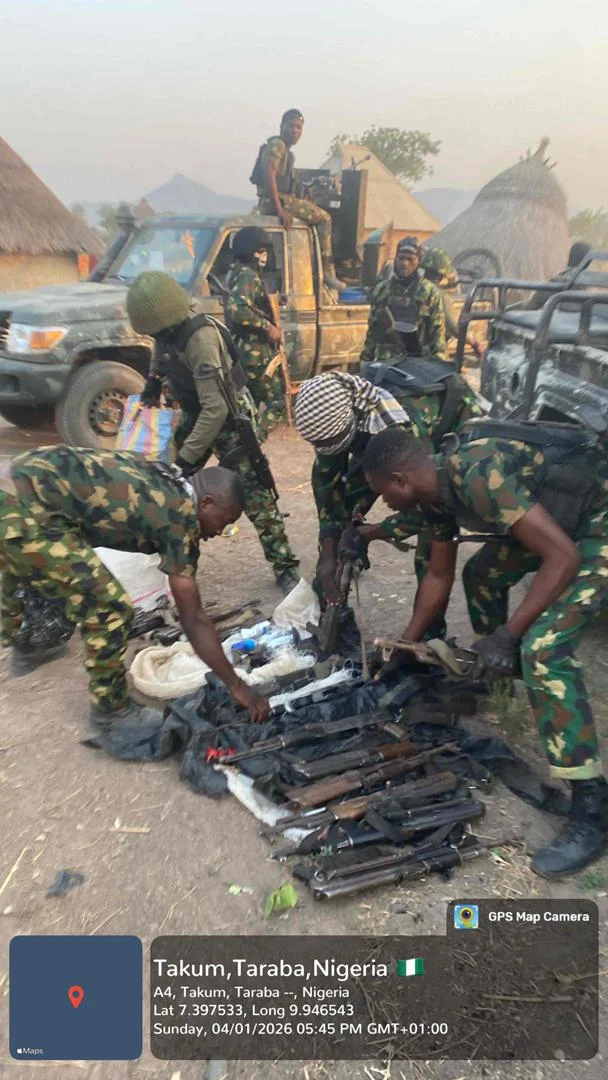
    Troops of Operation Whirl Stroke (OPWS) have intercepted the wife of notorious criminal kingpin John Gata and uncovered a major arms cache in Amadu Village, Takum Local Government Area, Taraba State.

    According to a source at Army Headquarters, actionable intelligence indicated that the suspect’s wife was moving from Amadu Village through Wukari, Kyado, and Zaki-Biam toward Gboko.

    “Troops of Sub Sector 1A quickly set up a snap roadblock at Zaki-Biam and intercepted the woman without any incident,” the source said.

    The suspect later led the troops to a hidden armoury, where they recovered:

    • 13 AK-47 rifles
    • 38 magazines
    • 690 rounds of 7.62mm ammunition
    • 4 hand grenades

    The facility was subsequently destroyed to prevent further use by the criminal network.

    Troops reportedly returned safely to base, with the security situation in the area described as calm but unpredictable, while civil-military relations remain cordial.

    “Troops’ morale and operational readiness continue to remain high as fighting and confidence-building patrols persist in the region,” the source added.

    This operation highlights the ongoing efforts by the military to disrupt criminal networks in the region and strengthen security in Taraba.

  • Nigeria Records 3.98% GDP Growth in Q3 2025, Misses Target

    Nigeria Records 3.98% GDP Growth in Q3 2025, Misses Target

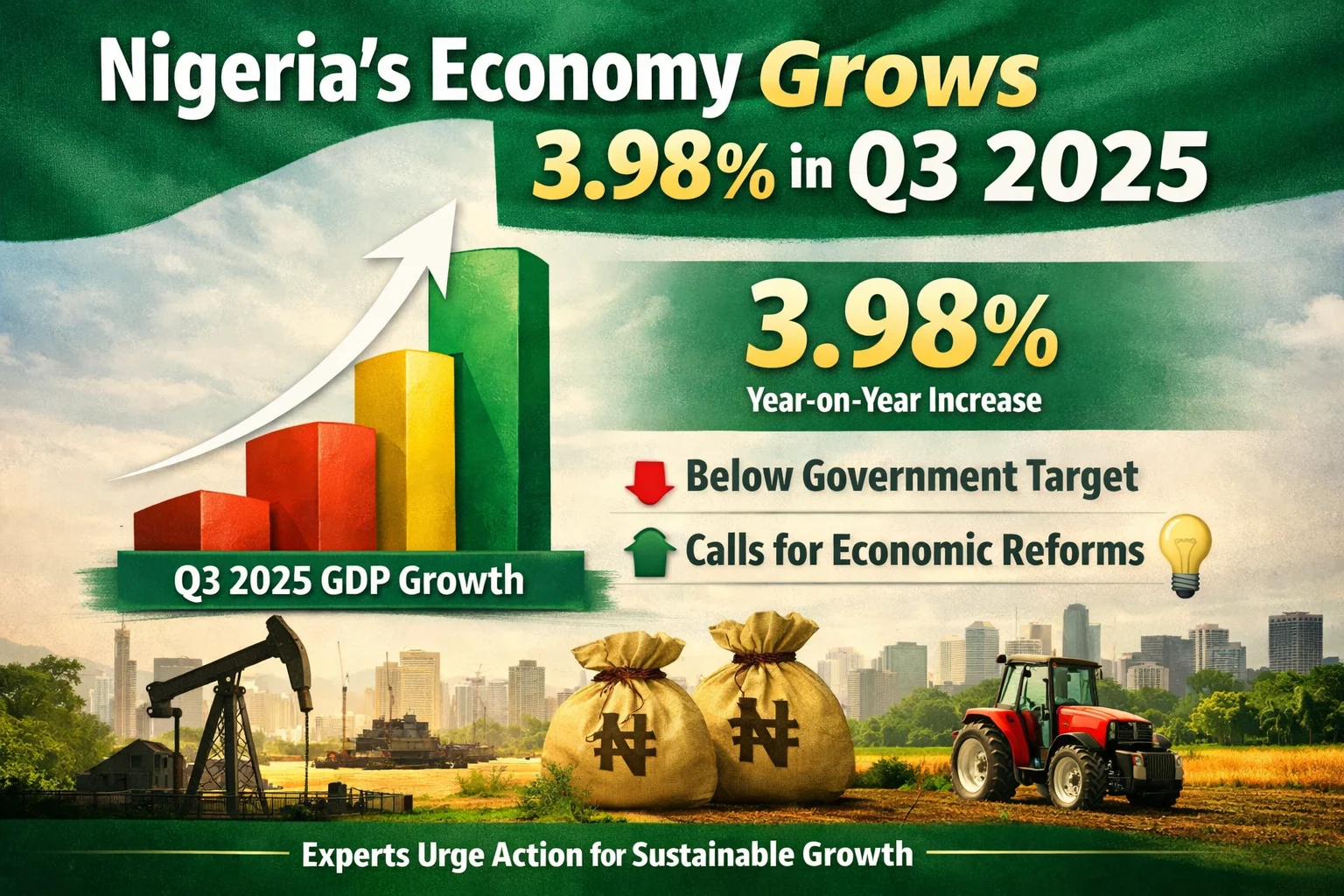
    Abuja / Lagos — Nigeria’s economy recorded a 3.98 per cent growth in the third quarter of 2025, a modest expansion that has intensified calls for decisive reforms to unlock faster, broader-based and more sustainable growth.

    The National Bureau of Statistics (NBS) said the Gross Domestic Product (GDP) grew in real terms on a year-on-year basis, reflecting increased output of goods and services across key sectors of the economy.

    However, the performance remains below the Federal Government’s 4.6 per cent growth target for 2025, and its long-term ambition of achieving about seven per cent annual growth needed to drive sustainable development.

    The Central Bank of Nigeria (CBN) had projected a 4.1 per cent growth rate for 2025, citing easing inflation and improved foreign exchange inflows, while the International Monetary Fund (IMF) recently revised Nigeria’s growth forecast upward to 3.9 per cent.

    Economists Call for Targeted Interventions

    Against this backdrop, economists who spoke with to the media on Friday said targeted policy interventions could help bridge the gap between projections and actual performance.

    Prof. Sherifdeen Tella of the Department of Economics, Babcock University, urged the government to prioritise investment in the industrial sector to stimulate domestic production.

    “The government should empower domestic production firms in critical areas with funds that can be repaid in the future,” Tella said, likening the approach to the U.S. industrial bailout during the 2008 global financial crisis.

    He also stressed the importance of subsidising energy, particularly electricity and petroleum products, to support productivity, and called for sustained peace in the Niger Delta to boost oil production and export earnings.

    Business Environment and Security

    Similarly, Prof. Ndubisi Nwokoma of Caleb University said improving the business environment and ensuring macroeconomic stability were essential to accelerating growth.

    “Insecurity must be reduced to restore investor confidence in the economy,” he said, adding that Nigeria should prioritise the development of its rare earth minerals through partnerships with experienced private firms to boost exports and revenue.

    Agriculture as Growth Driver

    Former President of the Chartered Institute of Bankers of Nigeria (CIBN), Mr Okechukwu Unegbu, said increased investment in modern agriculture could significantly accelerate economic growth.

    He urged the government to allocate at least 10 per cent of the annual budget to agriculture, in line with recommendations by the Food and Agriculture Organisation (FAO), to mechanise the sector and strengthen its value chain.

    Unegbu also called for incentives to encourage private sector participation in agricultural processing and packaging, noting that value addition would enhance the sector’s contribution to the economy.

  • Tinubu Presents 2026 Budget, Projects ₦34.33tr Revenue, ₦58.18tr Spending

    Tinubu Presents 2026 Budget, Projects ₦34.33tr Revenue, ₦58.18tr Spending

    By Caroline Ameh

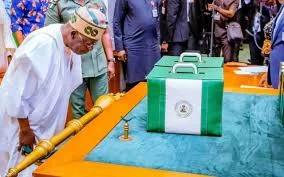
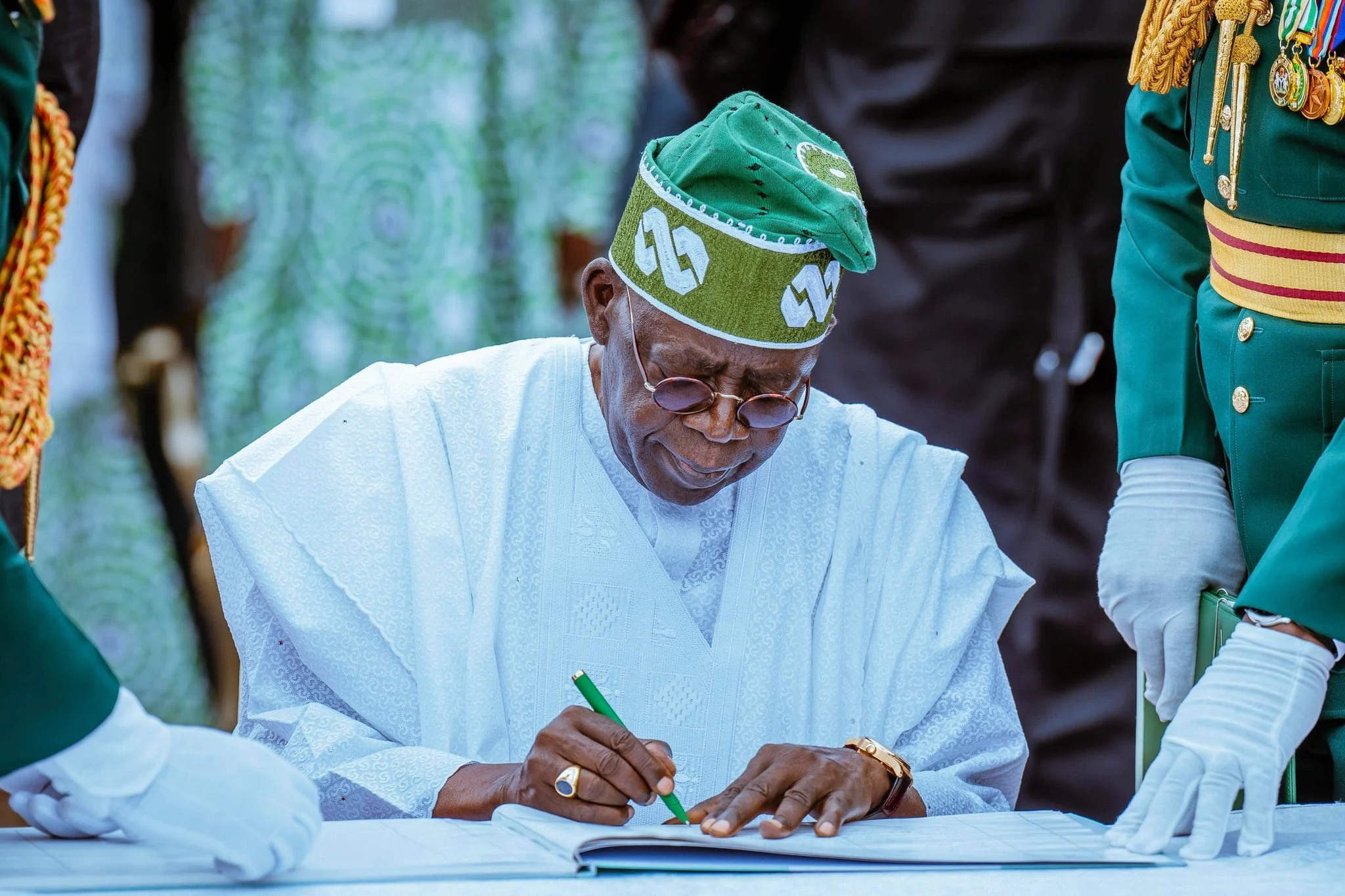
    President Bola Ahmed Tinubu on Friday presented the 2026 Appropriation Bill to a joint sitting of the National Assembly, pledging stricter discipline in budget execution, stronger accountability and enhanced monitoring of public spending in the new fiscal year.

    The budget, titled “Budget of Consolidation, Renewed Resilience and Shared Prosperity,” seeks to entrench recent economic reforms, stabilise macroeconomic conditions and convert recovery gains into sustained, inclusive growth.

    Addressing lawmakers, the President said he had directed key fiscal authorities—including the Minister of Finance and Coordinating Minister of the Economy, the Minister of Budget and Economic Planning, the Accountant-General of the Federation and the Director-General of the Budget Office—to enforce strict adherence to the approved budget framework and implementation timelines.

    “2026 will mark a turning point in budget execution. We will demand accountability, rigorous monitoring and reporting that translate policy into measurable outcomes for Nigerians,” Tinubu said.

    The President said the budget was formulated against a backdrop of emerging macroeconomic stability, following what he described as difficult but necessary policy adjustments implemented by his administration.

    He reported that Nigeria’s economy expanded by 3.98 per cent in the third quarter of 2025, up from 3.86 per cent in the corresponding period of 2024, while inflation declined for eight consecutive months to 14.45 per cent in November 2025, from 24.23 per cent in March.

    Tinubu further cited improved crude oil output, stronger non-oil revenue mobilisation driven by tax administration reforms, rising investor confidence and external reserves estimated at $47 billion, sufficient to cover more than 10 months of imports.

    “These results reflect deliberate policy choices. The task before us is to consolidate these gains so that stability evolves into prosperity and prosperity is broadly shared,” he said.

    Reviewing the performance of the 2025 budget, the President said the government realised ₦18.6 trillion in revenue and ₦24.66 trillion in expenditure by the third quarter, representing 61 per cent and 60 per cent of their respective annual targets.

    He attributed delays in capital releases partly to the extension of the 2024 capital budget into 2025, noting that the experience highlighted the need for firmer fiscal discipline in the 2026 budget cycle.

    For 2026, the President projected total revenue of ₦34.33 trillion and total expenditure of ₦58.18 trillion, including ₦15.52 trillion earmarked for debt servicing.

    Recurrent non-debt expenditure is estimated at ₦15.25 trillion, while capital expenditure is projected at ₦26.08 trillion. The resulting budget deficit of ₦23.85 trillion, he said, represents 4.28 per cent of Gross Domestic Product (GDP).

    Underlying the projections are assumptions of a crude oil price benchmark of $64.85 per barrel, daily production of 1.84 million barrels, and an exchange rate of ₦1,400 to the US dollar.

    The budget prioritises national security, infrastructure development and human capital investment, with proposed allocations of ₦5.41 trillion for defence and security, ₦3.56 trillion for infrastructure, ₦3.52 trillion for education and ₦2.48 trillion for health.

    Tinubu said security spending would be outcome-based, aligned with the implementation of a new national counter-terrorism doctrine and expanded intelligence-led operations.

    On education, he referenced the Nigerian Education Loan Fund, which has supported more than 418,000 students across 229 tertiary institutions, while noting that healthcare expenditure represents six per cent of total budgetary spending, net of liabilities.

    The President warned government-owned enterprises to meet their revenue remittance obligations, announcing plans to deploy digitised revenue collection systems to curb leakages and strengthen fiscal transparency.

    “A budget’s true value lies not in its announcement, but in its execution,” Tinubu said, pledging prudent expenditure management, enhanced revenue mobilisation and tighter oversight.

    He urged the National Assembly to support the proposals, expressing confidence that effective executive-legislative collaboration would ensure successful implementation.

    The President subsequently laid the 2026 Appropriation Bill before the National Assembly for legislative consideration.

  • Benue South Protests Exclusion from U.S. Fact-Finding Mission

    Benue South Protests Exclusion from U.S. Fact-Finding Mission

    “We Are Victims of Both Terror and State Marginalisation”

    The Ochetoha K’Idoma, the apex socio-cultural organisation of Benue South Senatorial District (Zone C), has formally protested the exclusion of Idoma and Igede communities from the itinerary of the visiting United States Fact-Finding Mission led by Congressman Riley Moore.

    In a petition submitted to the U.S. Embassy in Nigeria, the group described the omission as a deliberate act that reinforces what it called a “dangerous and misleading narrative” portraying Benue State’s security crisis as affecting only Tiv-speaking areas.

    “This exclusion is not an oversight; it is a systemic erasure of the suffering of our people,” the organisation stated.

    The Invisible War

    According to the petition, Benue South has endured sustained violent attacks for more than a decade. A 12-year timeline (2013–2024) attached to the letter documents repeated massacres across Agatu, Apa, Otukpo, and Obi Local Government Areas.

    The group cited the 2016 Agatu Massacre, where more than 500 people were reportedly killed, and the April 2023 Umogidi attack in Otukpo LGA, during which 52 victims were buried in mass graves.

    “Our land flows with blood,” the statement said. “Yet because our people absorb displaced families into private homes rather than formal IDP camps, the world assumes we are safe. We are not.”

    Demands to the U.S. Delegation

    The Ochetoha K’Idoma called on the U.S. Fact-Finding Mission to:

    • Grant an immediate audience to leaders of Benue South
    • Correct the distorted narrative that confines insecurity in Benue to a single ethnic group
    • Channel humanitarian relief and reconstruction assistance to the Apa–Agatu corridor

    In a statement signed by Dr. Echeofu Agada, Public Relations Officer of the organisation, the group warned that excluding Benue South undermines the credibility of any investigative mission.

    “You cannot claim to establish facts while ignoring half the victims,” the statement read.
    “The silence of Benue South is not peace; it is the silence of the graveyard.”

  • Tinubu Constitutes Boards of NADF, Bank of Agriculture, and UBEC

    Tinubu Constitutes Boards of NADF, Bank of Agriculture, and UBEC

    President Bola Ahmed Tinubu has approved the constitution of the governing boards of the National Agricultural Development Fund (NADF), the Bank of Agriculture (BOA), and the Universal Basic Education Commission (UBEC).


    The announcement was contained in a statement by Bayo Onanuga, Special Adviser to the President on Information and Strategy.


    At the UBEC, Senator Umaru Tanko Al-Makura, earlier appointed in July, will continue to serve as chairman of the board.

    Other members include Uchendu Ikechi Mbaegbulem (South East), Gift Ngo (South South), Mrs. Ibiwunmi Akinnola (South West), Dr. Meiro Mandara (North East), Dr. Abdu Imam Saulawa (North West), and Professor Paul Ibukun-Olu Bolorunduro (North Central).Each member will serve a four-year term in the first instance.


    For the Bank of Agriculture (BOA), President Tinubu confirmed the appointments of Muhammad Babangida as chairman and Ayo Sotinrin as managing director.

    He also approved the appointments of three executive directors and five non-executive directors representing Nigeria’s six geo-political zones.


    The executive directors are:
    • Fatima Garba (Sokoto) — Executive Director, Corporate Services
    • Ka’amuna Ibrahim Khadi (Borno) — Executive Director, Risk Management and Strategy
    • Hakeem Oluwatosin Salami (Kwara) — Executive Director, Operations


    The non-executive directors include Aminu Malami Mohammed (North East), Charles Amuchienwa (South East), Oladejo Odunuga (South West), Rabiu Idris Funtua (North West), and Kochi Donald Iorgyer (North Central).


    In the National Agricultural Development Fund (NADF), the President reaffirmed the appointment of Muhammad Abu Ibrahim as Executive Secretary and CEO, while constituting a new board to support the agency’s mission of expanding access to affordable agricultural finance.


    Mallam Bello Maccido, pioneer chairman of FBNQuest Merchant Bank Limited and a veteran of over 30 years in financial services, will chair the NADF board, representing the North West.


    Other members include:
    • Dr. Nelson Henry Essien (Akwa Ibom, South South)
    • Amina Ahmed Habib (Jigawa, North West)
    • Engr. Akinyinka Olufela Akinnola (Ondo, South West)
    • Hassan Tanimu Musa Usman (Borno, North East)
    • Lufer Samson Orkar (Benue, North Central)
    • Felix Achibiri (Imo, South East).


    Achibiri is the Group Director of Genesis Energy Holdings and Chairman/CEO of DFC Holdings Limited.


    The new boards are expected to strengthen institutional performance, deepen accountability, and enhance national development outcomes in education, agriculture, and rural financing.

  • Nigerian Navy Boosts Legal Capacity to Tackle Maritime Crime

    Nigerian Navy Boosts Legal Capacity to Tackle Maritime Crime

    The Nigerian Navy has launched a renewed drive to strengthen its legal capacity in response to rising concerns over failed maritime prosecutions, procedural lapses, and the growing complexity of enforcing the law across Nigeria’s waters.

    Rear Admiral Jonathan Mamman, Chief of Administration of the Navy, announced the initiative at the opening of the Navy’s inaugural Legal Training Seminar in Abuja on Tuesday.

    Mamman described legal weaknesses as a critical national security gap, allowing maritime offenders to exploit loopholes and evade justice. He said the three-day seminar, themed “Strategic Enforcement of Maritime and Labour Law for Enhanced Naval Operations and Justice Delivery in Nigeria,” is aimed at addressing systemic shortcomings in handling maritime crimes, including piracy, illegal oil bunkering, smuggling, and unlawful vessel operations.

    “The challenges in prosecuting maritime-related offences are no longer abstract—they affect operations, morale, and national security. Too many cases collapse due to technicalities and avoidable errors. This must stop,” Mamman said.

    He identified four major problem areas: weak prosecution due to poor documentation, mishandled evidence, and gaps in inter-agency coordination; procedural inconsistencies in Standing Courts Martial; labour and personnel-related disputes; and issues in civil–military relations and rules of engagement, which intersect with human rights and international law.

    Mamman emphasized that the seminar will equip naval legal officers with enhanced skills in maritime law enforcement, vessel detention procedures, prosecution of maritime and military offences, and compliance with national and international legal frameworks. He noted that hosting the seminar at a Nigerian Army facility underscores the growing tri-service approach to operational justice.

    He also commended the Chief of Naval Staff, Vice Admiral Idi Abbas, for championing legal reforms and supporting initiatives to strengthen legal professionalism.

    Representing the Minister of State for Defence, Bello Matawalle, Director Legal of the Ministry of Defence, Mr. Usman Muhammed, praised the Navy for its commitment to upholding the rule of law. He described the seminar as a testament to the Navy’s dedication to professionalism and its resolve to operate within legal frameworks.

    “The Nigerian Navy plays a vital role in safeguarding our nation’s interests. It is imperative that operations are guided by a thorough understanding of laws governing both land and sea,” Muhammed said, urging participants to leverage the seminar to enhance their expertise and share knowledge with colleagues.

    The event also featured paper presentations by prominent legal professionals from the military, judiciary, and academia, providing a platform to tackle legal challenges and reinforce the Navy’s operational effectiveness.